Floquet codes represent a promising new approach to protecting quantum information in dynamic systems, but understanding their limitations has remained a significant challenge. Keller Blackwell from Stanford University and Jeongwan Haah from the Leinweber Institute for Theoretical Physics and Google Quantum AI now demonstrate a crucial property of these codes, revealing how errors accumulate and ultimately limit their performance. The researchers prove that all undetectable errors within a stable Floquet code can be broken down into fundamental components linked to measurements and pairs of Pauli operators, establishing a clear connection between these dynamic codes and the well-understood principles of static quantum error correction. This breakthrough defines the code distance of a Floquet code in a new way, providing a powerful tool for evaluating and improving the resilience of future quantum technologies and extending the principles of error correction to a broader range of dynamic quantum systems.
This decomposition clarifies the structure of errors within these codes and provides a foundation for improved error correction strategies. The research establishes a precise relationship between detectable errors and the underlying physical processes within the quantum memory system, crucial for optimising the performance and reliability of future quantum technologies.
The team demonstrates that undetectable errors are either benign disturbances or represent genuine logical operations on the encoded quantum information, and that identifying which is the case can be done efficiently. This understanding extends to a broader class of dynamical codes where instantaneous stabilisers can be determined from measurements within a limited time window.
Dynamic Logical Qubit Creation and Maintenance
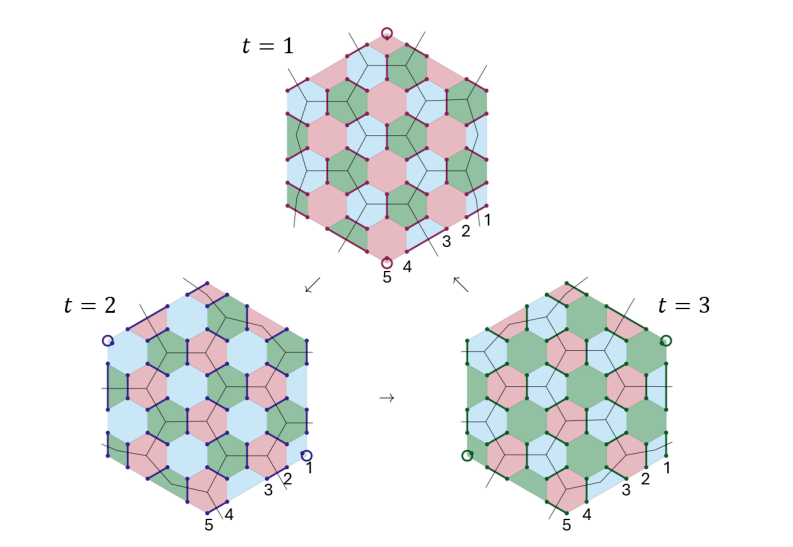
This research investigates dynamical quantum error correction, focusing on building robust logical qubits, the fundamental units of quantum information, without relying on static error correction codes. Traditional quantum error correction requires a large overhead of physical qubits to protect a single logical qubit. This work explores a dynamic approach where the logical qubit is created and maintained through a time-dependent process, a sequence of measurements and operations. The key challenge is understanding how these dynamic processes reliably encode and protect quantum information, and developing tools to analyse their performance.
The authors utilise the Bacon-Shor code as a framework for building these dynamical logical qubits. This code is interesting because it is based on stabilizer formalism and allows for a relatively simple construction of logical operators. They frame their work in terms of spacetime codes, considering the entire history of measurements and operations as part of the code, not just the current state of the qubits. This allows for error correction without a fixed, pre-defined code, where error correction emerges from the dynamics of the system itself. The research develops tools and techniques for analysing the performance of these dynamical codes, including understanding how errors propagate and optimising the measurement schedule to minimise errors. The team aims to achieve fault tolerance, meaning the error correction process itself is robust against errors, even if some measurements or operations fail. This approach could significantly reduce the number of physical qubits needed for a fault-tolerant quantum computer, offering greater flexibility and inspiring new quantum computer architectures.
Floquet Code Errors Are Predictable And Controllable
This research establishes a fundamental understanding of error correction within Floquet codes, a type of quantum memory employing periodic measurements. The team demonstrates that any undetectable error occurring during stable operation can be understood as a combination of measurement effects and predictable Pauli errors. Crucially, they prove that these undetectable errors either represent benign disturbances or implement genuine logical operations on the encoded quantum information, and that identifying which is the case can be done efficiently. This provides a clear framework for analysing the performance of these dynamic codes, mirroring the well-established methods used for static, conventional quantum error correction. The findings extend to a broader class of dynamical codes where instantaneous stabilisers can be determined from measurements within a limited time window. This research represents a significant step towards building robust and reliable quantum memories capable of protecting quantum information from environmental noise.