

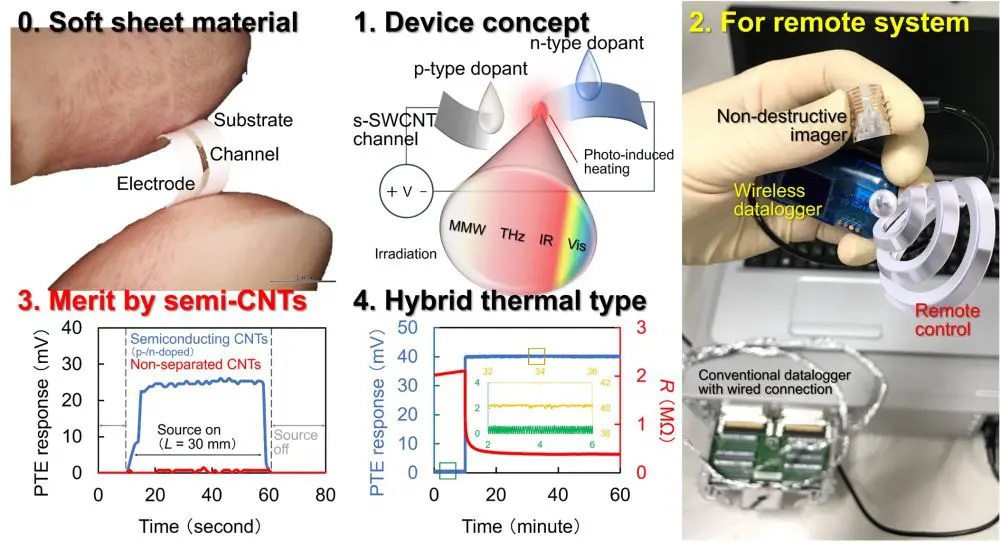
Chuo University researchers, led by Assistant Professor Kou Li, have developed a carbon nanotube-based photo-thermoelectric imager achieving a 4,060-fold improvement in performance, enabling wireless, on-site non-destructive testing. Published July 11, 2025, in Communications Materials, the technology overcomes limitations in existing sensors – typically producing responses of tens to hundreds of microvolts – by utilising chemically enriched films that generate signal intensities exceeding tens of millivolts. This advancement, funded by multiple grants totalling an undisclosed sum, facilitates remote inspection with palm-sized wireless circuits and was demonstrated through testing on an aerial object.
Enhanced Photo-Thermoelectric Imaging with Carbon Nanotubes
The development of high-performance photo-thermoelectric (PTE) imagers utilising carbon nanotubes (CNTs) represents a significant advancement in non-destructive testing methodologies. Conventional CNT film-based imagers, while promising for multimodal inspection, have historically been constrained by low response intensity, hindering their integration with compact wireless data logging systems essential for remote operations. These limitations stem from a trade-off between signal strength and noise reduction, with prior designs often prioritising the latter at the expense of adequate signal amplitude.
Researchers at Chuo University have addressed this challenge through the creation of chemically enriched PTE imagers based on semiconducting CNT (semi-CNT) films. While semi-CNTs intrinsically offer greater thermoelectric response than semi-metallic mixtures, the team incorporated both p- and n-type chemical carrier doping to mitigate bottlenecking noise and enhance material properties for PTE conversion. This approach has yielded a substantial improvement in performance, achieving up to a 4,060-fold increase in signal intensity.
Notably, the resulting imagers maintain comparable photo-detection sensitivity to existing CNT film devices – including ultrabroadband operation with a minimum noise sensitivity of 5 pWHz1/2 – while simultaneously exhibiting response signals exceeding tens of millivolts. This combination of high sensitivity and strong signal amplitude facilitates the implementation of remote, on-site non-destructive PTE imaging using palm-sized wireless circuits. The resulting wirelessly functional imager sheets are also mechanically deformable and repeatedly recoverable, broadening their potential applications in complex inspection scenarios.
Demonstrating the practical utility of this technology, the researchers successfully conducted on-site non-destructive testing of an aerial object using a remotely controlled semi-CNT film wireless PTE imager. This demonstrated the imager’s capability for omni-directional and multi-wavelength monitoring, further validating its potential for diverse industrial applications requiring reliable and efficient non-destructive evaluation.
Overcoming Limitations in Non-Destructive Testing
The core innovation lies in the synergistic combination of material composition and chemical doping. While semiconducting CNTs inherently provide a superior thermoelectric response compared to semi-metallic mixtures, achieving optimal performance necessitates addressing inherent noise limitations. The researchers’ implementation of both p- and n-type chemical carrier doping serves to modulate the charge carrier density within the semi-CNT film, effectively suppressing noise bottlenecks and enhancing the overall efficiency of photo-to-electrical conversion. This precise control over material properties is crucial for maximising signal strength without compromising sensitivity.
The resultant imagers demonstrate a marked improvement in performance metrics relevant to practical applications of non-destructive testing. Maintaining comparable photo-detection sensitivity to established CNT film devices – registering a minimum noise sensitivity of 5 pWHz1/2 and retaining ultrabroadband operation – the chemically enriched films simultaneously exhibit response signals exceeding tens of millivolts. This substantial increase in signal amplitude is critical for reliable wireless data transmission and facilitates the deployment of compact, palm-sized wireless circuits for remote on-site inspection.
The successful demonstration of on-site non-destructive testing on an aerial object underscores the practical viability of this technology. The remotely controlled semi-CNT film wireless PTE imager’s ability to perform omni-directional and multi-wavelength monitoring highlights its potential for comprehensive evaluation of complex structures and geometries. This capability is particularly valuable in scenarios where access is limited or traditional inspection methods are impractical, offering a flexible and efficient solution for a wide range of industrial applications requiring robust non-destructive testing.
Chemical Enrichment for Improved Performance
This advancement in imager performance is directly attributable to the optimisation of both material composition and electronic properties. The incorporation of p- and n-type chemical carrier doping serves not merely to enhance the thermoelectric conversion efficiency of the semi-CNT films, but also to actively mitigate inherent noise sources. This dual approach allows for a significant increase in signal-to-noise ratio, enabling the detection of subtle variations indicative of material defects or structural anomalies.
The resultant high signal amplitude – exceeding tens of millivolts – is particularly crucial for facilitating reliable and robust wireless data transmission. This capability is essential for remote, on-site applications of non-destructive testing, where real-time data acquisition and analysis are paramount. The ability to deploy compact, low-power wireless circuits alongside the imager sheets further enhances the practicality and versatility of the technology, allowing for inspection in confined spaces or challenging environments.
Furthermore, the mechanically deformable and repeatedly recoverable nature of these imager sheets expands their applicability beyond conventional planar surfaces. This flexibility allows for conformal contact with complex geometries, ensuring comprehensive coverage and accurate data acquisition, even in scenarios involving curved or irregularly shaped objects. This is a distinct advantage over rigid sensor arrays, which may struggle to maintain consistent contact and produce reliable results.
Key Research Contributions
The key technical achievement underpinning this performance enhancement lies in the synergistic interplay between material composition and electronic property modulation. The researchers’ strategic implementation of both p- and n-type chemical carrier doping does not merely improve thermoelectric conversion efficiency within the semi-CNT films; it actively suppresses inherent noise sources, resulting in a substantial increase in signal-to-noise ratio. This allows for the detection of subtle variations indicative of material defects or structural anomalies, crucial for precise evaluation during non-destructive testing.
Critically, the resultant high signal amplitude – exceeding tens of millivolts – facilitates robust wireless data transmission, essential for remote, on-site applications. This capability allows for the deployment of compact, low-power wireless circuits alongside the imager sheets, enhancing the practicality and versatility of the technology in inspection scenarios where real-time data acquisition and analysis are paramount.
Beyond the electrical and optical improvements, the mechanical properties of the imager sheets further broaden their potential. The mechanically deformable and repeatedly recoverable nature of these devices allows for conformal contact with complex geometries, ensuring comprehensive coverage and accurate data acquisition, even when inspecting curved or irregularly shaped objects. This represents a significant advantage over rigid sensor arrays, which may struggle to maintain consistent contact and produce reliable results.
The research team’s meticulous approach to material science and device engineering has yielded a demonstrably superior imager for a range of applications. By addressing the limitations of conventional CNT film-based imagers, they have created a versatile and efficient tool for non-destructive testing that promises to enhance quality control and reliability across diverse industries.
Wireless Functionality and On-Site Applications
The wirelessly functional imager sheets represent a significant advancement in the capabilities of on-site inspection methodologies. The achievement of over ten-fold larger photo-detection responses – up to tens of millivolts – compared to conventional sensors is directly attributable to the synergistic combination of high thermoelectric conversion efficiency and enriched electrical/optical properties of the chemically enriched semi-CNT films. This enhanced signal strength is critical for enabling reliable data transmission in remote, challenging environments, facilitating real-time assessment without the need for direct physical connection to data logging equipment.
The successful demonstration of on-site non-destructive testing of an aerial object further validates the practical utility of this technology. The remotely controlled semi-CNT film wireless PTE imager’s ability to perform omni-directional and multi-wavelength monitoring provides a comprehensive assessment of the object’s structural integrity and surface characteristics. This capability is particularly valuable in applications requiring inspection of complex geometries or inaccessible areas, offering a flexible and efficient alternative to traditional methods.
The mechanical characteristics of the imager sheets further enhance their versatility in diverse inspection scenarios. The deformable and recoverable nature of the films allows for conformal contact with irregularly shaped objects, ensuring comprehensive data acquisition and minimising the risk of inaccurate readings due to insufficient contact. This is a distinct advantage over rigid sensor arrays, which may struggle to adapt to complex surfaces and provide reliable results. The combination of wireless functionality, high sensitivity, and mechanical flexibility positions this technology as a powerful tool for a wide range of on-site applications, including infrastructure monitoring, aerospace inspection, and materials characterisation.
More information
External Link: Click Here For More


