The increasing demand for data transfer speeds in modern data centres presents a significant technological challenge, and optical interconnects offer the most promising solution. Researchers at MIT, including Chao Luan, Alex Sludds, and Chao Li, alongside their colleagues, have now demonstrated a highly parallel and high-capacity silicon microdisk transmitter capable of achieving 1. 2 terabits per second of off-die bandwidth. This advance addresses a key limitation of microdisk technology, its sensitivity to fabrication errors, through the development of an automated laser trimming technique that permanently tunes the microdisk wavelengths with picometer precision. Importantly, this trimming process reduces energy consumption by 33%, paving the way for a fully passive, five-channel dense wavelength division multiplexing transmitter and establishing a robust foundation for the next generation of optical interconnects needed to support the continued scaling of artificial intelligence and advanced hardware.
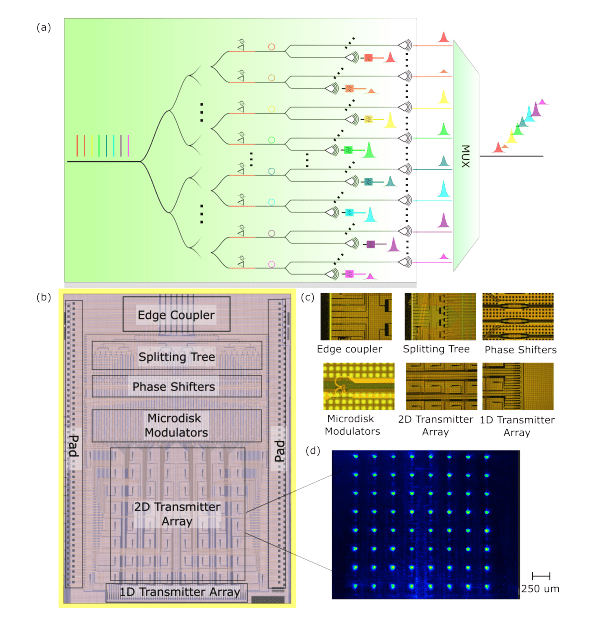
Microdisk resonators offer a compelling platform for optical modulation due to their small footprint, low energy consumption, and wavelength division multiplexing capability, yet they suffer from limited fabrication error tolerance which hinders practical deployment. To address this challenge, researchers demonstrate 1. 2 terabits per second of off-die bandwidth using a 64 microdisk modulator system fabricated on a CMOS photonics platform. Furthermore, they develop an automated, closed-loop, non-reversible, low-loss, and picometer-precision permanent wavelength tuning technique employing laser trimming. This trimming technique demonstrably reduces the energy consumption required for thermal tuning of the microdisk resonant wavelength by 33 percent.
Silicon Microdisk Modulator Fabrication and Tuning
This research details the design, fabrication, and testing of a compact silicon microdisk electro-optic modulator with integrated non-volatile trimming capabilities. The goal is to create a highly integrated, tunable photonic circuit that overcomes manufacturing variations. The work explores various post-fabrication trimming techniques to fine-tune the modulator’s resonance wavelength, including laser annealing and thermal annealing. Laser annealing uses a laser to compact the surrounding material, increasing its refractive index and shifting the resonance wavelength. Initial tests on a similar device proved successful, and the team is developing a spatial light modulator for parallel trimming.
Thermal annealing involves heating the chip to densify the surrounding material, also increasing the refractive index, though high temperatures can damage sensitive components. Silicon oxidation and phase-change materials were also investigated, but proved less effective due to device structure limitations and material conflicts. Experimental results demonstrate successful tuning using laser annealing and thermal annealing. A 256-wire bonded chip was successfully fabricated, demonstrating integration with external circuitry. Detailed measurements of circuit parameters were performed to optimize performance, and the RC-limited bandwidth of the modulator was calculated considering the photon lifetime and laser wavelength.
The research highlights the challenges of achieving precise wavelength tuning in integrated photonic circuits. Laser annealing appears to be the most promising approach, offering a localized and relatively low-temperature tuning mechanism. Further research is needed to optimize the laser annealing process and improve the reliability of the trimming technique.
Silicon Microdisks Achieve Terabit Data Transfer
Researchers have developed a new optical interconnect system using silicon microdisks, achieving a data transmission rate of 1. 2 terabits per second. This represents a significant step towards overcoming the data bottleneck in modern data centres and enabling the continued scaling of artificial intelligence and high-performance computing. The system utilizes 64 microdisk modulators integrated onto a single chip, demonstrating a substantial increase in bandwidth compared to existing technologies. A key innovation lies in a new wavelength tuning technique that permanently sets the correct operating wavelength for each microdisk, eliminating the need for continuous thermal adjustments.
This automated process reduces energy consumption by 33%, contributing to a remarkably low dynamic energy consumption of just 29 femtojoules per bit. The microdisk modulators operate by altering the properties of light as it circulates within the tiny structures, achieving a bandwidth ranging from 19 to 28 gigahertz for each modulator. The researchers also focused on minimizing signal loss and maximizing the efficiency of light transmission. By carefully controlling the design of the microdisks and optimizing the electrical properties of the device, they achieved a significant reduction in propagation loss and an increase in the quality factor, enhancing the overall performance of the system. This combination of high speed, low energy consumption, and precise wavelength control establishes a robust foundation for the next generation of optical interconnects.
Silicon Microdisk Modulator Achieves Terabit Transmission
This research demonstrates a silicon microdisk modulator system capable of transmitting 1. 2 terabits per second, addressing a critical bottleneck in data centre communication. The team achieved this high bandwidth through a 64-microdisk modulator architecture and a novel wavelength tuning technique that permanently adjusts the microdisks’ resonant wavelengths using laser trimming. This trimming process reduces energy consumption by 33% compared to traditional thermal tuning methods, enabling a fully passive, five-channel dense wavelength division multiplexing transmitter. The system’s parallelized design overcomes limitations found in cascaded architectures, ensuring uniform performance across all channels and precise independent operation.
Measurements confirm a high-speed electro-optic response, with the transmitter exhibiting over seven bits of precision in data encoding. The authors acknowledge that the system currently operates with a limited number of channels and that further work is needed to increase scalability and integration density. Future research directions include exploring methods to expand the channel count and optimise the laser trimming process for even greater energy efficiency and precision, ultimately paving the way for advanced optical interconnects and photonic computing applications.
👉 More information
🗞 Demonstration and Non-volatile Trimming of a Highly-Parallel, High-Capacity Silicon Microdisk Transmitter
🧠 ArXiv: https://arxiv.org/abs/2508.11146