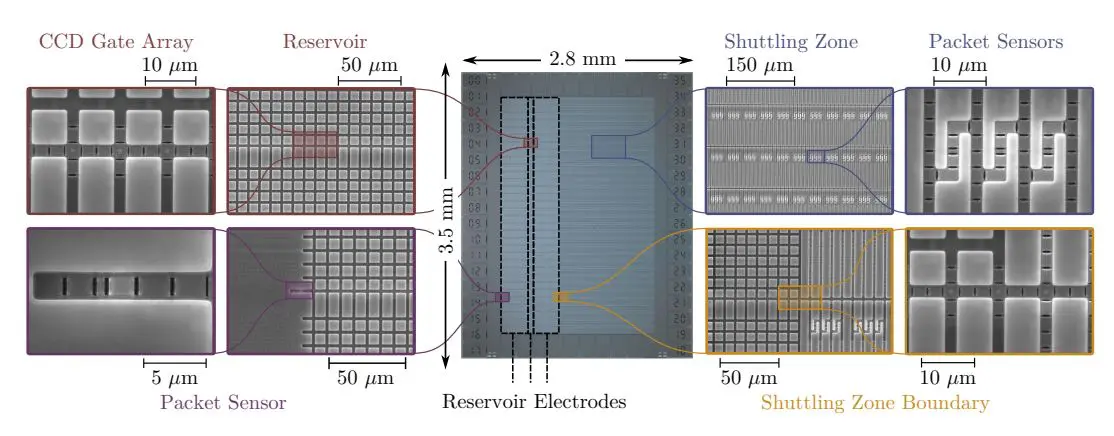
Electrons trapped on the surface of liquid helium represent a promising new platform for quantum computing, offering the potential for highly mobile and controllable quantum bits. Researchers led by K. E. Castoria, H. Byeon, and N. R. Beysengulov, alongside colleagues including E. O. Glen, M. Sammon, and J. Pollanen, have now demonstrated a crucial step towards realising this potential, achieving selective two-dimensional movement of electrons across a helium film using a standard CMOS control chip. The team successfully moved electrons in packets, ranging from a few to single electrons, through 128 individual microchannels, effectively creating a CCD-style system for electron transport. This achievement represents a significant advance in quantum information processing, as the device serves as a scalable prototype for controlling large arrays of single electron spins, paving the way for more complex quantum circuits.
This work details a system for selectively shuttling electrons on helium, achieved through a CMOS control platform. Researchers fabricate microstructures directly on a silicon chip and bring them into close proximity with the helium surface, creating a two-dimensional electron gas. By applying voltages to these microstructures, they demonstrate precise control and direction of individual electrons across the helium surface, a crucial step toward building scalable quantum circuits and enabling controlled interaction and entanglement of qubits.
This technology demonstrates selective two-dimensional shuttling of electrons across a helium film condensed on the surface of a CMOS control chip. Electrons are moved in packets containing, on average, several tens down to single electrons. Researchers perform electron shuttling in any of 128 transport microchannels, each linking electron storage and sensing zones in the two-dimensional plane. Shuttling sequences can be repeated at least 10 9 times with no detectable electron loss, making the device a prototype quantum information processing platform readily scalable to control large, monolithically integrated arrays of single electron spins.
Electrons on Helium Demonstrate Quantum Control
This research explores a novel approach to quantum computing using electrons trapped on the surface of superfluid helium. The focus is on manipulating individual electrons, which provides a remarkably clean and isolated environment minimizing decoherence, or the loss of quantum information. Researchers are building a quantum charge-coupled device (CCD), analogous to those used in cameras, but operating with single electrons and leveraging quantum mechanics to allow for controlled movement and manipulation of quantum information encoded in the electron’s charge. The goal is to create a scalable quantum processor by arranging and controlling many of these electron qubits.
Researchers use advanced microfabrication techniques to create tiny structures on the helium surface to trap and control the electrons. The design aims for integrated control and readout electronics directly on the chip, simplifying the system and improving performance. The experiment requires extremely low temperatures, around 1. 6 K, to maintain the superfluid state of helium and minimize thermal noise. Measurements of electron mobility on the helium surface provide insights into its properties and behavior.
Researchers have successfully trapped and confined individual electrons on the helium surface and achieved some level of control over their movement, enabling basic operations of a quantum CCD. The helium environment appears to offer a significant reduction in decoherence compared to other qubit technologies. This approach offers several potential advantages, including exceptionally long coherence times, inherent scalability, and potentially lower manufacturing costs compared to some other qubit technologies. Scientists successfully moved electrons in discrete packets, containing from several to single electrons, through a network of 128 microchannels, repeatedly performing these shuttling sequences without detectable loss over extended periods. This achievement showcases deterministic control of electron transport, mimicking operations essential for future quantum processors, where qubits must be moved for both readout and to interact with each other during quantum gate operations. The device architecture supports precise electron control, achieving performance through optimized electrode design and the inherent cleanliness of the helium substrate. This level of control, combined with the potential for long electron spin coherence times and compatibility with two-dimensional error-correcting lattices, positions this system as a promising platform for large-scale quantum processors.
🗞 Selective Shuttling of Electrons on Helium Using a CMOS Control Platform
🧠 ArXiv: https://arxiv.org/abs/2511.15922