

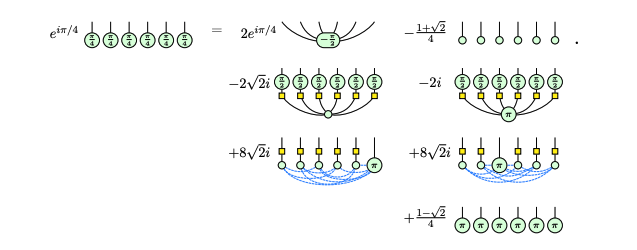
Magic state cultivation represents a promising pathway towards universal quantum computation, but simulating these non-Clifford circuits remains a significant challenge for classical computers. Kwok Ho Wan and Zhenghao Zhong, from Imperial College London and the University of Oxford, now demonstrate a powerful technique for simplifying these complex calculations. Their work applies cutting stabiliser decomposition methods to states generated through magic state cultivation, revealing that these states can be elegantly expressed using a combination of Clifford operations and a specific type of diagrammatic representation known as ZX-digrams. This advancement potentially enables more efficient simulation of quantum circuits containing a moderate number of non-Clifford gates, bringing practical quantum computation closer to reality.
Measured values simplify the resultant states for the d = 3 and d = 5 variant magic state cultivation circuits, expressing them as sums of 4 and 8 Clifford ZX-diagrams respectively. The presence of non-Clifford gates in a quantum circuit poses challenges for classical simulation, requiring exponentially increasing computational resources as the circuit complexity grows.
Magic State Decomposition with Stabiliser Diagrams
Researchers developed a new approach to decompose complex quantum states generated from magic state cultivation, achieving a logical error rate of 10 -9 at a circuit noise level of 0. 001. The team harnessed techniques for breaking down quantum circuits to represent these states as sums of Clifford ZX-diagrams, simplifying the classical simulation of circuits containing a moderate number of T gates. This method addresses the challenge posed by non-Clifford gates by transforming the problem into a more manageable form. Scientists decomposed individual magic states and extended this approach to multiple states, demonstrating the decomposition of two magic states into just two terms.
This decomposition was visually represented using ZX-calculus, a graphical language for reasoning about quantum circuits, and implemented using software tools. The team applied this technique to the d = 3 and d = 5 colour code variants, successfully representing the resulting states as sums of 4 and 8 Clifford ZX-diagrams respectively. This innovative method allows researchers to explore the structure of complex quantum states and potentially verify the performance of magic state cultivation circuits. While acknowledging that the resultant states are encodings of simple magic states, the team highlights the value of this exercise in developing more efficient classical simulation techniques, paving the way for advancements in fault-tolerant quantum computation.
ZX Decomposition Simplifies Quantum Circuit Simulation
Researchers achieved a breakthrough in simplifying complex quantum circuits using cutting stabiliser decomposition. This method focuses on ‘cutting’ quantum diagrams, known as ZX-diagrams, into smaller pieces, reducing the computational resources needed for simulation. The team successfully applied this approach to circuits generated from magic state cultivation. Initially, the researchers focused on a d = 3 colour code magic state circuit, decomposing the circuit’s complex state into a sum of just four Clifford ZX-diagrams. This is a remarkable achievement, as the original circuit required simulating 15 T gates.
Through careful application of their cutting method, they reduced the T-count within each diagram term to just one, representing a substantial simplification. This decomposition involved strategically ‘cutting’ the ZX-diagram at specific points, guided by a procedurally optimised algorithm. Extending this success, the team tackled a more complex d = 5 colour code magic state circuit, which originally demanded the simulation of 53 T gates. Applying a similar cutting strategy, they initially reduced the circuit to a sum of four terms, each with a T-count of 15. By leveraging the decomposition results from the d = 3 circuit, they further streamlined the process. The researchers demonstrate that this method offers a pathway to simulate increasingly complex quantum circuits with significantly reduced computational overhead, paving the way for more efficient quantum computer design and analysis.
ZX Calculus Simplifies Magic State Decomposition
This research demonstrates a novel application of cutting stabiliser decomposition techniques to states generated through magic state cultivation. The team successfully represented the resulting states from both the d=3 and d=5 variants as sums of Clifford ZX-diagrams, specifically, four diagrams for d=3 and eight for d=5. This decomposition offers a significant reduction in the number of terms required to represent these complex quantum states, particularly for the d=5 case where the reduction is over 260,000 times fewer terms. The findings highlight the versatility of ZX-calculus as a tool for simplifying quantum circuits and potentially enabling more efficient simulations.
While the decomposed states are ultimately encodings of simple magic states, the method itself presents a promising avenue for further exploration, particularly in the context of syndrome decoding for magic state cultivation. The authors acknowledge limitations in their simulations, noting that replicating the accuracy of full state-vector simulations requires further refinement. Future work could focus on optimising this decomposition to reduce the number of terms even further, and applying it to larger, more complex circuits to assess its scalability and practical benefits for quantum computation.
🗞 Cutting stabiliser decompositions of magic state cultivation with ZX-calculus
🧠 ArXiv: https://arxiv.org/abs/2509.01224


