

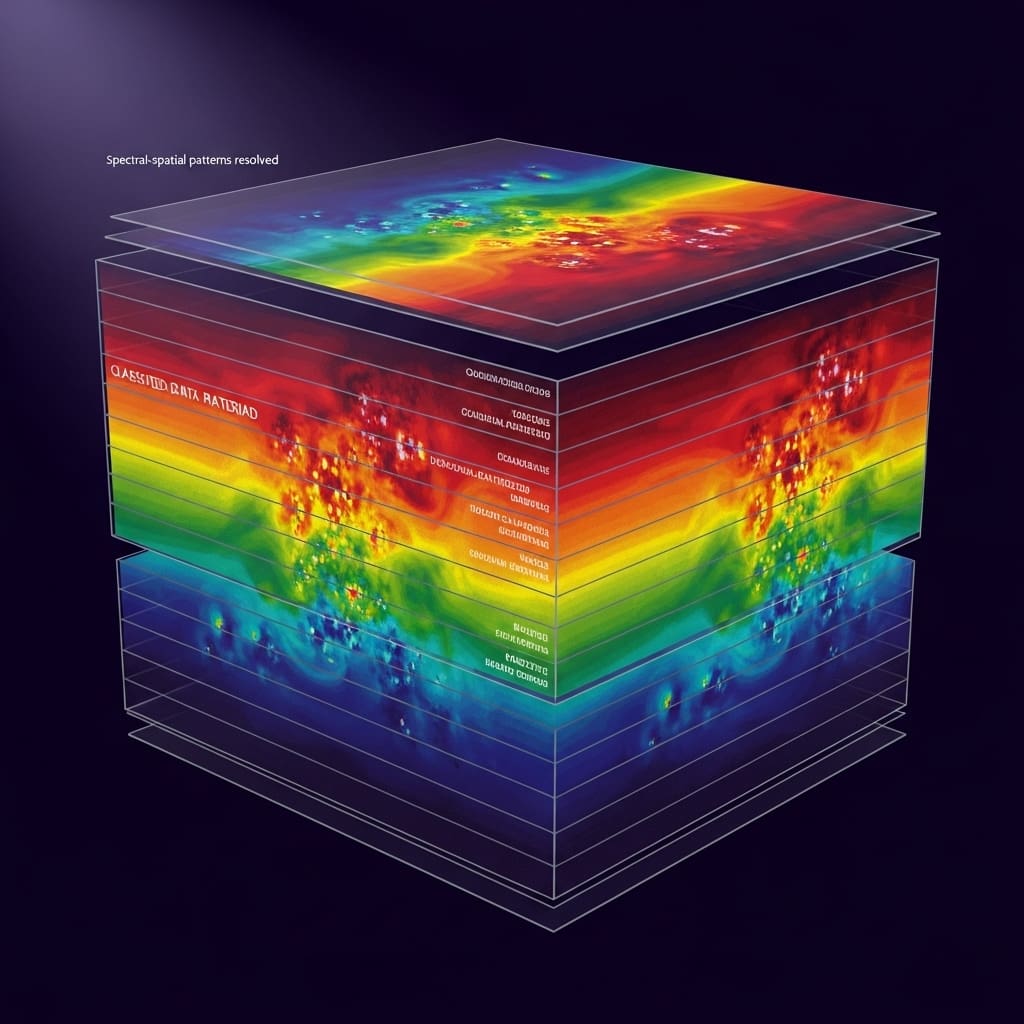
Researchers are tackling the persistent challenge of efficiently classifying hyperspectral images (HSIs), a crucial task for environmental monitoring and precision agriculture. Zack Dewis, Yimin Zhu, and Zhengsen Xu, alongside Mabel Heffring, Saeid Taleghanidoozdoozan, Quinn Ledingham et al from the University of Calgary’s Department of Geomatics Engineering, introduce a novel framework , CSSMamba (Clustering-guided Spatial-Spectral Mamba) , designed to significantly enhance performance by creating adaptive token sequences. This work is particularly significant as it integrates clustering mechanisms directly into the Mamba model, reducing sequence length and improving feature learning, ultimately achieving higher accuracy and better boundary preservation than existing convolutional neural network and Mamba-based methods on benchmark datasets like Pavia University and Indian Pines.
Clustering Mamba for Hyperspectral Image Classification improves accuracy
Scientists have demonstrated a novel framework, CSSMamba (Clustering-guided Spatial-Spectral Mamba), to significantly enhance Hyperspectral Image (HSI) classification performance. The research addresses critical challenges in defining efficient and adaptive token sequences within Mamba models, a recent advancement in long-range modelling. This breakthrough reveals a method for improved feature learning and accuracy in HSI analysis, a vital task for applications like precision agriculture, environmental monitoring, and urban planning. The team achieved this by integrating a clustering mechanism directly into a spatial Mamba architecture, creating a cluster-guided spatial Mamba module (CSpaMamba) that effectively reduces sequence length and boosts feature learning capabilities.
The study unveils a complete clustering-guided spatial-spectral Mamba framework by combining the CSpaMamba module with a spectral Mamba module (SpeMamba), enabling improved learning of both spatial and spectral information within the HSI data. To further refine feature learning, researchers introduced an Attention-Driven Token Selection mechanism, optimising the sequencing of Mamba tokens for greater efficiency. Experiments demonstrate that this dynamic approach allows the model to better capture subtle patterns and edges, improving detail preservation and the network’s ability to learn discriminative features. The work establishes a Learnable Clustering Module, designed to seamlessly integrate clustering into the Mamba model and learn cluster memberships adaptively.
Cluster-based Token Sequencing for Hyperspectral Images
Results demonstrate that the integration of CSpaMamba with a spectral Mamba module (SpeMamba) further improves the learning of both spatial and spectral information, leading to a complete clustering-guided spatial-spectral Mamba framework. To optimise Mamba token sequencing, scientists introduced an Attention-Driven Token Selection mechanism, enabling dynamic, learnable, sparse, and adaptive sequencing of pixels within each cluster. Measurements confirm this flexibility enhances the modelling of local structures, preserves detail, and improves the network’s ability to learn discriminative features from complex imagery. Furthermore, the researchers designed a Learnable Clustering Module that learns cluster memberships adaptively, seamlessly integrating clustering into the Mamba model. This module partitions the global tokens into K distinct subsets, creating cluster-specific tensors Xc, where Nc represents the number of tokens assigned to the c-th semantic class, and importantly, Nc varies dynamically per cluster. The work establishes a new standard for HSI classification, offering a pathway to more accurate and detailed analysis of complex geospatial data.
CSSMamba boosts HSI classification with adaptive tokens, achieving
Scientists have developed a new framework, CSSMamba, to improve hyperspectral image (HSI) classification by addressing challenges in defining efficient and adaptive token sequences within Mamba models. The core of this work lies in integrating a clustering mechanism into both spatial and spectral Mamba architectures, creating modules named CSpaMamba and SpeMamba, respectively. This integration effectively reduces the sequence length processed by the Mamba model and enhances its ability to learn relevant features. Furthermore, researchers introduced an Attention-Driven Token Selection mechanism and a Learnable Clustering Module to optimise token sequencing and cluster membership learning.
👉 More information
🗞 Clustering-Guided Spatial-Spectral Mamba for Hyperspectral Image Classification
🧠 ArXiv: https://arxiv.org/abs/2601.16098

