

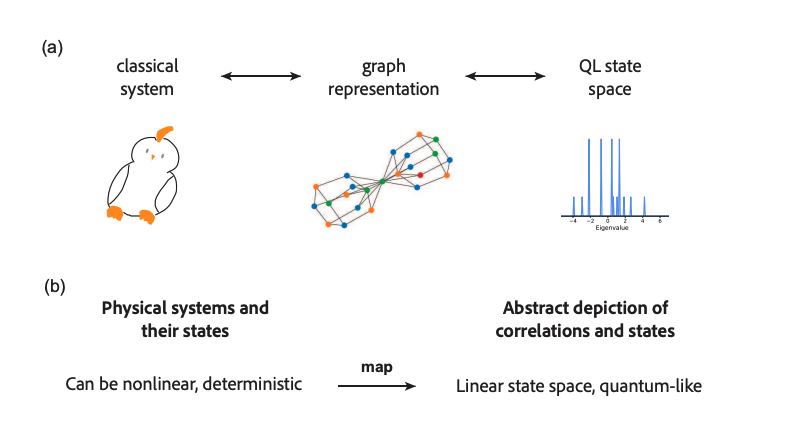
The behaviour of quantum systems, characterised by phenomena such as superposition and entanglement, continues to inspire investigations into whether similar properties can emerge within purely classical frameworks. Recent research explores the construction of classical systems exhibiting state spaces analogous to those found in quantum mechanics, potentially offering new ways to visualise complex correlations. Gregory D. Scholes from the Department of Chemistry at Princeton University, and colleagues, detail this approach in their article, “Quantum-like states from classical systems”, where they present a method for designing classical networks with state spaces capable of mimicking certain quantum behaviours, and critically assess the possibility of exhibiting entanglement within these systems.
The research outlines a methodology for constructing classical systems that exhibit behaviours analogous to those observed in quantum mechanics, specifically focusing on the creation of state spaces that mirror those found in quantum systems. It achieves this through graph theory, where the topology of the graph dictates both the network’s structure and defines a state space built from superpositions based on a tensor product basis. A tensor product combines two vector spaces to create a new vector space, and in this context, it forms the basis for representing the states within the QL system. The work reviews and expands upon existing foundations for constructing these quantum-like (QL) graphs, introducing an optimisation process to create more compact representations while preserving the essential properties needed to generate states resembling quantum states.
Central to this approach is the dual role of the graph; it not only defines the connections within the classical network but also establishes the structure of the state space itself. This allows researchers to visualise the correlation structure inherent within a quantum-like state, offering a tangible representation of complex phenomena typically described using abstract mathematical formalisms. The study actively investigates the possibility of exhibiting entanglement-like correlations within these QL systems, critically assessing this concept and contrasting it with established notions of ‘classical entanglement’, which arises from shared information but lacks the non-local character of quantum entanglement.
The methodology builds upon established principles of spectral
The methodology builds upon established principles of spectral graph theory, which studies the properties of graphs through the eigenvalues and eigenvectors of associated matrices, random graphs, and the Kuramoto model of synchronisation, a mathematical model for describing the collective behaviour of coupled oscillators. These are integrated with concepts from quantum information and computation, fields concerned with processing information using quantum mechanical phenomena. It explores the potential of harnessing synchronisation dynamics as a computational primitive, drawing parallels with memcomputing. This emerging field investigates novel computing paradigms based on physical systems utilising memory effects. Furthermore, the work acknowledges the relevance of quantum cognition, a field applying quantum mechanical principles to model cognitive processes, suggesting potential avenues for applying these QL networks to understand complex systems.
By combining mathematical tools such as tensor spaces and exterior algebra, a mathematical system that deals with alternating sums, with insights from cognitive science and computer science, the study proposes a highly interdisciplinary approach to understanding and emulating quantum behaviour. The optimisation of graph products, a method for combining graphs to create more complex networks, represents a key contribution, enabling the creation of more efficient and compact QL systems. This work actively positions itself at the intersection of classical and quantum realms, offering a concrete visualisation of correlation structures and prompting critical discussion regarding the emergence of entanglement-like phenomena.
👉 More information🗞Quantum-like states from classical systems🧠 DOI:https://doi
🗞 Quantum-like states from classical systems
🧠 DOI: https://doi.org/10.48550/arXiv.2507.00967


