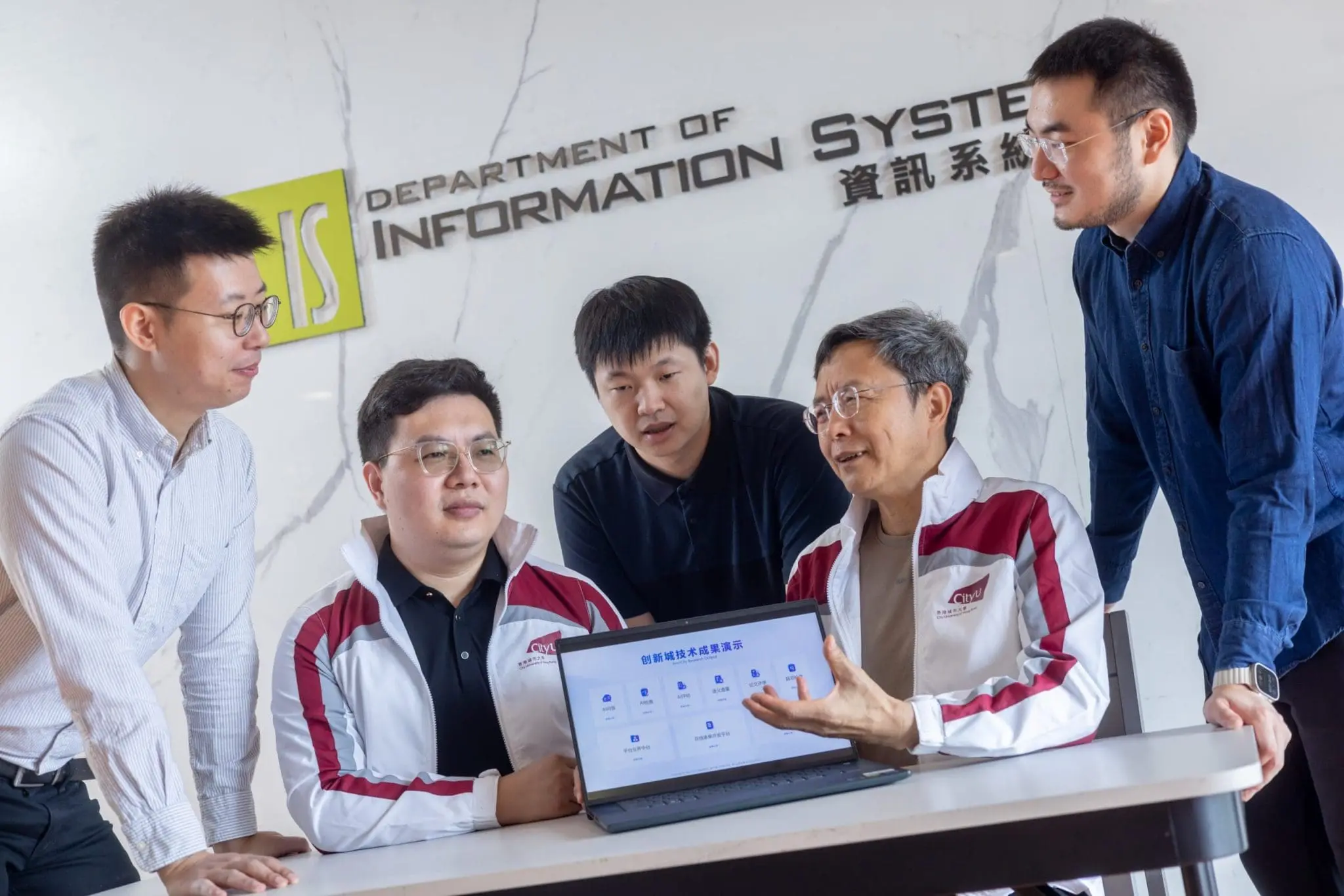
Researchers at City University of Hong Kong are pioneering the use of generative artificial intelligence (GenAI) on a collaborative innovation network platform to transform science, technology, and innovation services. Professor Ma Jian’s team aims to create a secure GenAI model that digitally transforms processes, facilitating research development and technology innovation while enhancing data security and service efficiency.
Building on their successful ScholarMate platform, which connects over 8 million registered users and 78 million research outputs, the team is developing a new federated learning technology integrated with research knowledge graphs and large language models to unleash the power of GenAI. The project has secured funding from the Research, Academic and Industry Sectors One-plus Scheme and involves key partners such as InnoCity.com, a start-up established by Professor Ma’s team to commercialize their research outcomes.
Unleashing the Power of Generative AI on Smart Collaborative Innovation Network Platforms
The advent of generative artificial intelligence (GenAI) technologies has opened up new avenues for transforming science, technology, and innovation (STI) services. A dedicated team of researchers from City University of Hong Kong (CityUHK) is pioneering cutting-edge GenAI technologies on a collaborative innovation network platform, aimed at empowering research and innovation.
Revolutionizing STI Services with Secure GenAI Models
STI services, including research management, research achievement promotion, and technology transfer, are pivotal in driving technology innovation. However, data security and personal privacy concerns have resulted in fragmented systems for STI services, leading to the problem of information silos. To address these challenges, Professor Ma Jian and his team at CityUHK developed ScholarMate, a professional collaborative innovation network platform that connects government funding agencies, universities, research institutes, and technology companies, fostering collaboration and knowledge sharing.
Building on this successful achievement, Professor Ma’s team is now spearheading the development of a new federated learning technology, integrated with research knowledge graphs and large language models (LLMs) to digitally transform STI services. The project recently secured funding from the Research, Academic and Industry Sectors One-plus Scheme (RAISe+ Scheme), launched by the Innovation and Technology Commission of the HKSAR Government.
Creating a Smart Collaborative Innovation Network Platform with Generative AI Capabilities
The primary objective of the project is to create a smart collaborative innovation network platform with GenAI capabilities that prioritizes data security, privacy, and operational efficiency. The team will focus on creating comprehensive research knowledge graphs to map relationships among researchers, projects, research papers, patents, and other relevant entities in universities, research institutes, and technology companies around the world.
By organizing data according to national standards of research disciplines and related emerging industries, the research knowledge graph will form a comprehensive, domain-specific knowledge base. Leveraging the large volume of papers and patents from the collaborative innovation network platform, the team will further train and fine-tune a domain-specific LLM, called STIGPT (GPT for Science, Technology, and Innovation).
Empowering Researchers with Intelligent Assistant Services
STIGPT will provide intelligent assistant services for knowledge co-creation using semantic search, intelligent recommendations, and personalized content generation for research institutions and researchers. The team also plans to develop a low-code system development platform, which can empower institutional users to implement digital transformation solutions with minimal programming effort.
This will significantly lower adoption barriers and enhance operational efficiency. By integrating STIGPT with ScholarMate, the project envisions building the first smart collaborative innovation network platform in the world that connects researchers from universities and industry to co-create IP knowledge.
Accelerating Digital Transformation of STI Services
The research team expects that by leveraging GenAI technologies on a collaborative innovation network platform, this project will help accelerate the pace of research and innovation. The market potential for STI services is immense, with significant investments in research and development in the Mainland and rest of the world.
With the support of HK Tech 300, a flagship innovation and entrepreneurship program at CityUHK, the team established a start-up, called InnoCity.com, to commercialize the project’s research outcomes, focusing on the use of GenAI technologies for technology transfer. This taps into a promising market, aligning with the government’s policy to position Hong Kong as an international innovation and technology hub.
The goal is to facilitate knowledge co-creation among industry, academia, and research users while enhancing the quality and efficiency of STI services.
External Link: Click Here For More