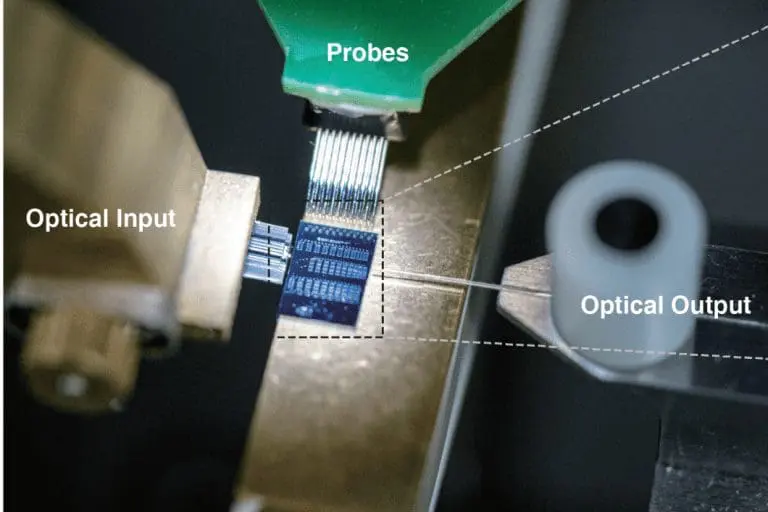
Manipulating light’s spectrum is fundamental to modern photonics, yet creating devices with truly complex spectral responses often proves challenging. Hao He, Zengji Tu, and Yuanlei Wang, alongside colleagues at their institutions, now present a new approach to building hyper-spectral photonic integrated circuits, dramatically increasing spectral complexity beyond what conventional methods allow. Their work introduces recursive inverse design, a technique that cleverly exploits interactions between components within a circuit as design tools, effectively expanding the possibilities for spectral engineering. The team demonstrates that this method enables a single waveguide structure to achieve sub-picometer resolution, exceeding the performance of existing spectrometers and paving the way for devices capable of simultaneously monitoring both optical and radio signals, representing a significant advance for sensing and communication technologies.
Integrated Photonics for Compact Dual-Comb Spectroscopy
Scientists are developing photonic integrated circuits (PICs) to create compact and versatile spectroscopic tools. This research focuses on high-spectral PICs (HS-PICs), employing a reconfigurable intelligent design (RID) approach to achieve unprecedented levels of spectral complexity and miniaturize dual-comb spectroscopy. The team is also exploring applications in precise microwave frequency measurement and the development of miniaturized spectrometers. This work achieves significant miniaturization by integrating multiple functionalities onto a single chip, enabling high spectral resolution, accuracy, and bandwidth. Researchers are developing novel PIC architectures and algorithms for spectral reconstruction, pushing the boundaries of integrated photonics and enabling dynamic adjustment of the chip’s functionality through the RID approach.
Sub-Picometer Resolution with Hyper-Spectral PICs
Scientists have created hyper-spectral photonic integrated circuits (HS-PICs) that achieve a level of spectral complexity previously unattainable. This breakthrough stems from a new approach to photonic circuit design, utilizing recursive inverse design instead of combining discrete components. The team demonstrates that even a single waveguide within an HS-PIC can resolve spectra with sub-picometer resolution, exceeding the performance of current state-of-the-art spectrometers over an 800nm bandwidth. Analytical modeling reveals that conventional circuits exhibit a linear increase in spectral complexity with each added component.
In contrast, HS-PICs, utilizing circulating photonic pathways and recursive design, demonstrate an exponential increase in complexity. Numerical simulations and independent trials validate this exponential relationship, enabling the reconstruction of both optical spectra and microwave signals within a single device. Experiments successfully reconstructed microwave signals with 125MHz resolution across more than 20THz of optical bandwidth. The team applied this capability to monitor signals from a microwave photonic radar and high-speed optical communication links, demonstrating the practical utility of the new technology and establishing a transformative framework for next-generation sensing and communication technologies.
Sub-Picometer Resolution Hyperspectral PIC Demonstration
This research demonstrates hyper-spectral photonic integrated circuits (HS-PICs) capable of resolving spectra with sub-picometer resolution, exceeding the performance of current state-of-the-art spectrometers. The team achieved this breakthrough by employing a recursive inverse design strategy, which unlocks exponential scaling of spectral complexity with each added component, unlike traditional linear approaches. This innovative design enables simultaneous monitoring of both microwave and radio frequencies within a single device. The HS-PIC successfully recovers complex signals, including multi-tone, QPSK, and FMCW inputs, with a high resolution of 125MHz. While some frequency mismatch was observed, this was attributed to noise and future work may focus on mitigation. This work establishes a transformative framework for photonic design, moving towards data-guided automation and potentially accelerating the development of complex photonic integrated circuits for widespread use in computing, communication, and sensing.
🗞 Recursive Inverse Design Enables Hyper-spectral Photonic Integrated Circuits
🧠 ArXiv: https://arxiv.org/abs/2510.12104