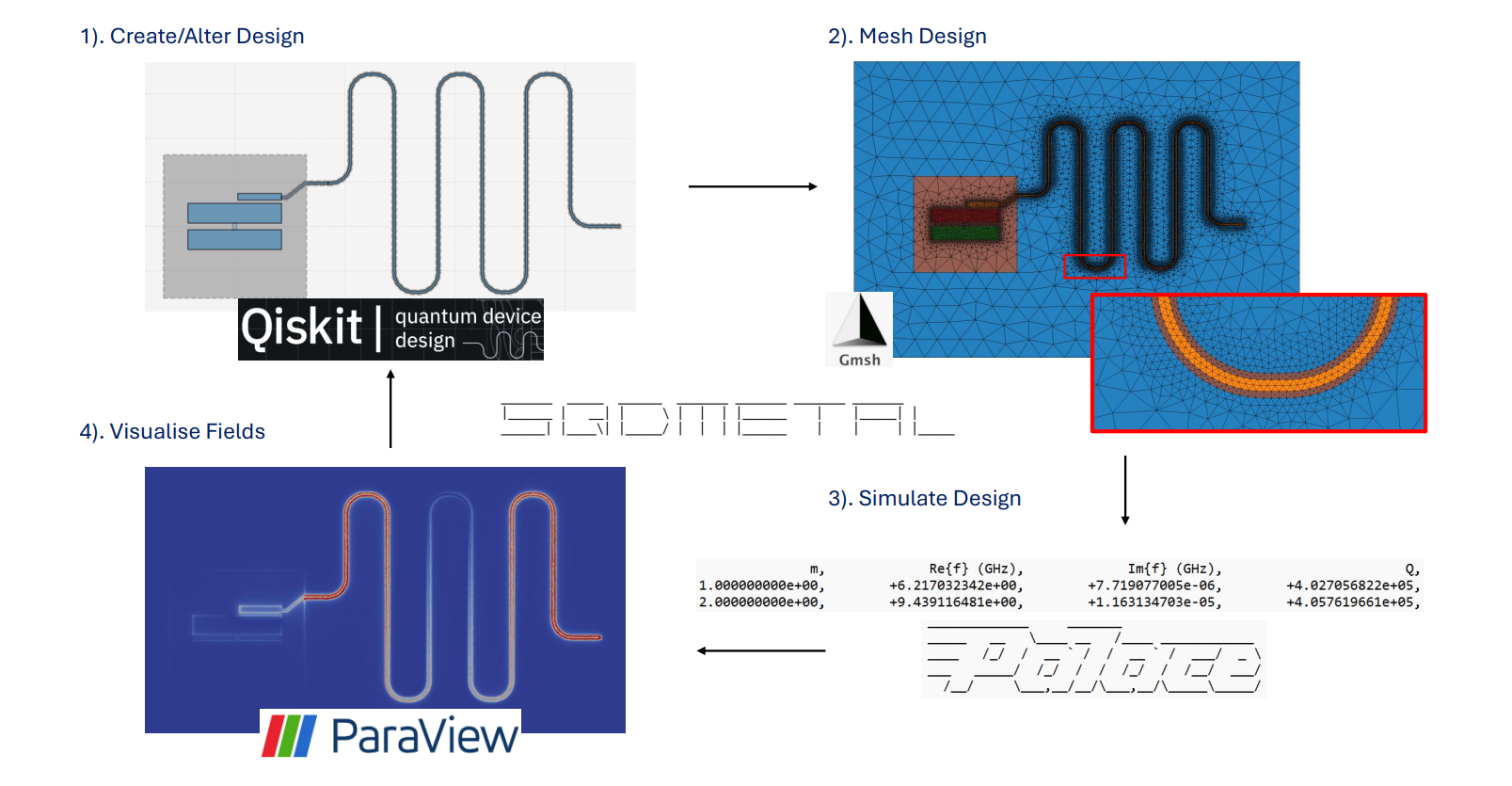
Electromagnetic simulations are crucial for designing and improving superconducting circuits, yet readily available, high-performance, open-source options have been scarce. David Sommers, Prasanna Pakkiam, and Zach Degnan, along with colleagues at the University of Queensland, now present a solution, a new framework called SQDMetal. This innovative API unifies existing open-source tools, creating a highly parallel simulation workflow that allows researchers to accurately and efficiently model complex superconducting devices. SQDMetal not only matches the performance of established commercial software, as demonstrated through rigorous benchmarking against COMSOL and Ansys, but also offers advanced capabilities like kinetic inductance modelling and full 3D geometry support, ultimately lowering the barriers to entry for researchers designing the next generation of quantum hardware.
While several commercial platforms exist, open-source alternatives provide greater flexibility, customisation, and accessibility for a wider range of researchers. This work introduces a highly parallel, open-source electromagnetic simulation framework specifically designed for analysing superconducting circuits, utilising a finite-element method implemented in Python. The framework achieves significant speedups through parallelisation using multiple graphics processing units, enabling the efficient simulation of complex three-dimensional structures.
The framework’s accuracy is confirmed by comparing simulation results with analytical calculations and experimental data for a transmon qubit, demonstrating a relative error of less than 1% in predicting the qubit frequency. Furthermore, the framework incorporates advanced features such as automatic mesh refinement and support for various material models, enhancing its versatility and accuracy for diverse superconducting circuit designs. The developed software is publicly available, fostering collaborative research and accelerating innovation in the field of superconducting quantum computing.
Energy Participation Ratio Simulates Superconducting Circuits
Accurately simulating superconducting circuits requires accounting for the non-linear behaviour of Josephson junctions. Researchers present the Energy Participation Ratio (EPR) method, a technique that simplifies the circuit for initial simulation and then uses the EPR to incorporate the non-linearities and precisely determine the system’s Hamiltonian. The method begins by treating the Josephson junction as a simple inductor, allowing for a standard simulation of the simplified, linear circuit. The EPR quantifies the fraction of electromagnetic energy stored within each Josephson junction, enabling the removal of non-linearity from the initial simulation.
This allows for accurate calculation of the Hamiltonian, which fully represents the circuit’s behaviour. The team demonstrates the method’s effectiveness by applying it to a transmon qubit coupled to a resonator. This involves assigning a lumped port inductance to model the Josephson junction and performing an eigenmode simulation on the simplified circuit. The calculated Hamiltonian parameters for this example system demonstrate the method’s ability to accurately predict key characteristics, such as the transmon mode frequency and the resonator mode frequency. The team emphasises the importance of energy balance between inductive and capacitive elements in the circuit for achieving accurate results. This work provides a sophisticated technique for modelling superconducting circuits, offering a pathway to better understand and design quantum devices.
Addressing a gap in available tools, researchers introduce SQDMetal, a new open-source workflow for simulating superconducting quantum circuits. SQDMetal integrates several existing programs, including Qiskit Metal, Gmsh, Palace, and Paraview, into a highly parallel and scalable simulation framework. The team demonstrated the accuracy of SQDMetal through detailed mesh convergence studies, showing excellent agreement with established commercial software such as COMSOL Multiphysics and Ansys for both eigenmode and electrostatic simulations. Further validation involved comparing SQDMetal’s simulations of superconducting resonators and transmon qubits with experimental measurements, achieving reasonable agreement across key qubit parameters. The researchers acknowledge that incorporating more complex material effects, such as kinetic inductance, and utilising fully three-dimensional device geometries could further refine the accuracy of future simulations. Overall, this study establishes SQDMetal as a reliable, community-driven platform for the electromagnetic simulation and design of advanced superconducting quantum devices, lowering barriers to entry for researchers in the field.
🗞 Open-Source Highly Parallel Electromagnetic Simulations for Superconducting Circuits
🧠 ArXiv: https://arxiv.org/abs/2511.01220