

Superconducting circuits represent a leading technology for future quantum computers and ultra-sensitive electronics, but their fabrication traditionally relies on complex nanolithography techniques. Alexander Kreiner, Navid Hussain, and Ritika Dhundhwal, along with colleagues at their institutions, now demonstrate a fundamentally different approach, using liquid-metal printing to create high-performance superconducting circuits. This innovative method achieves surprisingly high internal quality factors, challenging the expectation that additive manufacturing would compromise superconducting properties, and offers the unique ability to add structures to existing circuits without disruption. The team’s achievement unlocks new possibilities for building larger, more complex superconducting computers and advancing the field of low-loss superconducting devices.
Superconducting Qubits and High-Fidelity Control
Superconducting circuits are a promising platform for building advanced quantum computers, amplifiers, and low-power electronics. Researchers are investigating circuit quantum electrodynamics (cQED) architectures, specifically employing transmon qubits coupled to high-quality microwave resonators. The team focuses on improving qubit coherence and fidelity, critical parameters for scalable quantum computation, by minimizing noise and enhancing qubit control through careful materials selection, advanced nanofabrication techniques, and precise circuit design. This work involves fabricating and characterizing multi-qubit devices, including couplers that enable controlled interactions between qubits, essential for implementing quantum algorithms.
They demonstrate two-qubit gate fidelities exceeding 99. 9% using optimized control pulses and techniques to suppress crosstalk and other sources of error. Furthermore, the team explores novel resonator designs to improve qubit readout speed and efficiency, crucial for scaling up quantum processors, and investigates methods for dynamically reconfiguring qubit connectivity, allowing for flexible quantum circuit implementation. This represents a significant advancement in superconducting qubit technology, demonstrating high-performance multi-qubit circuits with improved coherence, fidelity, and connectivity, and providing a pathway towards building larger and more complex quantum processors.
Liquid Metal Printing of Superconducting Resonators
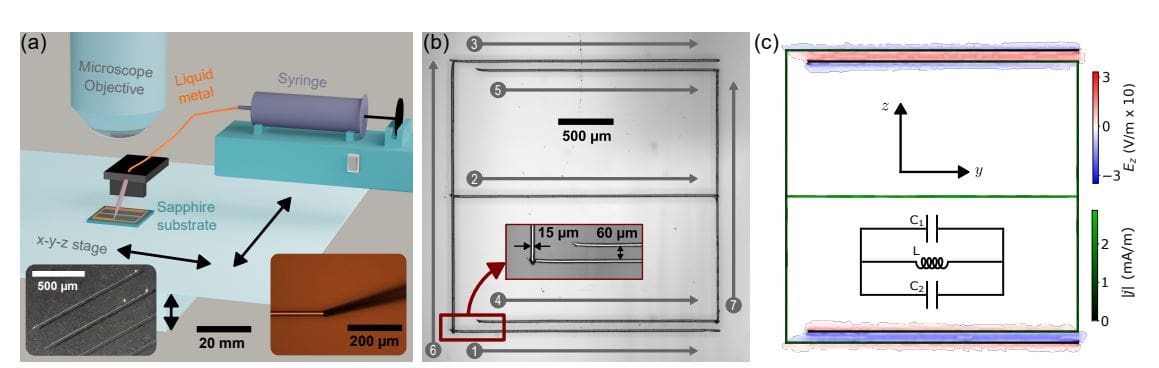
Scientists have pioneered a novel fabrication technique for superconducting circuits using liquid metal alloy EGaInSn and micro-pipette printing, achieving high internal quality factors and opening new avenues for scalable superconducting computers. Recognizing limitations of standard nanolithography and the potential of additive manufacturing, the team developed a method to directly print superconducting lumped-element resonators without the need for high-temperature processing or vacuum conditions, overcoming challenges associated with conventional metal precursors. The study harnessed the unique properties of EGaInSn, a liquid metal near room temperature, to circumvent issues with viscosity and surface tension that typically hinder printing at the low-micrometer scale. Researchers engineered a capillary printing setup to deposit EGaInSn with precision, allowing for the creation of resonators with features suitable for quantum circuits.
Optical micrographs reveal the precise patterning of EGaInSn, and electromagnetic simulations confirm their functionality as lumped-element resonators operating at approximately 5. 5GHz, achieving single-photon quality factors approaching one million. This innovative approach represents a significant advancement in superconducting circuit fabrication, offering a pathway towards more scalable and robust quantum computing hardware.
EGaInSn Resonator Power Dependence and Mapping
Detailed characterization of EGaInSn resonators reveals key insights into their behavior and performance. Investigations demonstrate that the resonator’s quality factor (Qi) changes with input power, increasing at low power but decreasing at higher powers, indicating saturation and potential heating effects. The complex reflection coefficient exhibits a circular trajectory, deviating slightly due to power-dependent loss. Energy Dispersive X-ray Spectroscopy (EDS) reveals phase segregation within the printed EGaInSn, with gallium and indium/tin separating, particularly at lower temperatures, and re-melting homogenizes the alloy, suggesting incomplete mixing during printing and cooling.
Microwave measurements of resonators during second cool-down show a slight frequency shift and a lower Qi compared to the first, with a critical temperature (Tc) of 1. 4K, close to the aluminum waveguide’s Tc. Resonators printed on silicon and MgO substrates are also compared, with silicon resonators achieving high Qi (up to one million) and MgO resonators exhibiting significantly lower Qi, likely due to higher substrate losses. While some structural damage is observed after cool-down, the resonators generally maintain integrity. Key findings include phase segregation of EGaInSn, substrate dependence of Qi, and power dependence of Qi.
Liquid-Metal Printing Yields High-Q Resonators
Researchers have successfully fabricated superconducting lumped-element resonators using a liquid-metal based micro-capillary printing technique, achieving quality factors approaching one million with linewidths close to 10 micrometers. This demonstrates the viability of the method for creating low-loss superconducting devices without the need for further processing steps and allows for the local addition of superconducting circuit elements without impacting pre-existing structures. The printed resonators exhibit a superconducting critical temperature of approximately 6 Kelvin, consistent with previously reported values for the gallium-indium-tin alloy used. However, the team observed degradation of the resonators during thermal cycling, often resulting in catastrophic failure, and identified a destructive phase transition at low temperatures as the likely cause, potentially related to a phenomenon known as tin pest. The researchers propose that future work incorporating suitable additives to the alloy or exploring alternative low-melting-point materials could mitigate this issue and improve the long-term stability of the devices.
👉 More information
🗞 Liquid metal printing for superconducting circuits
🧠 ArXiv: https://arxiv.org/abs/2511.09705


