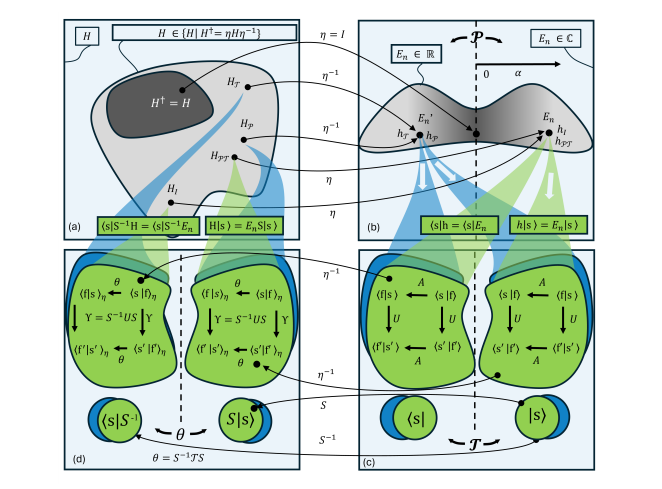
The surprising phenomenon of chirality-induced spin selectivity, where chiral molecules generate spin polarization even at normal temperatures, challenges fundamental principles of physics, but a new theoretical framework developed by Pius M. Theiler and Matthew C. Beard, both from the National Renewable Energy Laboratory, resolves this paradox. Their work demonstrates that structural chirality and electron interactions together create observable spin polarization, explaining how this occurs without violating established laws of thermodynamics. The team’s approach introduces a novel concept, a connection between spin and spatial movement through a non-local metric, and predicts a unique spin-displacement ordering within chiral molecules. This achievement establishes a robust foundation for understanding equilibrium chirality-induced spin selectivity and opens avenues for linking molecular handedness with measurable spin-to-charge conversion effects, potentially impacting fields like spintronics and materials science.
This observation has challenged established principles of microscopic reversibility and Onsager reciprocity. Researchers have resolved this paradox by formulating a pseudo-Hermitian quantum framework which consistently treats non-reciprocal transport and spin polarization in chiral systems. The framework demonstrates that observed spin polarization arises not from a violation of fundamental symmetries, but from the specific boundary conditions imposed on the chiral system. This approach successfully explains the origin of equilibrium spin polarization in chiral materials and reconciles it with established thermodynamic principles. The team’s work provides a theoretical foundation for understanding and potentially harnessing spin-selective effects in chiral molecules and materials, opening avenues for novel spintronic devices and chiral sensing applications.
The research demonstrates that both structural chirality and electron correlations are sufficient to produce CISS observables. Chirality enters through a non-local metric that couples spin and spatial motion, leading to predictable spectra, unitary evolution, and thermodynamic consistency. The framework predicts a chirality-induced spin magnetic ordering, characterised by a specific arrangement of spin and displacement, which reconciles equilibrium spin polarisation with detailed balance and explains the persistence of CISS in materials composed of light elements. The team also derived generalised Onsager-Casimir relations that respect observed parity and time-reversal breaking, while preserving combined symmetry.
Non-Hermitian Chirality and Topological Quantum Effects
This supplementary material details a theoretical investigation into non-Hermitian quantum mechanics, chirality, and topological effects in quantum systems. The work explores how chirality, or handedness, affects the quantum behaviour of particles, particularly in systems where the Hamiltonian, describing the system’s energy, is non-Hermitian. Non-Hermitian Hamiltonians model open systems that exchange energy with their environment or describe effective theories where certain degrees of freedom are simplified. Appendix A rigorously demonstrates that a chiral potential is necessary for observing CISS.
The analysis begins by assuming a non-chiral potential, one that possesses mirror or rotational symmetry. It then shows that combining a non-chiral potential with a chiral coupling parameter, representing the strength of the chiral interaction, leads to a contradiction. This contradiction arises because the system would require identical properties for both enantiomers, or mirror images, of the chiral potential, which the non-Hermitian Hamiltonian and chiral coupling prevent. Therefore, a non-zero chiral coupling requires a structurally chiral potential. Appendix B provides a specific example, a particle in a triangular potential well, to illustrate how the theoretical framework works in practice.
The team calculated the energy eigenvalues and eigenfunctions for this system, solving the Schrödinger equation while accounting for the non-Hermitian terms. The solution utilizes the Airy function and demonstrates how the energy eigenvalues shift with the chiral coupling parameter. This example illustrates how chirality affects the energy levels and wavefunctions of a quantum system. Appendix C provides a mathematical proof that time-reversal symmetry is preserved in the system, despite the non-Hermitian nature of the Hamiltonian. The analysis defines wavefunctions and operators, then uses mathematical manipulations to demonstrate that a specific expression remains consistent.
This preservation of time-reversal symmetry is crucial for understanding the physical behaviour of the system. In summary, these appendices provide the mathematical rigor and specific examples to support the research claims. They demonstrate that chirality is essential for observing CISS, provide a concrete example of how chirality affects quantum systems, and prove that time-reversal symmetry is preserved despite the non-Hermitian nature of the Hamiltonian. The appendices validate the theoretical framework and ensure the physical consistency of the results.
Chirality Drives Equilibrium Spin Ordering
This research establishes a new theoretical framework for understanding chirality-induced spin selectivity, a phenomenon where chiral molecules generate spin polarization even at thermal equilibrium. Scientists have resolved a long-standing paradox concerning this observation by demonstrating that structural chirality and electron correlations are sufficient to produce measurable spin effects. The team formulated a pseudo-Hermitian approach, revealing that chirality introduces a non-local metric which couples spin and spatial motion, resulting in predictable spectra and consistent thermodynamic behaviour. Crucially, the work predicts a chirality-induced spin magnetic ordering, characterised by a specific arrangement of spin and displacement, which reconciles equilibrium spin polarisation with the fundamental principle of detailed balance.
This finding explains why CISS persists even in systems composed of lighter elements. Furthermore, the researchers derived generalised relationships between flows and forces, respecting observed breaking of parity and time-reversal symmetries while preserving a combined symmetry. This work provides a coherent foundation for understanding equilibrium CISS and establishes a pathway to connect chemical chirality with measurable spin-to-charge conversion effects. The authors acknowledge that their framework relies on specific approximations and that further investigation is needed to fully explore the implications for different materials and conditions. They suggest that future research should focus on experimentally verifying the predicted spin magnetic ordering and exploring the potential for manipulating spin currents using chiral molecules.
🗞 Equilibrium Spin Polarization Arising From Chirality
🧠 ArXiv: https://arxiv.org/abs/2510.24624