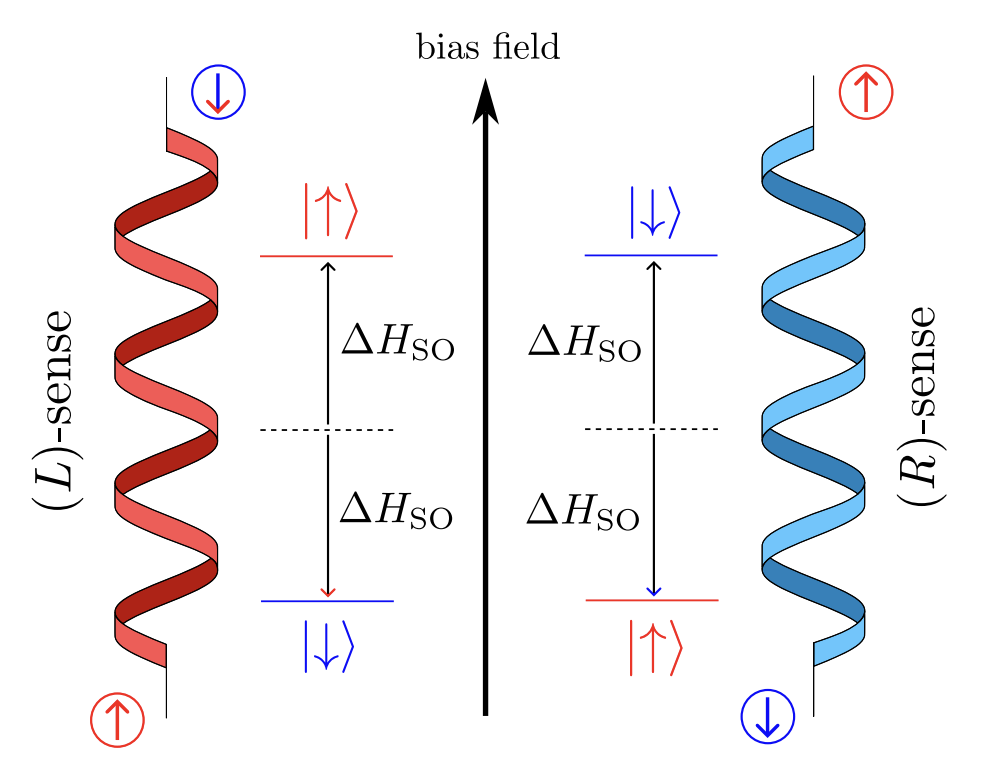
The subtle link between molecular handedness and electron spin, known as chiral-induced spin selectivity (CISS), continues to challenge physicists and chemists, despite growing evidence of its potential in advanced technologies. Yan Xi Foo from Nanyang Technological University, Aisha Kermiche from the University of California, Los Angeles, and Farhan T. Chowdhury from the University of Exeter, alongside their colleagues, investigate the fundamental origins of this effect, where electrons travelling through chiral materials exhibit a pronounced spin polarization even at room temperature. This research addresses a critical gap in understanding whether CISS arises from specific helical structures or a more general property of chirality, and whether a single unifying theory can explain observations across diverse materials, from solid-state films to individual molecules. By clarifying the theoretical underpinnings of CISS, the team highlights its broad relevance and paves the way for innovative applications in areas such as spintronics, molecular sensing, and the development of biomimetic technologies that harness spin-correlated radical pairs.
The chirality-induced spin selectivity (CISS) effect, where electrons gain spin polarization when passing through chiral materials, has been widely observed experimentally, yet its underlying principles remain a topic of active investigation. Understanding the origins of CISS is crucial for developing new spintronic devices and advanced sensors that exploit this phenomenon.
Radical Pairs and Avian Magnetic Sense
Research focuses on radical-pair mechanisms and magnetoreception, particularly in birds, to understand how animals sense and navigate using the Earth’s magnetic field. Radical pairs, molecules with unpaired electrons, form within biological systems and their behavior is sensitive to magnetic fields, proposing a basis for magnetoreception with the interconversion between singlet and triplet states as a key process. The efficiency of this reaction is affected by magnetic fields, providing a mechanism by which a magnetic field can influence biological processes. Surprisingly, spin relaxation and decoherence, processes that typically destroy quantum coherence, can actually enhance magnetoreception.
Exchange and dipolar interactions between electron spins within the radical pair affect the singlet-triplet interconversion rate, while radical scavengers can alter the lifetime of the radical pair, potentially influencing the sensitivity of the magnetoreceptor. Motion, both of the radical pair and surrounding molecules, can enhance sensitivity and potentially push magnetosensing towards quantum limits, with the quantum Zeno effect potentially protecting the radical pair from decoherence. Researchers are developing quantum sensors, using materials like diamonds with nitrogen-vacancy centers, to detect and control spin-state dynamics in radical-pair reactions. These sensors allow for experimental verification of the quantum nature of these processes and can be used in vivo to study biological processes, with potential applications in medical diagnostics for detecting subtle magnetic signals from biological systems. Researchers are also exploring ways to control the spin states of radical pairs using external stimuli, such as light or radio waves, to manipulate biological processes.
Spin Selectivity Arises From Helical Structures
Recent research investigates the chiral-induced spin selectivity (CISS) effect, where electrons exhibit spin polarization when passing through chiral materials, even at room temperature. While observed in various systems, a comprehensive theoretical understanding remains elusive, with debate centering on whether it arises from the geometry of the material or more fundamental chiral properties. Clarifying these mechanisms is crucial for harnessing CISS in potential applications like spintronics and advanced sensors. Researchers are exploring how spin-momentum locking, the connection between an electron’s spin and its direction of travel, contributes to CISS.
Initial models suggested that helical structures should naturally produce a spin current, but these predictions haven’t fully aligned with experimental results. A key challenge arises from the principles of equilibrium physics, which dictate that without external influences, spin transport or accumulation should not occur. To resolve this contradiction, scientists are investigating the role of interfaces and imperfections within chiral materials. One possibility is that the junction itself acts as a scatterer, inducing a spin-flip before the electron enters the chiral region. Alternative models propose that the curvature of the chiral structure generates a quantum geometric potential, also causing spin-flips.
Another approach considers CISS as a form of current-induced spin polarization, where applying an electric bias splits the spin states of electrons, creating a spin asymmetry. These investigations reveal that simply shifting the distribution of electrons isn’t enough to achieve preferential transmission of a specific spin. Instead, researchers are employing gauge-covariant formulations of the Hamiltonian, a mathematical description of the system, to understand the effective electromagnetic fields within the chiral material. This approach aims to identify the conditions under which a charge current can naturally accompany a finite spin current, ultimately leading to a deeper understanding of how CISS can be controlled and utilized in future technologies.
Chirality and Spin Selectivity Explained
This review clarifies the chiral-induced spin selectivity (CISS) effect, where electrons gain spin polarization when passing through chiral materials. Researchers have observed CISS in various systems, from solid-state structures to biological molecules, suggesting broad relevance for applications like spintronics and sensing. This work bridges theoretical models, experimental observations, and potential implementations of CISS, focusing on the fundamental aspects of chirality, induction, and spin selectivity. The review highlights that while several models attempt to explain CISS, a universally accepted theory remains elusive.
Current explanations range from the geometry of chiral structures to interfacial scattering effects and current-induced spin polarization. Importantly, the authors demonstrate that a simple helical structure alone cannot account for the observed spin polarization, and that factors like interfacial effects or asymmetric potential barriers likely play a crucial role. They also show how applying an electric bias can induce a spin current, potentially leading to spin accumulation. Future research should focus on refining these models and exploring the interplay between different mechanisms to achieve a comprehensive understanding of CISS and unlock its full potential for technological applications.
🗞 Mind the Gap: From Resolving Theoretical Foundations of Chiral(ity)-Induced Spin Selectivity to Pioneering Implementations in Quantum Sensing
🧠 ArXiv: https://arxiv.org/abs/2508.05611