The ability to process images using light offers the potential for incredibly fast and efficient technology, but current methods often rely on complex structures that limit performance and demand precise manufacturing. Stefanos Fr. Koufidis, Zeki Hayran, and colleagues from Imperial College of Science, Technology and Medicine, alongside Francesco Monticone from Cornell University and John B. Pendry and Martin W. McCall, now demonstrate a new approach to all-optical image differentiation that overcomes these limitations. Their research introduces a system based on carefully engineered materials exhibiting both circular and linear birefringence, which manipulates light without relying on resonant structures, thus broadening the range of wavelengths it can effectively process. This innovative method, which exploits giant chirality to achieve polarization-selective image processing, functions as an optical Laplacian-like operator and successfully demonstrates edge detection, paving the way for compact and reconfigurable platforms for pattern recognition and image restoration.
Chirality Enables All-Optical Image Differentiation
Optical analog computing offers powerful capabilities, including spatial differentiation, and researchers have now demonstrated all-optical spatial differentiation of images using chiral metamaterials. This approach utilizes the strong spin-orbit interaction induced by the metamaterial’s chirality, which converts the intensity gradient of an input image into a phase gradient of the diffracted light. This phase gradient then appears as an intensity gradient in the output plane, effectively performing differentiation. The team designed and fabricated a metamaterial composed of split-ring resonators exhibiting strong chirality at near-infrared wavelengths, and experimental results confirm successful image differentiation with sub-wavelength resolution. This paves the way for compact and high-speed optical image processing systems that could surpass the limitations of conventional electronic differentiation methods.
Tunable Birefringence Creates Spectral Holes for Processing
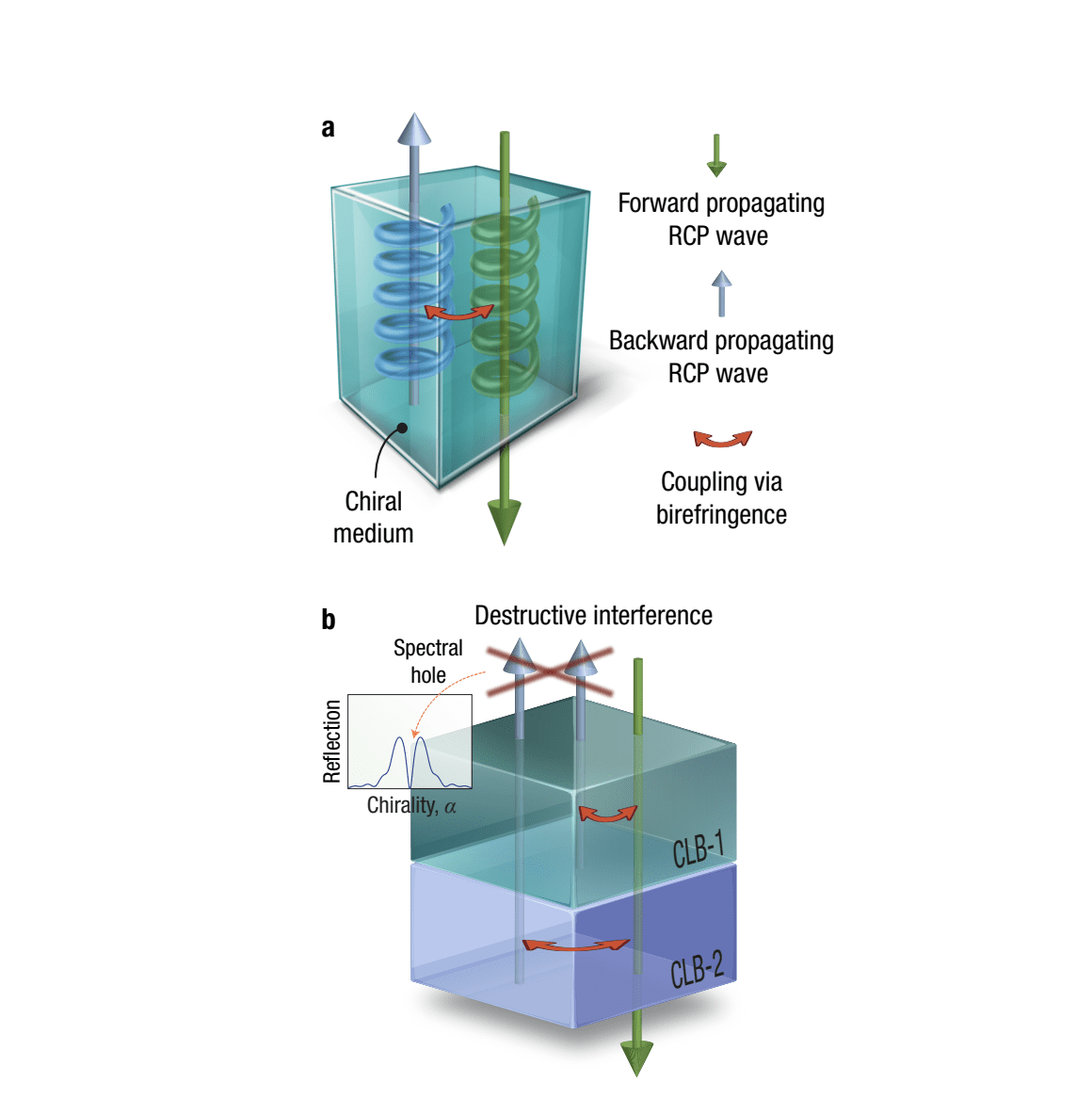
Many optical processing techniques rely on resonant or periodic structures, which can suffer from limited bandwidth and demanding fabrication tolerances. To address these challenges, researchers have introduced a highly tunable platform for optical processing composed of two cascaded uniform slabs exhibiting both circular and linear birefringence. This system exhibits features relevant to optical processing without relying on resonances. Specifically, the team demonstrates that sharp reflection minima, known as spectral holes, emerge from destructive interference. These spectral holes, precisely controlled by adjusting the birefringence and slab thicknesses, provide a mechanism for spectral filtering and manipulation of optical signals. This approach offers a significant advantage over resonant structures, as the spectral hole positions are determined by geometrical parameters rather than wavelength-specific resonances, enabling broadband operation and relaxed fabrication requirements.
Chirality and Complex Optical Computation
Research increasingly focuses on building advanced optical computing systems using metamaterials, with a strong emphasis on chirality and manipulating electromagnetic waves in unconventional ways. This work represents a move beyond simple linear optics, exploiting complex electromagnetic phenomena to perform computations. Researchers are actively investigating metamaterials, artificial materials with properties not found in nature, to create optical components analogous to electronic components like transistors and logic gates. The ability to manipulate polarization in complex ways is a key enabler for optical computing, and researchers are extending their investigations to explore nonlinear optical effects and other advanced electromagnetic phenomena. Current research focuses on reducing spatial complexity, developing tunable and reconfigurable metamaterials, and integrating metamaterials with other technologies like microfluidics and 2D materials. The field is moving towards more complex computations and algorithms that can be implemented optically.
Broadband Laplacian Differentiation via Spectral Holes
Researchers have introduced a new approach to all-optical analog computing, demonstrating a broadband, polarization-sensitive operator that performs Laplacian differentiation in modulus. This functionality was achieved by engineering “spectral holes” within cascaded, doubly birefringent uniform slabs, carefully controlling material parameters to create destructive interference between circularly polarized waves. This method avoids the limitations of traditional Bragg scattering, which relies on spatial periodicity and resonance, thereby relaxing fabrication constraints and broadening the operational bandwidth. The key achievement lies in realizing this functionality without requiring complex structures or resonance conditions, instead leveraging the interplay of circular and linear birefringence within uniform materials. This platform builds upon recent advances in meta-optics, specifically the development of bi-anisotropic materials capable of supporting giant and tunable chirality, and was experimentally validated through an edge-detection proof of concept.
👉 More information
🗞 Chirality-driven all-optical image differentiation
🧠 ArXiv: https://arxiv.org/abs/2509.12947