

Researchers fabricated a lithium niobate microdisk laser emitting visible light at 780nm. The integrated device achieves a narrow linewidth of 254 Hz with a 1.81 mW threshold, enabled by strong photon-phonon interaction and efficient second harmonic generation. This advances chip-scale metrology and information processing.
The demand for compact, high-precision lasers operating at visible wavelengths continues to grow, driven by applications ranging from advanced spectroscopy to atomic clocks and sensing technologies. Traditionally, achieving narrow linewidths at these wavelengths has necessitated complex and bulky laboratory setups. Researchers are now demonstrating visible light laser generation on a silicon chip. A collaborative team, comprising Xiaochao Luo, Chuntao Li, Xingzhao Huang, Jintian Lin, Renhong Gao, Yifei Yao, Yingnuo Qiu, Yixuan Yang, Lei Wang, Huakang Yu, and Ya Cheng, report their findings in a new study detailing a visible Brillouin-quadratic microlaser fabricated from a thin-film lithium niobate microdisk. Their work, entitled ‘Visible Brillouin-quadratic microlaser in a high-Q thin-film lithium niobate microdisk’, details a device exhibiting a narrow linewidth of 254 Hz and a low threshold power of 1.81 mW, alongside efficient second harmonic generation.
Chip-Scale Visible Light Source Enabled by Integrated Brillouin Photonics
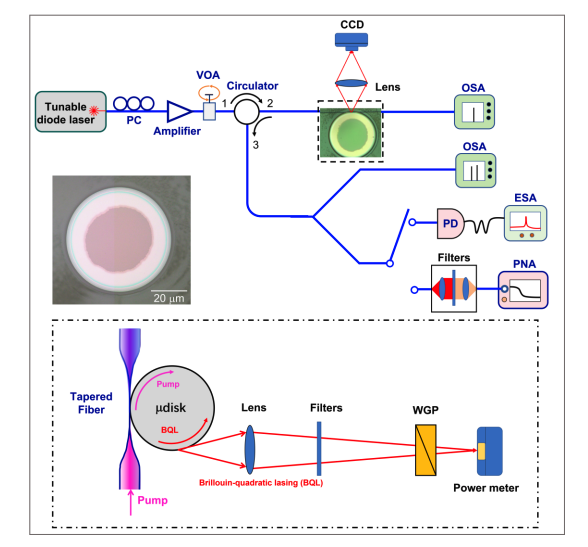
Recent research details a compact, on-chip laser emitting at visible wavelengths, achieved through integrated Brillouin photonics within a thin-film lithium niobate (TFLN) microdisk resonator. This development addresses a need for narrow-linewidth lasers in applications such as atomic clocks, spectroscopy and precision sensing, which traditionally rely on bulky laboratory equipment. The system generates lasing via stimulated Brillouin scattering (SBS), a nonlinear optical process involving the interaction of light with acoustic waves within the material, enabling the creation of miniaturised optical systems.
Researchers engineered dispersion within the 117-µm diameter TFLN microdisk to enhance the SBS interaction, carefully controlling light propagation within the resonator. The high quality factor (Q = 4.0 x 10⁶) and small mode volume of the resonator facilitate strong photon-phonon coupling – the interaction between light and mechanical vibrations – crucial for efficient Brillouin lasing and enabling a significant reduction in device size. A 1560 nm pump laser initiates the process, generating a Stokes Brillouin lasing (SBL) signal with a 10.17 GHz Brillouin shift, providing a stable and coherent light source.
Notably, the resulting SBL exhibits a short-term narrow linewidth of 254 Hz and a low lasing threshold of only 1.81 mW, representing a substantial improvement in performance for on-chip laser systems. This combination of characteristics positions the device as a viable alternative to conventional lasers in various applications, offering reduced size, weight and power consumption.
Beyond generating a narrow-linewidth laser, the system also demonstrates efficient second harmonic generation (SHG) of the SBL signal, expanding its functionality and potential applications. The researchers observe SHG at 780 nm with a normalised conversion efficiency of 3.61%/mW, providing a visible light output from a near-infrared pump source. This simultaneous achievement of narrow-linewidth SBL and its SHG arises from careful phase matching – ensuring the light waves constructively interfere – optimising conditions for both nonlinear processes and creating a versatile optical platform.
This integrated device circumvents the limitations of traditional bulky tabletop lasers typically required for generating narrow-linewidth visible light, offering a pathway towards compact and portable optical instruments. By confining the laser functionality onto a single chip, the research eliminates the need for complex free-space optical setups, reducing alignment challenges and improving system stability.
The fabrication process involves careful control of material properties and device geometry to satisfy the phase-matching condition for efficient SHG and to optimise the high quality factor and small mode volume of the resonator.
The potential applications of this technology are vast, ranging from optical communications and sensing to metrology and biomedical imaging. The compact size, low power consumption and high performance of the integrated device make it ideal for portable and handheld applications. The ability to generate a narrow-linewidth visible light source opens up new possibilities for advanced imaging and sensing techniques.
Future research will focus on optimising the device geometry and fabrication processes to further reduce the lasing threshold and enhance the output power, pushing the boundaries of integrated Brillouin photonics. Investigating alternative resonator designs and exploring different pump wavelengths could broaden the operational bandwidth and improve the overall device performance, expanding the range of applications. Furthermore, integrating this Brillouin-quadratic microlaser with other photonic components will enable the creation of more complex and functional on-chip optical systems for advanced information processing and sensing applications.
This integrated system represents a significant step towards miniaturising complex optical systems, paving the way for portable and low-cost devices. By combining the benefits of integrated photonics with the unique properties of Brillouin scattering, researchers have created a versatile platform for a wide range of applications. The demonstrated performance characteristics and potential for further development make this technology a promising candidate for future optical systems.
This research demonstrates the power of integrated photonics to revolutionise the field of optics, enabling the creation of compact, efficient and versatile optical systems. The successful demonstration of this integrated Brillouin laser highlights the importance of interdisciplinary research, bringing together expertise in materials science, optics and microfabrication. Continued collaboration between researchers will be essential for driving further innovation in the field of integrated photonics.
👉 More information
🗞 Visible Brillouin-quadratic microlaser in a high-Q thin-film lithium niobate microdisk
🧠 DOI: https://doi.org/10.48550/arXiv.2506.08615


