Quantum entanglement, a fundamental property in quantum mechanics, has been the focus of recent research due to its potential applications. Researchers from Zhejiang University and Hefei National Laboratory in China have made a significant breakthrough in this field by deterministically generating and characterizing a maximally entangled Bell state between a magnonic system and a superconducting qubit in a hybrid quantum system.
This achievement demonstrates the potential of hybrid quantum systems in quantum information processing and other quantum technology applications. The team also developed a new joint tomography approach, simplifying the process of characterizing entangled Bell states.
What is Quantum Entanglement, and Why is it Important?
Quantum entanglement is a fundamental property in quantum mechanics where systems share inseparable quantum correlation regardless of their mutual distances. This property has been the focus of current research due to its fundamental significance and versatile applications. Quantum entanglement between macroscopic systems, or systems large enough to be seen with the naked eye, is of particular importance. This is because it can test some fundamental properties in quantum mechanics.
Quantum entanglement has been demonstrated in various systems such as the circuit QED system and the mechanical resonator. In the hybrid magnonic system, entanglement has been used as the resource to detect the magnon number, where the entanglement plays the same role as in the superconducting qubit dispersive readout process.
The generation of an entangled Bell state between the magnonic system and the qubit is one of the essential ingredients for quantum transduction. However, a convincing characterization of the entangled Bell state by quantum tomography remains the greatest outstanding challenge due to the shorter lifetime of the magnon and the limited number of qubits that can be integrated into the hybrid system.
What is a Hybrid Quantum System and How Does it Work?
Hybrid quantum systems harness the advantages of different subsystems to implement quantum information processing and other quantum technology applications. Recently, the hybrid quantum system based on collective spin excitations in ferromagnetic materials has become a promising platform for quantum information and quantum engineering, especially for the quantum transducer applications in a quantum network.
The quantum of these collective excitations, magnon, is capable of coupling many different systems including optical photons, microwave photons, phonons, and superconducting qubits. The large size of the ferromagnetic spin system and the enormous number of spins in it also make it an ideal platform for testing some fundamental properties in quantum mechanics.
In a recent experiment, a team of researchers from Zhejiang University and Hefei National Laboratory in China reported the deterministic generation and tomography of the maximally entangled Bell state between a magnonic system and a superconducting qubit. The Bell state was generated in the resonant qubit-magnon coupling regime using a fast magnon-qubit swap operation.
How is the Bell State Generated and Characterized?
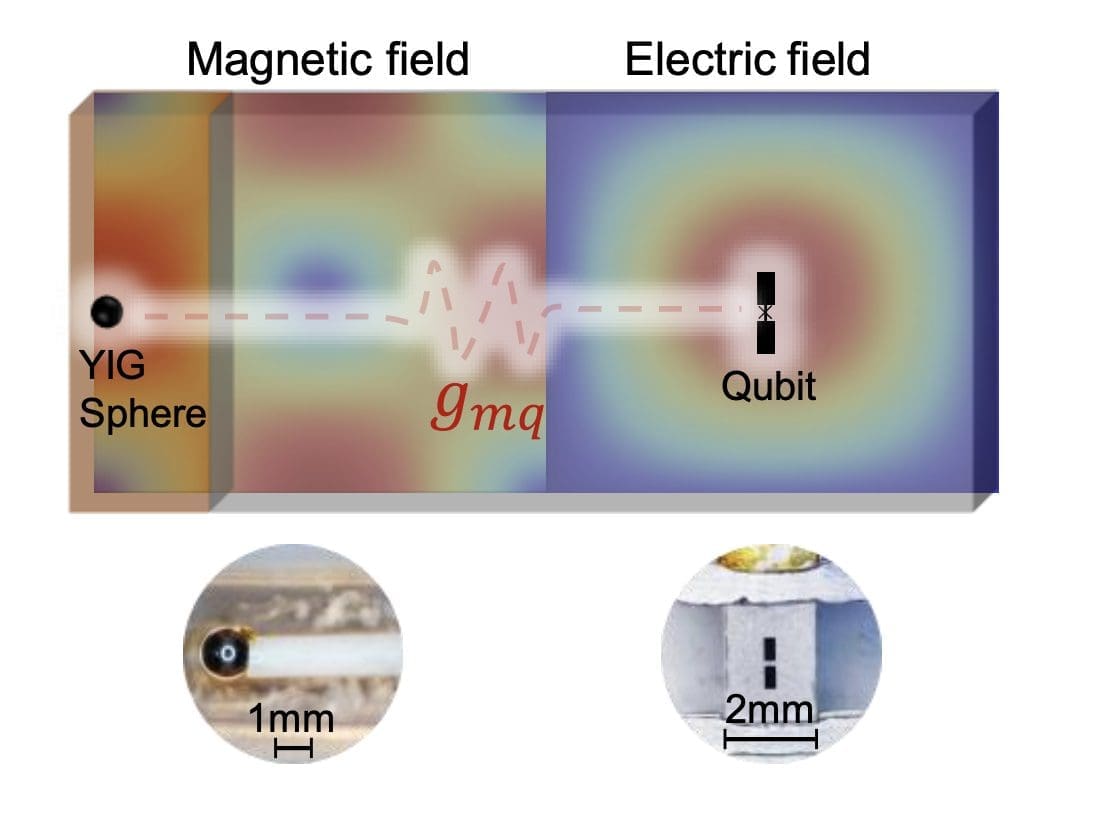
A three-dimensional (3D) microwave cavity mediates the effective coupling between the magnon and the qubit, and the qubit frequency is tuned using the dressed Autler-Townes (AT) doublet states. The researchers developed a new joint tomography approach to characterize the deterministically generated magnon-qubit Bell state.
In contrast to the conventional joint tomography technique, which requires separate local measurements of the two subsystems, their method only requires measuring the qubit. This approach simplifies the process and makes it more efficient. The researchers confirmed the deterministic generation of the Bell state, which gives a generation fidelity of 0.90001.
What is the Significance of this Research?
This research is significant because it makes the macroscopic spin system the largest system in the sense of atom number capable of generating the maximally entangled quantum state. This is a major breakthrough in the field of quantum mechanics and could pave the way for more advanced quantum technology applications.
The deterministic generation and tomography of the macroscopically entangled Bell state in a hybrid quantum system containing a millimeter-sized spin system and a micrometer-sized superconducting qubit is a significant achievement. It demonstrates the potential of hybrid quantum systems in implementing quantum information processing and other quantum technology applications.
Moreover, the development of a new joint tomography approach that only requires to measure the qubit is a significant advancement in the field. This approach could potentially simplify the process of characterizing entangled Bell states and make it more efficient, which could have significant implications for future research and applications in quantum mechanics.
Publication details: “Macroscopic Bell state between a millimeter-sized spin system and a superconducting qubit”
Publication Date: 2024-03-22
Authors: Dazhi Xu, Xu-Ke Gu, Yuan-Chao Weng, Hekang Li, et al.
Source: Quantum Science and Technology
DOI: https://doi.org/10.1088/2058-9565/ad36dc