Researchers from Jiangxi Normal University in China have studied tripartite entanglement and steering in three-qubit pure states. They have created a class of three-qubit pure states using a tritter with a variable parameter induced by vacuum-one-photon superpositions. The team’s research builds on previous work and contributes to understanding multipartite entanglement and EPR steering, both vital for quantum information and technologies. They have also introduced a scheme to generate a novel class of three-qubit pure states. Their findings provide valuable insights into complex quantum phenomena.
Tripartite Entanglement and Steering in Three Qubit Pure States
A team of researchers from the College of Physics and Communication Electronics at Jiangxi Normal University in China, including Jian Wang, Huan Liu, Xuefeng Zhan, and Xuexiang Xu, have been investigating tripartite entanglement and steering in three-qubit pure states. They have generated a class of three-qubit pure states using a tritter with variable parameter T, induced by vacuum-one-photon superpositions. The coefficients c0, c1, c2, and c3 can be manipulated through interaction parameters α, φ, and T.
Genuine Tripartite Entanglement
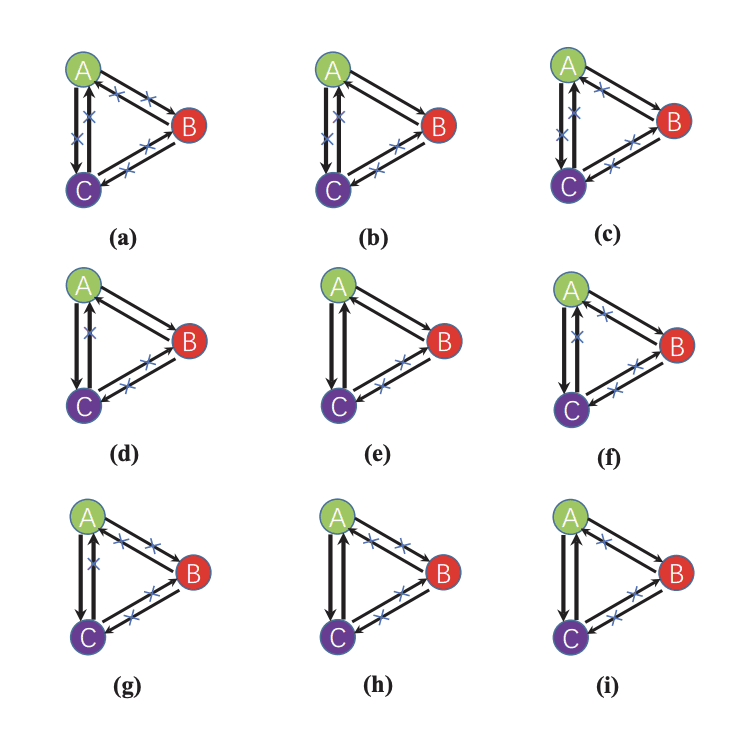
The team’s research builds on the work of Xie and Eberly, who investigated genuine tripartite entanglement using the concurrence triangle measure. The researchers have identified nine potential configurations exhibiting varying steerability across different parameter spaces. However, they found that while the state ψ exhibits entanglement, steering remains unattainable in a substantial portion of the parameter space.
Multipartite Entanglement
Multipartite entanglement exists in two-party, three-party, or even more-party systems and is a vital resource for quantum information and technologies. Numerous measures of multipartite entanglement have been developed, including partial-norm, entanglement of formation, von Neumann entropy, normalized negativity, concurrence, and others. The team’s research contributes to the ongoing efforts to quantify the genuine multipartite entanglement.
Einstein-Podolsky-Rosen (EPR) Steering
EPR steering stipulates that one observer can manipulate another party’s state through local measurements and is a crucial resource for various quantum applications. The researchers have examined tripartite steering for ψ under specific measurements based on the uncertainty relations criterion.
Preparation of Three-Qubit Pure States
The researchers have introduced a scheme designed to generate a novel class of three-qubit pure states, the parameters of which can be modified through various interaction parameters. The entire process is bifurcated into two primary stages: the preparation of the vacuum-one-photon superposition (VOPS) and the preparation of the three-qubit states under study.
Tripartite Entanglement Analysis
The team has derived the Cijk-type concurrence, where i, j, and k are distinct values of 1, 2, or 3, and investigated the genuine tripartite entanglement of ψ using the concurrence triangle proposed by Xie and Eberly.
Conclusion and Future Research
The research conducted by Jian Wang, Huan Liu, Xuefeng Zhan, and Xuexiang Xu provides valuable insights into the tripartite entanglement and steering in three-qubit pure states. Their findings contribute to the understanding of multipartite entanglement and EPR steering, which are crucial resources for quantum information and technologies. Future research will continue to explore these complex quantum phenomena.
The article titled “Tripartite entanglement and tripartite steering in three-qubit pure states induced by vacuum-one-photon superpositions” was published on January 25, 2024. The authors of this research are Jingbo Wang, Huan Liu, Xue-feng Zhan, and Xue-Xiang Xu. The article was sourced from arXiv, a repository managed by Cornell University. The research can be accessed through the DOI: https://doi.org/10.48550/arxiv.2401.14328.