

Quantum computation promises to solve problems intractable for even the most powerful conventional computers, and researchers are actively pursuing demonstrations of this potential, known as quantum advantage. Hua-Liang Lin, Guangwen Yang, and Jia-Min Xu, alongside their colleagues, have achieved a significant step forward in this field with a new experiment utilising Gaussian boson sampling. The team, based at Tsinghua University and Jiuzhang Quantum Technology Co. Ltd., demonstrates a robust quantum advantage by processing photons through a programmable quantum processor, named Jiuzhang 4.0, and generating over three thousand detection events. This achievement surpasses the capabilities of current classical algorithms, with simulations requiring timescales exceeding ten to the power of forty-two years, while the quantum processor completes the task in mere microseconds, establishing a new benchmark and bringing fault-tolerant quantum hardware closer to reality.
Quantum Advantage in Gaussian Boson Sampling Demonstrated
Achieving Quantum Advantage in Boson Sampling
A Chinese research team has demonstrated a significant milestone in quantum computation, achieving a quantum advantage in Gaussian Boson Sampling (GBS) that surpasses previous achievements. They have developed a system that is both more powerful and more efficient than previous GBS demonstrations, and their results are robust against attempts to mimic quantum behaviour using classical methods. This work represents a substantial step towards harnessing the power of quantum computers for real-world problems, with potential applications in diverse fields like drug discovery, machine learning, and materials science. The researchers successfully demonstrated that their quantum computer can perform GBS faster than any classical computer, achieving a speedup of approximately 1024 over the best classical algorithms. This robust experiment utilised a substantial computational resource, a 1432-core GPU cluster, for both simulation and validation of the findings, solidifying the claim of quantum advantage.
Photonic Processor Demonstrates Complex Gaussian Boson Sampling
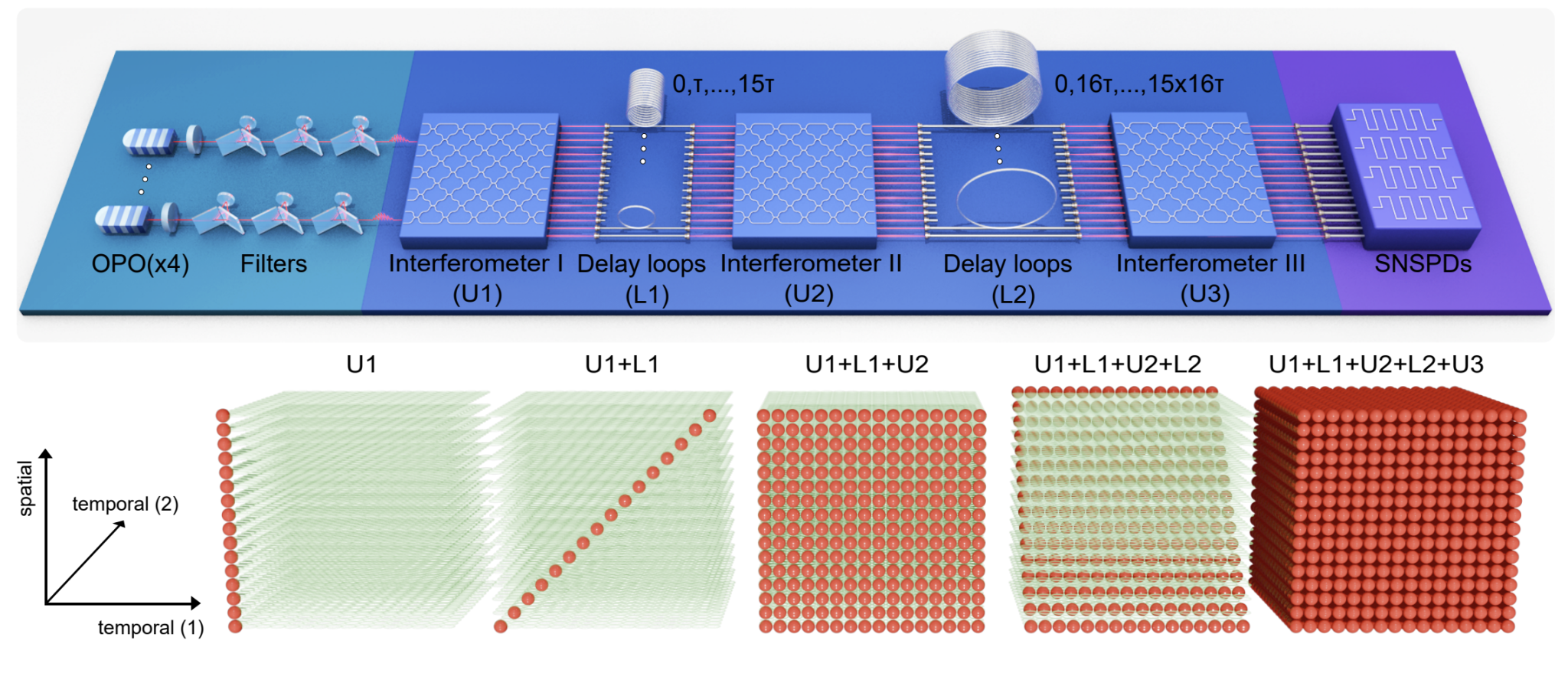
Researchers have developed a novel approach to quantum computation using Gaussian boson sampling, a technique that harnesses the principles of linear optics to demonstrate a computational advantage over classical computers. The team constructed Jiuzhang 4.0 (named in line with previous devices), a sophisticated photonic quantum processor capable of handling a substantial number of squeezed states, up to 1024, and output modes, 8176. This advanced processor allows for complex quantum computations previously unattainable, utilizing a programmable spatial-temporal hybrid encoding circuit to manipulate photons and maximize computational potential intricately.
Processor Architecture and Squeezed Light Implementation
The core of this processor begins with squeezed light generated by multiple optical parametric oscillators, carefully filtered to ensure high purity. Photons then enter a network of interferometers and delay loops, effectively spreading each input photon across a vast number of temporal and spatial modes, creating a cubic scaling of connectivity. This dense coupling of photons, combined with the hybrid encoding scheme that combines spatial and temporal dimensions, allows for a more complex and potentially more powerful quantum computation than traditional methods. A highly sensitive single-photon detection system measures the output states, enabling validation of the quantum computation and comparison with classical algorithms.
Jiuzhang 4.0.
This processor utilizes squeezed states of light to perform Gaussian boson sampling, a technique that allows quantum computers to outperform classical computers on specific tasks potentially. The team successfully implemented boson sampling with 1024 input squeezed states and 8176 output qumodes, representing a substantial increase in scale and complexity compared to previous experiments. A primary challenge in photonic quantum computing is photon loss, which can degrade performance.
Demonstrated Quantum Speedup Outperforming Classical Limits
While previous work suggested photon loss might simplify classical simulations, the team’s experiments demonstrate the opposite: loss does not negate the quantum advantage. Jiuzhang 4.0 generates up to 3050 detected photons, and the results clearly outperform the most advanced classical algorithms currently available. Specifically, the team compared their quantum processor’s performance to that of the EI Capitan supercomputer running a sophisticated matrix product state algorithm. The comparison revealed a dramatic difference in speed and efficiency: while the supercomputer would require over 10 42 years to complete the same calculation, Jiuzhang 4.
This represents a monumental speedup, firmly establishing a new frontier in quantum computational advantage, achieved through a novel spatial-temporal hybrid encoding circuit and squeezed state generation with 92% efficiency.
Photonic Quantum Advantage with 1024 Squeezed States
This research demonstrates a significant advance in quantum computation through a large-scale boson sampling experiment. Researchers successfully injected 1024 squeezed states into a programmable quantum processor, achieving a computational speedup exceeding 10 54 compared to the most powerful classical supercomputers. This result establishes a new benchmark for quantum advantage, surpassing previous demonstrations and solidifying the potential of photonic quantum computing, while conclusively ruling out existing classical spoofing algorithms. The team’s quantum processor generated samples in 25. 6 microseconds, a task estimated to take over 10 42 years for a state-of-the-art supercomputer to complete. While acknowledging the limitations of current technology, the authors highlight the potential for scaling up these systems and developing fault-tolerant quantum hardware. Future research will focus on controlling larger clusters of entangled quantum states and improving the efficiency of squeezed light sources, paving the way for more complex quantum computations.
🗞 Robust quantum computational advantage with programmable 3050-photon Gaussian boson sampling
🧠 ArXiv: https://arxiv.org/abs/2508.09092


