

Aqueous zinc-ion batteries hold great potential for large-scale electrochemical energy storage due to their safety, low cost, and environmental friendliness. However, their practical application is hindered by challenges such as dendrite formation and water-induced corrosion at the anode. Researchers led by Prof. YANG Weishen and Prof. ZHU Kaiyue from the Dalian Institute of Chemical Physics of the Chinese Academy of Sciences have made a crucial advancement in addressing these challenges.
They utilized trace amounts of carbon dots to construct a dynamic hydrophobic monolayer at the zinc anode/electrolyte interface, effectively protecting the anode from water-induced corrosion and achieving a highly reversible zinc anode. This innovative approach was published in ACS Nano and has significant implications for the development of more efficient and durable zinc-ion batteries. The work of Prof. YANG and his team could pave the way for the widespread adoption of this technology.
Introduction to Aqueous Zinc-Ion Batteries
Aqueous zinc-ion batteries (ZIBs) have garnered significant attention in recent years due to their potential for large-scale electrochemical energy storage. These batteries offer several advantages, including safety, low cost, and environmental friendliness, making them an attractive alternative to traditional lithium-ion batteries. However, the practical application of ZIBs is hindered by challenges such as dendrite formation and water-induced corrosion at the anode. To overcome these limitations, researchers have been exploring innovative approaches to enhance the reversibility and durability of zinc anodes.
The development of ZIBs is crucial for addressing the growing demand for sustainable energy storage solutions. Zinc, being an abundant and inexpensive metal, offers a promising alternative to lithium. Moreover, aqueous electrolytes used in ZIBs are more environmentally friendly and less prone to thermal runaway compared to organic electrolytes used in traditional lithium-ion batteries. Despite these advantages, the performance of ZIBs is limited by the instability of the zinc anode, which undergoes corrosion and dendrite formation during charge-discharge cycles.
To address these challenges, researchers have been investigating various strategies to improve the interfacial stability between the zinc anode and the electrolyte. One such approach involves the use of hydrophobic carbon dots to construct a dynamic monolayer at the zinc anode/electrolyte interface. This innovative method has shown promise in regulating the electric double-layer (EDL) structure at the zinc anode, thereby altering the reaction kinetics of zinc deposition and dissolution.
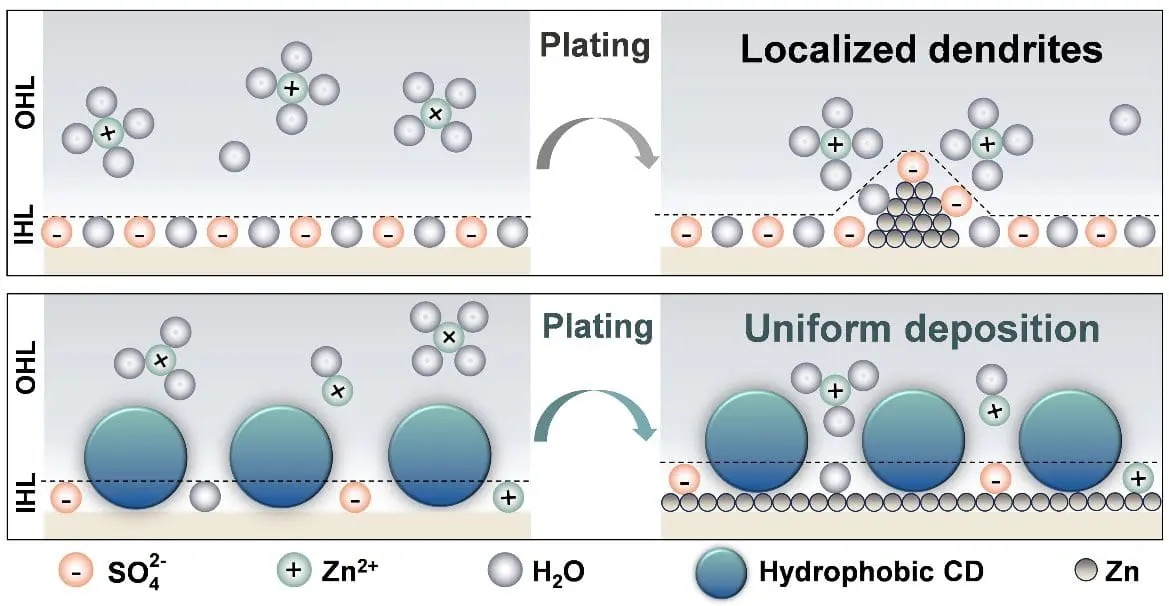
The concept of EDL is crucial in understanding the behavior of ions at the electrode-electrolyte interface. The EDL consists of two layers: the inner Helmholtz layer (IHL) and the outer Helmholtz layer (OHL). The IHL is where water molecules and anions preferentially adsorb, directly contacting the zinc anode and triggering side reactions. Meanwhile, hydrated zinc ions in the OHL must overcome a high desolvation energy barrier to enter the IHL and undergo electron transfer.
Dynamic Interface Engineering with Hydrophobic Carbon Dots
Researchers at the Dalian Institute of Chemical Physics (DICP) of the Chinese Academy of Sciences (CAS) have proposed a novel approach to enhance the reversibility of zinc anodes using dynamic interface engineering with monolayer hydrophobic carbon dots. This method involves the construction of a dynamic hydrophobic monolayer at the zinc anode/electrolyte interface, which regulates the EDL structure and prevents undesirable side reactions.
The use of hydrophobic carbon dots is crucial in this approach, as they repel sulfate ions and water molecules in the IHL, thereby reconstructing a hydrophobic IHL that facilitates the desolvation process of hydrated zinc ions. This results in a significant improvement in the reaction kinetics of zinc deposition and dissolution, ultimately leading to a highly reversible zinc anode.
The dynamic interface engineering approach has been demonstrated to be effective in preventing dendrite formation and water-induced corrosion at the zinc anode. The cycled zinc anode maintained a smooth and compact surface free of byproducts, and the Zn||Zn symmetric cells and Zn||MnO2 full cells exhibited exceptional cycling stability.
The robust adsorption of hydrophobic carbon dots onto the anode and their weak coordination with Zn2+ ensures that the dynamic interface remains well preserved during plating. This is in contrast to hydrophilic carbon dots, which exhibit irreversible co-deposition. The use of hydrophobic carbon dots provides a pioneering “nanosized hydrophobic monolayer” strategy that effectively regulates the interfacial EDL structure for reversible and durable zinc anodes.
Mechanism of Hydrophobic Carbon Dot Monolayer
The mechanism of the hydrophobic carbon dot monolayer is based on the regulation of the EDL structure at the zinc anode/electrolyte interface. The hydrophobic carbon dots adsorb onto the anode, creating a dynamic hydrophobic monolayer that repels sulfate ions and water molecules in the IHL. This results in a reconstructed hydrophobic IHL that facilitates the desolvation process of hydrated zinc ions.
The desolvation energy barrier is significantly reduced, allowing hydrated zinc ions to easily enter the IHL and undergo electron transfer. The reaction kinetics of zinc deposition and dissolution are improved, resulting in a highly reversible zinc anode. The dynamic interface engineering approach also prevents dendrite formation and water-induced corrosion at the zinc anode, leading to exceptional cycling stability.
The use of hydrophobic carbon dots provides a novel strategy for regulating the interfacial EDL structure, which is crucial for improving the performance of ZIBs. The mechanism of the hydrophobic carbon dot monolayer is based on the principles of electrochemistry and surface science, and its understanding is essential for the development of high-performance ZIBs.
Applications and Future Directions
The development of aqueous zinc-ion batteries with dynamic interface engineering using hydrophobic carbon dots has significant implications for various applications. These batteries can be used in renewable energy systems, electric vehicles, and consumer electronics, providing a sustainable and environmentally friendly alternative to traditional lithium-ion batteries.
Future research directions include the optimization of the hydrophobic carbon dot monolayer, the development of new electrolyte materials, and the scaling up of ZIBs for commercial applications. Additionally, the use of hydrophobic carbon dots can be explored in other electrochemical systems, such as supercapacitors and fuel cells.
The pioneering “nanosized hydrophobic monolayer” strategy developed by researchers at DICP has opened up new avenues for improving the performance of ZIBs. Further research and development are necessary to fully realize the potential of this technology and to address the growing demand for sustainable energy storage solutions.
External Link: Click Here For More


