

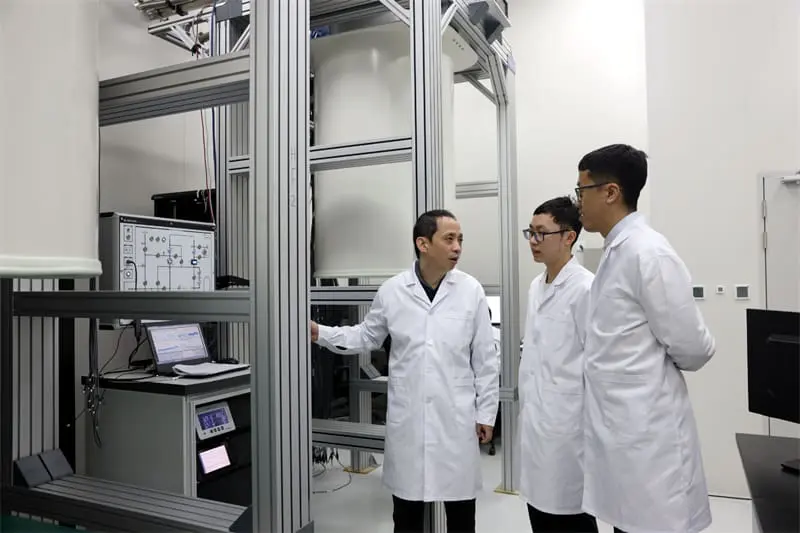
Chinese scientists led by Pan Jianwei, Zhu Xiaobo, and Peng Chengzhi have unveiled a superconducting quantum computer prototype named “Zuchongzhi 3.0” with 105 qubits in Hefei, Anhui Province.
This system features 182 couplers and processes quantum random circuit sampling tasks at a speed quadrillion times faster than the world’s most powerful supercomputer, surpassing Google’s latest results by a factor of 1 million.
The achievement sets a new record for quantum computational advantage within superconducting systems. It underscores China’s advancements in quantum computing, positioning it as a global leader alongside the United States in this rapidly evolving field.
China’s Breakthrough in Quantum Computing
Chinese scientists have unveiled a significant advancement in quantum computing by developing “Zuchongzhi 3.0,” a superconducting quantum computer prototype featuring 105 qubits. This milestone represents a substantial leap forward in quantum computational power, achieving a processing speed quadrillion times faster than the world’s most influential classical supercomputers and surpassing recent results from Google. The system also includes 182 couplers, enhancing its ability to perform complex quantum operations.
The achievement of “Zuchongzhi 3.0” demonstrates China’s continued progress in the field of quantum computing, following previous milestones such as the development of “Jiuzhang” and “Zuchongzhi 2.1.” These advancements highlight the nation’s commitment to achieving quantum computational advantage, a critical step toward practical applications of quantum technology. The research team, led by prominent scientists including Pan Jianwei and Zhu Xiaobo, has emphasized improving qubit control precision and scalability for future developments.
The global scientific community recognizes quantum computational advantage as a foundational step toward developing large-scale, fault-tolerant quantum computers capable of solving problems that are intractable for classical systems. China’s advancements in this area underscore its growing influence in the competitive landscape of quantum technology research.
The Development of Zuchongzhi 30
The development of Zuchongzhi 3.0 represents a notable advancement in China’s quantum computing capabilities. The system features 105 qubits and 182 couplers, enabling it to perform complex quantum operations at unprecedented speeds. This upgrade builds on previous iterations, such as Zuchongzhi 2.1, and reflects ongoing efforts to enhance the scalability and precision of quantum systems.
The research team, led by scientists including Pan Jianwei and Zhu Xiaobo, has emphasized improving qubit control and integration for future applications. Their work on quantum error correction, with a focus on achieving code distances of 7, 9, and eventually 11, demonstrates a strategic approach to addressing key challenges in large-scale quantum computing.
Zuchongzhi 3.0’s capabilities align with global goals in quantum technology, particularly in advancing toward fault-tolerant quantum systems capable of solving complex problems beyond the reach of classical computers. This development underscores China’s growing role in shaping the future of quantum computing research and its potential for practical applications.
Quantum Computational Advantage Explained
Quantum computational advantage refers to the ability of a quantum computer to solve specific problems significantly faster than classical supercomputers. The development of Zuchongzhi 3.0 represents a concrete demonstration of this capability, with its 105-qubit system achieving processing speeds quadrillion times faster than state-of-the-art classical machines. This advancement builds on earlier milestones such as the 76-qubit “Jiuzhang” and the 62-qubit “Zuchongzhi 2.1,” showcasing a clear progression in quantum computing capabilities.
The system’s architecture, featuring 182 couplers, enables precise control over qubit interactions, facilitating complex quantum operations. This design reflects ongoing efforts to enhance scalability and precision, which are critical for advancing toward large-scale, fault-tolerant quantum systems. The research team has emphasized the importance of improving qubit control and integration, with current work focusing on achieving code distances of 7, 9, and 11 in quantum error correction protocols.
Zuchongzhi 3.0 underscores China’s position as a key player in global quantum technology research by demonstrating quantum computational advantage at this scale. The system’s capabilities align with broader goals to develop practical applications for quantum computing, addressing challenges beyond classical systems’ reach.
Global Competition in Quantum Research
Chinese scientists have developed “Zuchongzhi 3.0,” a superconducting quantum computer prototype with 105 qubits and 182 couplers, achieving processing speeds quadrillion times faster than classical supercomputers. This advancement surpasses previous milestones such as the 76-qubit “Jiuzhang” and the 62-qubit “Zuchongzhi 2.1,” demonstrating significant progress in quantum computational power. The system’s architecture enables precise control over qubit interactions, facilitating complex operations and reflecting efforts to enhance scalability and precision for large-scale quantum computing.
The research team, led by Pan Jianwei and Zhu Xiaobo, has focused on improving qubit control and integration, with current work targeting code distances of 7, 9, and eventually 11 in quantum error correction protocols. These advancements underscore China’s growing influence in global quantum technology research, aligning with broader goals to develop fault-tolerant quantum systems capable of solving problems beyond classical capabilities.
Zuchongzhi 3.0 represents a concrete demonstration of quantum computational advantage, achieving processing speeds unmatched by classical machines. The system’s design and performance highlight the importance of precision and scalability in advancing toward practical applications of quantum computing, positioning China as a key player in the global competition for quantum technology dominance.
Future Directions in Quantum Error Correction
Quantum computational advantage refers to the ability of a quantum computer to solve specific problems significantly faster than classical supercomputers. The development of Zuchongzhi 3.0 represents a concrete demonstration of this capability, with its 105- qubit system achieving processing speeds quadrillion times faster than state-of-the-art classical machines. This advancement builds on earlier milestones such as the 76-qubit “Jiuzhang” and the 62-qubit “Zuchongzhi 2.1,” showcasing a clear progression in quantum computing capabilities.
The system’s architecture, featuring 182 couplers, enables precise control over qubit interactions, facilitating complex quantum operations. This design reflects ongoing efforts to enhance scalability and precision, critical factors for advancing toward large-scale, fault-tolerant quantum systems. The research team has emphasized the importance of improving qubit control and integration, with current work focusing on achieving code distances of 7, 9, and eventually 11 in quantum error correction protocols.
Zuchongzhi 3.0 underscores China’s position as a key player in global quantum technology research by demonstrating quantum computational advantage at this scale. The system’s capabilities align with broader goals to develop practical applications for quantum computing, addressing challenges that remain beyond the reach of classical systems.
Zuchongzhi 3.0’s advancements align with global goals in quantum technology, emphasizing the potential for practical applications and addressing computational challenges that remain unsolved by classical systems.
More information
External Link: Click Here For More


