

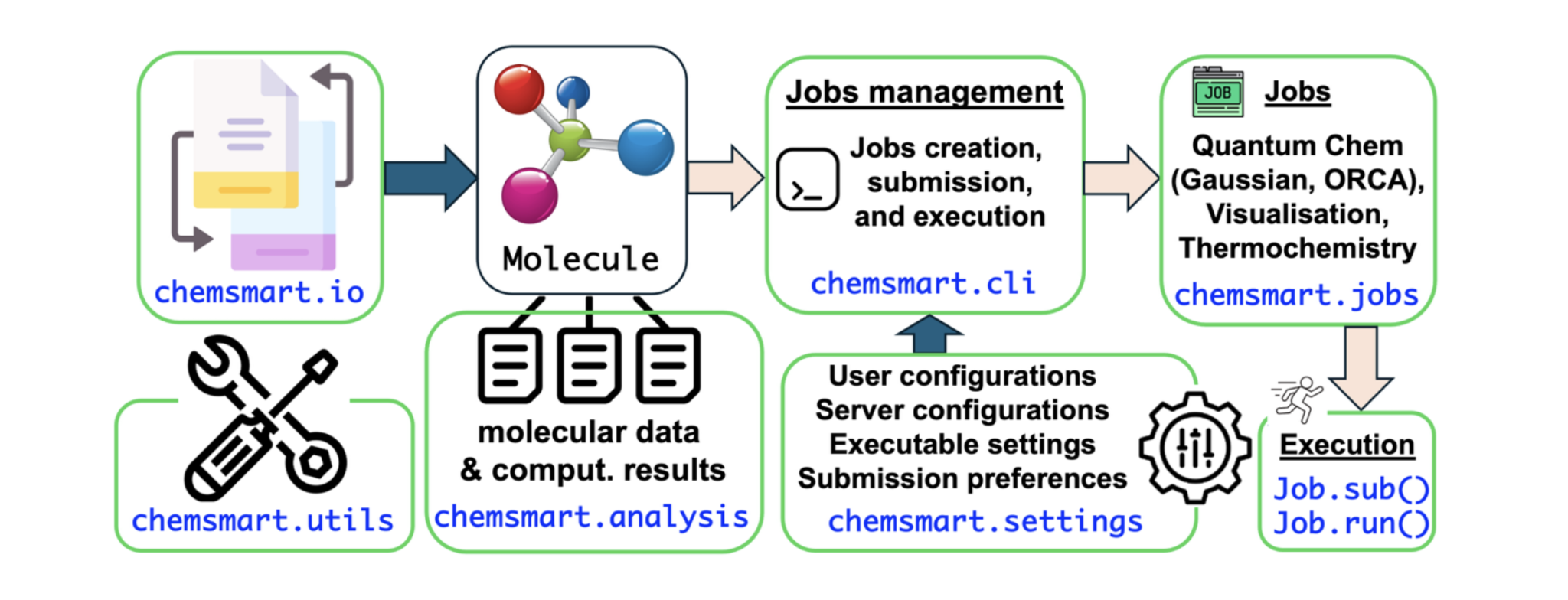
Computational chemistry often relies on complex, multi-step workflows that demand significant researcher time and effort, but a new toolkit aims to dramatically simplify these processes. Xinglong Zhang, J. Chen (from the Institute of High Performance Computing, A*STAR), and Huiwen Tan, along with colleagues, present CHEMSMART, an open-source framework that automates key stages of molecular modeling and simulation. The toolkit integrates job preparation, execution, and analysis into a seamless workflow, addressing the inefficiencies of manual management and ensuring compatibility with widely used cheminformatics platforms. By automating tasks such as geometry optimisation and transition state searches, CHEMSMART empowers researchers to focus on scientific discovery rather than computational logistics, ultimately accelerating progress in areas like catalyst design and materials science.
CHEMSMART (Chemistry Simulation and Modeling Automation Toolkit) is an open-source, Python-based framework designed to streamline quantum chemistry workflows for homogeneous catalysis and molecular modeling. By integrating job preparation, submission, execution, results analysis, and visualization, it addresses inefficiencies in computational chemistry, offering a comprehensive solution for researchers. The framework ensures seamless interoperability with existing quantum chemistry packages and cheminformatics platforms, facilitating complex molecular simulations. Its modular architecture supports automated job submission and execution tasks, accelerating the discovery of novel catalysts and materials.
Command-Line Tools for Chemical Calculations
The chemsmart package provides a comprehensive suite of command-line tools for performing chemical calculations and analyses. These tools cover a wide range of tasks, from calculating molecular properties to managing files and submitting jobs. The package includes commands for calculating Fragment Molecular Orbital (FMO) energies, Fukui indices, Hirshfeld charges, Mulliken charges, and Wiberg Bond Indices. It also offers tools for converting between molecular structure file formats, filtering structures based on similarity, and visualizing data like DIAS plots. Furthermore, the package facilitates job submission to clusters or queues and helps organize files for supporting information.
A crucial tool within the package is for Natural Bond Orbital (NBO) analysis, providing insights into bonding and electronic structure. Additionally, the package allows operations on cube files, useful for visualizing charge density or electrostatic potential. Many scripts share common options, such as specifying input files, atom numbers, directories, and file types, streamlining workflows and promoting consistency. This package is particularly well-suited for computational chemistry workflows involving DFT calculations, providing tools for reactivity analysis, data extraction, and automation. To effectively use the package, researchers first identify their specific task, then locate the corresponding script.
Consulting the help message for each script reveals available options and arguments. By combining the script name with the appropriate parameters, researchers can perform a wide range of calculations and analyses. For example, calculating Fukui indices involves specifying the output files for neutral, radical cation, and radical anion species. This detailed breakdown empowers researchers to leverage the full potential of the chemsmart package for their computational chemistry needs.
CHEMSMART streamlines quantum chemistry workflows efficiently
Researchers have developed CHEMSMART, an open-source Python-based framework designed to streamline quantum chemistry workflows for homogeneous catalysis and molecular modeling. This toolkit addresses significant inefficiencies in computational chemistry by integrating every stage of a simulation, from initial job preparation and submission to execution, results analysis, and data visualization. CHEMSMART ensures seamless interoperability with existing quantum chemistry packages and cheminformatics platforms, offering a unified environment for complex molecular simulations. The core of CHEMSMART is a modular architecture built around a ‘Molecule’ object, mirroring the functionality of established tools, but specifically tailored for quantum chemical calculations.
This design prioritizes extensibility, allowing researchers to easily incorporate new software and adapt the framework to evolving research needs. This toolkit has been successfully tested across Windows, Linux, and macOS operating systems, demonstrating its broad compatibility and accessibility. This comprehensive approach tackles the operational inefficiencies inherent in manual workflow management, particularly the challenges of job submission, resource allocation, and error handling. By automating these processes, CHEMSMART significantly reduces the potential for human error and accelerates the pace of discovery. The framework’s adaptable interfaces and forward-compatible design position it as a versatile platform for accelerating molecular quantum chemistry workflows while accommodating future advancements in the field. Researchers anticipate that CHEMSMART will prove invaluable for high-throughput screening, multiscale simulations, and the integration of machine learning techniques into computational chemistry research.
Automated Chemistry Workflows and Data Provenance
CHEMSMART presents a new, open-source toolkit designed to automate and streamline computational chemistry workflows, addressing inefficiencies often caused by manual processes and a lack of interoperability. The framework integrates tasks from job preparation and submission through to results analysis and visualization, offering a modular and extensible platform for researchers. A central feature is the ‘Molecule’ object, which facilitates compatibility between different quantum chemistry engines and analysis tools, alongside broader cheminformatics ecosystems. The toolkit improves reproducibility and data accessibility by generating machine-readable files that preserve structural information.
While currently supporting a limited number of electronic structure packages, the authors acknowledge this as a limitation and plan to expand compatibility to include additional software. Future development will also focus on incorporating more advanced techniques and aligning the toolkit with FAIR data principles to further enhance data accessibility and reuse. Ultimately, the goal is to establish a robust foundation for high-throughput computational chemistry research, promoting efficiency, reproducibility, and collaboration within the scientific community.
🗞 CHEMSMART: Chemistry Simulation and Modeling Automation Toolkit for High-Efficiency Computational Chemistry Workflows
🧠 ArXiv: https://arxiv.org/abs/2508.20042


