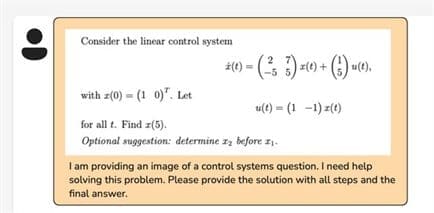
Researchers at the University of Illinois Urbana-Champaign evaluated how well ChatGPT performed in an undergraduate control systems course, comparing its results with those of human students. The study found that while ChatGPT achieved an A on straightforward math problems and a D on higher-level reasoning tasks, resulting in an overall low B grade, human students averaged 84.85%, slightly outperforming the AI. Using the free version of ChatGPT, which aligns with typical student usage, the researchers observed that while the tool was efficient for structured questions, it struggled with open-ended problems, sometimes using incorrect terminology or fabricating information. The findings suggest that while ChatGPT can pass a course with minimal effort, it does not foster deep learning, prompting educators to consider adjusting their teaching methods to include more complex and analytical assignments.
Researchers at the University of Illinois Urbana-Champaign compared ChatGPT’s performance to human students in an undergraduate control systems course. The study evaluated ChatGPT using the free version, assigning it the same coursework as enrolled undergraduates. This curriculum included structured math problems and open-ended questions requiring higher-level reasoning.
Key aspects of the methodology involved analyzing ChatGPT’s responses across different question types. For straightforward calculations, ChatGPT demonstrated high accuracy, earning an A grade comparable to top-performing students. However, its performance significantly declined on tasks demanding critical thinking and problem-solving, where it received a D grade.
The research also explored how ChatGPT approached complex assignments. While capable of efficiently completing basic tasks, the AI exhibited limitations in understanding nuanced concepts or creatively applying knowledge. These findings highlight ChatGPT’s potential as an educational tool while emphasizing its current boundaries in advanced learning scenarios.
The Future of AI Tools like ChatGPT in Academic Settings
The study underscores the importance of balancing AI-driven solutions with pedagogical strategies that foster deep comprehension and analytical skills, which remain essential for higher education. Educators can leverage insights from this research to better understand how tools like ChatGPT might assist or complement traditional homework assignments.
In conclusion, integrating AI tools into teaching requires a balanced approach. By focusing on assignments that demand deeper understanding and critical thinking, educators can capitalize on ChatGPT’s strengths while addressing its limitations in advanced reasoning tasks. This balanced strategy ensures students develop both technical proficiency and the ability to creatively apply knowledge in complex situations.
More information
External Link: Click Here For More