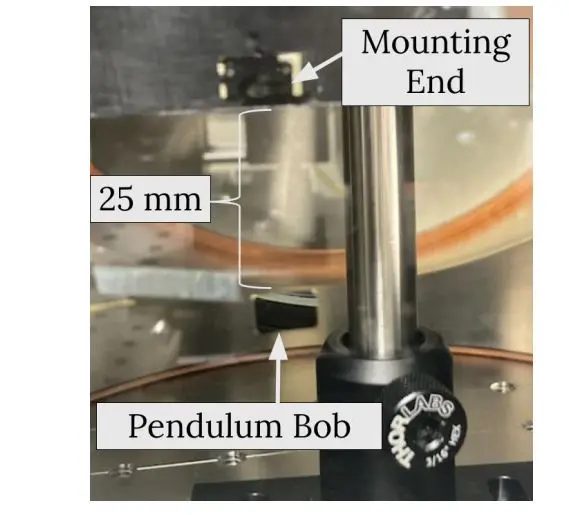
Torsion pendulums offer a unique opportunity to investigate subtle forces, potentially even revealing insights into gravity itself, and a team led by Thomas Bsaibes from the University of Maryland, College Park, and Charles Condos from the University of Arizona, now demonstrates a significant advance in their design and fabrication. Researchers, including Jack Manley and Jon Pratt from the National Institute of Standards and Technology, have created a silicon nitride torsion pendulum using lithographic techniques, offering a scalable approach to building these delicate instruments. This innovative method allows for the creation of extremely thin and elongated structures, crucial for minimising energy loss and achieving the ultra-sensitive measurements needed to detect weak forces. The resulting device, weighing just 37 milligrams, exhibits a remarkably low frequency of oscillation and a high quality factor, representing a foundational step towards building ultra-coherent pendulums capable of probing previously inaccessible phenomena, alongside Dalziel J. Wilson from the University of Arizona and Jacob Taylor from the University of Maryland, College Park.
Bayesian Optimization of High-Q Nanoresonators
Researchers are pushing the boundaries of precision measurement with the development of ultra-high quality factor (Q) torsional nanomechanical resonators. These tiny devices hold immense potential for improving sensors, exploring quantum phenomena, and even detecting gravitational waves. A central challenge lies in minimizing energy loss within the resonator, which limits how long it can sustain oscillations. The team addressed this by carefully selecting silicon nitride as the core material and employing a sophisticated optimization technique called Bayesian optimization to refine the resonator’s design.
Bayesian optimization efficiently explores a vast design space, identifying geometries that maximize the Q-factor, a measure of the resonator’s efficiency. This method is particularly valuable because physically fabricating and testing resonator designs is time-consuming. Through this process, they successfully fabricated resonators with Q-factors exceeding 10^6, a significant improvement over previous designs. The research identified key loss mechanisms, such as thermoelastic damping and surface dissipation, and demonstrated the importance of optimizing the resonator’s geometry to minimize energy loss. These advancements pave the way for more sensitive sensors, quantum technologies, and fundamental physics research.
Silicon Nitride Pendulums Achieve High Coherence
Scientists have achieved a significant breakthrough in the development of ultra-coherent torsion pendulums, devices with the potential to explore subtle gravitational effects and test fundamental physics. The team fabricated and released a centimeter-scale torsion pendulum using a novel silicon nitride ribbon suspension, demonstrating a foundational step towards highly sensitive gravitational experiments. This innovative fabrication process allows for extreme aspect ratios and multi-filar designs, overcoming challenges associated with traditional pendulum construction. The resulting pendulum exhibits a fundamental frequency of 162 mHz and an undiluted Q factor of 12000, demonstrating exceptional performance for a 37mg device.
These measurements confirm the viability of the silicon nitride suspension for creating ultra-low frequency, high-coherence pendulums. The team optically excited and cooled the pendulum using measurement-based feedback, further enhancing its sensitivity and stability. Calculations reveal that the ribbon suspension can readily support a torsion beam mass exceeding 5g, representing over a 100-fold increase in potential mass loading. This achievement opens new avenues for investigating weak forces, including tests of gravity at small scales and the search for interactions mediated by dark energy or axions.
Wafer-Scale Pendulums Beat Thermal Noise Limit
This work demonstrates a new approach to fabricating torsion pendulums using wafer-scale nanofabrication techniques, resulting in a monolithic silicon nitride device with a fundamental frequency of 162 mHz and an initial quality factor of 12000. The team successfully created a centimeter-scale pendulum with a low-frequency torsional mode, demonstrating control over damping through optical actuation and measurement-based feedback. Measurements confirm that the damping rate increases with applied feedback gain, and the pendulum can be cooled below the modeled thermal noise limit. The researchers highlight the scalability of their fabrication process, achieving near 100% yield, and the potential for increasing the quality factor through bifilar or high aspect ratio designs, as well as by increasing the pendulum’s mass. While the current prototype has a mass of only 37mg, the robust nature of the silicon nitride allows for significant mass loading, potentially exceeding 100times the current value. This technology will enable the exploration of gravitational phenomena at unprecedented levels of precision, potentially revealing new insights into the nature of gravity and the universe.
🗞 Lithographically Defined Si N Torsional Pendulum
🧠 ArXiv: https://arxiv.org/abs/2512.13435