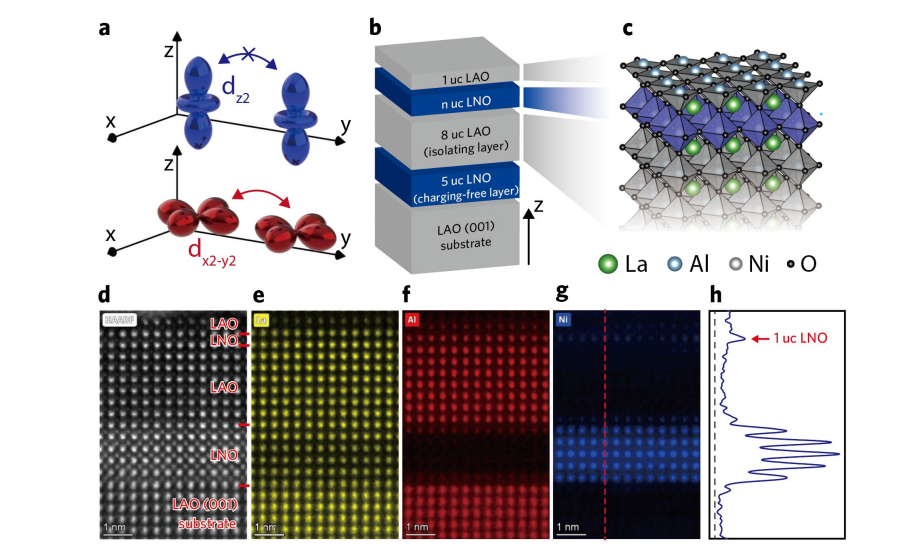
The interplay between reduced dimensionality and strong electron interactions dictates the behaviour of many materials, and recent research focuses on how these factors influence the electronic properties of nickelates. Byungmin Sohn, Minjae Kim, and Sangjae Lee, along with colleagues, investigate this phenomenon in layered nickel oxide, revealing a dramatic shift in how electrons behave as the material becomes increasingly thin. Their work demonstrates that, as layers of lanthanum nickelate are reduced to a single atomic layer, electrons in one particular orbital lose their ability to move freely much faster than others, indicating a stronger tendency towards electron localisation. This orbital-selective decoherence, confirmed by theoretical calculations, points to a fundamental change in the material’s electronic structure and provides crucial insight into the origins of complex properties like metal-to-insulator transitions and even superconductivity in these materials.
Twisted Graphene and Tungsten Diselenide Heterostructures
This research investigates a heterostructure crafted from twisted bilayer graphene and a single layer of tungsten diselenide to explore how dimensionality and electronic interactions affect electronic behaviour. The team fabricated high-quality heterostructures and characterized their electronic properties using low-temperature transport measurements and scanning tunnelling spectroscopy. Low-temperature transport measurements revealed insulating behaviour at specific twist angles, indicating strong electronic correlations. Scanning tunnelling spectroscopy directly observed spatially localized states associated with this correlated insulating phase, confirming its presence. This work demonstrates the ability to engineer correlated electronic states in van der Waals heterostructures through precise control of interlayer coupling and twist angle, revealing that the observed insulating behaviour arises from a combination of reduced dimensionality and enhanced electronic interactions, leading to a Mott-like insulating state.
Dimensional Confinement and Orbital-Selective Decoherence
Scientists investigated the electronic behaviour of lanthanum nickelate (LNO) layers, focusing on how reducing the material’s thickness impacts its electronic structure and correlations. Angle-resolved photoemission spectroscopy (ARPES) revealed a pronounced orbital-selective decoherence, where the spectral weight of the dz2 band diminished much faster than that of the dx2-y2 band as the LNO layer thickness decreased, suggesting a stronger correlation effect for the dz2 band under dimensional confinement. Complementary dynamical mean-field theory (DMFT) calculations on LNO layers confined within layers of lanthanum aluminate demonstrated a clear evolution of the electronic band structure. For a single-atomic-cell thick film, the calculations predicted the absence of spectral weight from the β bands, consistent with the ARPES data.
Further analysis using DMFT focused on the orbital-dependent spectral weight for each LNO thickness, showing that in the single-atomic-cell LNO, only the dx2-y2 orbital contributes to the band structure near the Fermi level, while the dz2 orbital opens a gap, forming a Mott gap with an energy scale of approximately 6 eV, alongside a Hund satellite peak at -0. 3 eV. This signifies the emergence of an orbital-selective Mott phase, driven by Hund’s coupling, and demonstrates a route to engineer electronic structure in strongly correlated systems.
Nickelate Superconductivity and Correlated Electron Physics
Research in strongly correlated electron systems, particularly nickelates, is advancing our understanding of materials exhibiting exotic electronic behaviour and aiming to design better superconductors. A key concept is orbital selectivity, where certain electron orbitals are more strongly correlated than others, potentially driving unconventional superconductivity. This research relies on advanced computational methods, including dynamical mean-field theory (DMFT), density functional theory (DFT), and quantum Monte Carlo (QMC), implemented using the TRIQS software toolbox. Recent discoveries of superconductivity in materials like La3Ni2O7 are driving this research, with a strong emphasis on achieving ambient-pressure superconductivity for practical applications.
Research focuses on layered nickelates and the importance of growing high-quality thin films for both experimental studies and potential device applications. The computational workflow typically involves DFT calculations to provide input for DMFT, followed by DMFT calculations to determine the correlated electronic structure. Key theoretical concepts explored include orbital selectivity, the Mott insulator state, Hund’s rule, Van Hove singularities, and non-Fermi liquid behaviour. This collection of information points to an active area of research, aiming to understand the fundamental physics of strongly correlated electron systems and design new materials with enhanced properties, particularly high-temperature superconductors.
Orbital Selectivity and Dimensionality in Nickelates
This research demonstrates a dimensionality-controlled orbital selective Mott phase (OSMP) in ultrathin layers of the nickelate material LaNiO3. By reducing the material’s thickness to a single atomic layer, scientists observed that the electronic behaviour of the dz2 orbital changes dramatically, becoming strongly correlated and localized, contrasting with the more conductive dx2-y2 orbital. The team confirmed these findings using angle-resolved photoemission spectroscopy (ARPES) and corroborated them with theoretical calculations employing dynamical mean-field theory (DMFT). These calculations revealed that the dimensional confinement induces a Mott gap in the dz2 orbital, resulting in a single-band Fermi surface dominated by the dx2-y2 orbital. This discovery establishes a new way to control the electronic properties of nickelates by tuning their thickness, offering a potential pathway to investigate phenomena like metal-to-insulator transitions and superconductivity, and suggests a close link between orbital selectivity and the emergence of superconductivity.
🗞 Layer controlled orbital selective Mott transition in monolayer nickelate
🧠 ArXiv: https://arxiv.org/abs/2509.19075