Colloidal nanocrystals possess exceptional potential as light-amplifying materials, offering strong absorption and tunable emission, but incorporating them into practical laser systems proves difficult due to the need for high concentrations. Veronika Adolfs, Dominik Rudolph, Simon Spelthann, and colleagues at Leibniz University Hannover and the Leibniz Institute of Photonic Technology overcome this limitation by integrating cadmium selenide/cadmium sulfide nanoplatelets within liquid-core optical fibres. This innovative platform achieves amplified spontaneous emission at a remarkably low threshold, requiring a concentration two orders of magnitude lower than previously thought possible for colloidal nanocrystals. The research demonstrates that the efficient light guidance provided by the fibre is critical for stimulating emission, establishing liquid-core fibres as a promising foundation for developing nanocrystal-based lasers.
Colloidal Quantum Well Lasers in Fibers
This body of work focuses on developing and exploring colloidal quantum well (CQW) lasers, particularly for integration into optical fiber systems. The research investigates the potential of CQWs as gain media within optical fibers, aiming to create novel laser sources and photonic devices. This interdisciplinary field combines materials science and optics, with a strong emphasis on controlling CQW properties for optimal performance. Scientists are meticulously controlling CQW shape, size, and composition to enhance their optical properties, including emission wavelength, quantum yield, and stability.
Understanding the role of excitons and biexcitons, and managing biexciton dynamics, is crucial for maximizing laser efficiency. Researchers are also deeply investigating the detailed optical properties of CQWs, such as refractive index, absorption, and emission spectra, to design efficient laser systems. A key goal is achieving low-threshold stimulated emission in CQWs, essential for practical laser applications. This involves optimizing material properties and understanding the underlying gain mechanisms. Controlling biexcitons and minimizing Auger recombination are critical aspects of this work.
Researchers are also exploring the use of optical fibers as a platform for CQW-based lasers, investigating different fiber types and their potential for waveguiding and light confinement. Several studies specifically focus on liquid-core optical fibers, which offer a unique way to incorporate CQWs into a fiber-based laser system. The liquid core allows for easy dispersion of the CQWs and potentially dynamic control of the laser properties. Scientists are also investigating nonlinear optical phenomena within these liquid-core fibers, potentially expanding applications beyond simple lasing. Understanding and controlling the refractive index of both the CQWs and the surrounding medium is vital for efficient light coupling and waveguiding.
Based on this research, scientists aim to develop high-performance CQW lasers with low thresholds and high efficiencies. They are integrating these lasers into optical fiber systems for applications such as tunable lasers, compact laser sources, fiber-based sensors, and nonlinear optical devices. Furthermore, researchers are exploring the use of liquid-core fibers as a versatile platform for CQW-based photonics, seeking to understand and control the optical properties of CQWs within fiber environments.
Nanoplatelet Gain in Liquid-Core Fibers
Scientists have developed a new platform for optical gain by integrating colloidally dispersed core/crown CdSe/CdS 2D nanoplatelets within liquid-core optical fibers. This addresses the challenge of achieving sufficient amplification with low nanocrystal concentrations. The study pioneered a method to overcome solubility limitations by utilizing the waveguiding properties of optical fibers, enabling effective gain at concentrations two orders of magnitude lower than previously required. Researchers fabricated liquid-core fibers and introduced NPL dispersions via capillary action under ambient conditions, avoiding high-temperature doping processes.
The team engineered a system where the low-loss waveguiding of the fiber efficiently confined and amplified the NPL emission, creating a scalable platform for optical integration. Experiments employed quasi-CW pumping to induce stimulated emission, achieving a remarkably low threshold of 1. 8kW/cm2. A numerical spectral decomposition analyzed the emission characteristics, revealing that optical gain primarily developed from red-shifted biexcitons, providing insight into the gain mechanism within the NPLs. This approach leverages the technological maturity and chemical robustness of fused silica fibers, traditionally used in data communication and lanthanide-doped lasers, while circumventing the limitations of solid-state doping. By integrating NPLs into liquid-core fibers, scientists demonstrated a scalable, chemically inert, and environmentally robust platform for photonic integration, opening a path towards extending the spectral range of fiber lasers into the visible wavelengths and enabling new applications in optical technologies. The method achieves gain with significantly reduced nanocrystal concentrations, addressing a key obstacle to broader deployment of NPLs as a gain medium.
Low Threshold Lasing in Liquid Core Fibers
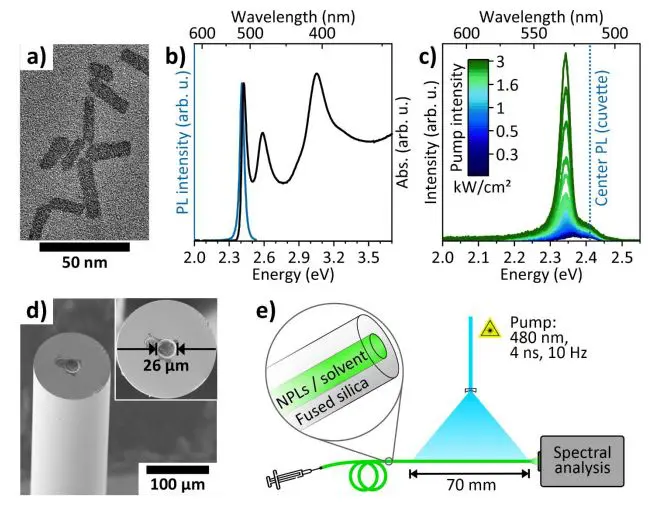
Scientists achieved amplified spontaneous emission (ASE) using colloidal core/crown CdSe/CdS 2D nanoplatelets integrated within liquid-core optical fibers, demonstrating a breakthrough in nanocrystal-based lasing. Experiments revealed sufficiently effective gain at a remarkably low threshold of 1. 8kW/cm2 under quasi-continuous wave pumping, a value significantly lower than previously reported for dispersed nanocrystals. This achievement was attained even with nanoplatelet concentrations two orders of magnitude lower than those considered necessary for gain in conventional colloidal systems. The research team dissolved the nanoplatelets, measuring 27 × 9 nm2 on average, in tetrachloroethylene, a liquid with a high refractive index that facilitates waveguiding within the fiber core.
Measurements of the nanoplatelet emission from within the 26μm core fiber revealed a pronounced red-shifted emission, indicating the formation of biexcitons and the potential for ASE. The team employed a 7cm section of liquid-core fiber, transversally pumped with pulses providing an energy density of up to 21 μJ/cm2, corresponding to a peak intensity of 5. 4kW/cm2. Detailed spectral decomposition of the emitted light at a pump intensity of 1. 8kW/cm2 confirmed the onset of ASE, separating the emission into excitonic and biexcitonic components.
The data shows a significant steepening of the biexcitonic slope above the 1. 8kW/cm2 threshold, indicating stimulated emission. This threshold corresponds to an energy density of 7. 2 μJ/cm2, substantially lower than previous results of 1 mJ/cm2 for quantum dots and 30-44 μJ/cm2 for other NPLs. Analysis of the center energies of the excitonic and biexcitonic components revealed a red shift of the ASE gain, with the biexcitonic emission stabilizing at 2. 34 eV (~530nm) above the threshold, maintaining a separation of ~65 meV from the excitonic emission. This red shift is understood by considering the underlying physics of gain in nanoplatelets, where the ASE emerges on the red tail of the spontaneous biexcitonic emission.
Low Threshold Lasing in Liquid Fibers
This research demonstrates a scalable platform for integrating colloidally dispersed nanocrystals into photonic systems, overcoming a significant limitation in the field of nanolasing. Scientists successfully integrated core/crown CdSe/CdS 2D nanoplatelets within liquid-core optical fibers, achieving amplified spontaneous emission at a remarkably low threshold of 1. 8kW/cm2. This represents a substantial improvement, as previous approaches required nanocrystal concentrations two orders of magnitude higher to achieve comparable gain. The key to this advancement lies in the low-loss optical waveguiding of the liquid-core fiber, which efficiently confines and amplifies the NPL emission. Experiments employing.
🗞 Stimulated Emission from 2D CdSe/CdS Nanoplatelets Integrated in a Liquid-Core Fiber
🧠 ArXiv: https://arxiv.org/abs/2511.14194