

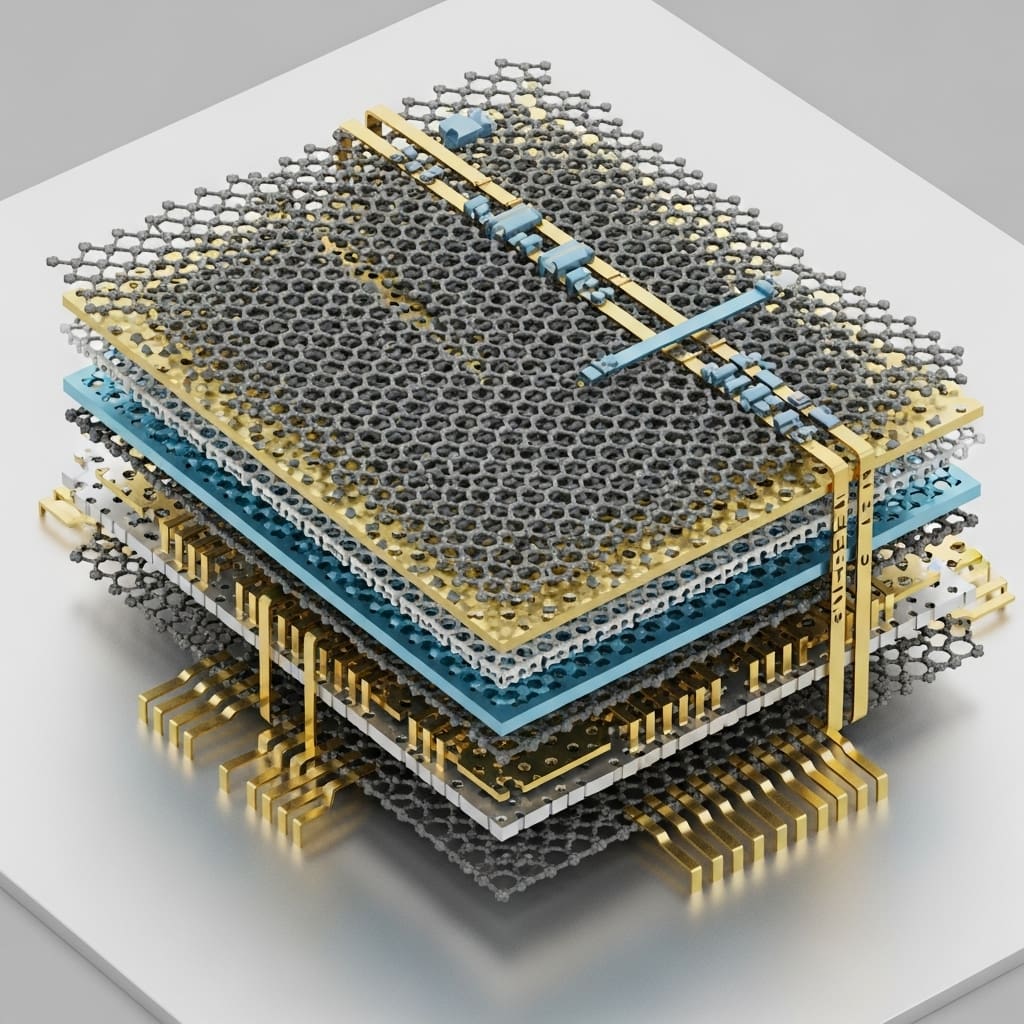
Defects in hexagonal boron nitride represent a significant hurdle, and a potential opportunity, for realising advanced quantum technologies. Marek Maciaszek from Warsaw University of Technology and Center for Physical Sciences and Technology, along with Bartłomiej Baur from Warsaw University of Technology, and colleagues, now demonstrate that specific defect complexes, involving carbon, boron vacancies, and hydrogen, are remarkably stable and likely prevalent in hBN grown using metal-organic vapor-phase epitaxy. Their calculations reveal that these CBVB-nH complexes form readily under typical growth conditions, driven by strong electrostatic interactions between carbon and boron-vacancy defects. This research explains the origin of observed emission peaks in hBN samples, providing crucial insight into the optical properties of these defects and paving the way for controlled creation of light-emitting quantum systems.
HBN Defects, Formation Energies and Luminescence
This research provides a detailed theoretical understanding of defects within hexagonal boron nitride (hBN), a material with promising applications in optoelectronics and quantum technologies. Scientists investigated the formation energies and stability of various point defects, including boron and nitrogen vacancies, hydrogen passivation of these vacancies, and complexes involving carbon and boron vacancies. The goal was to understand how these defects influence the optical properties of hBN, specifically its ability to emit light. The team employed sophisticated computational methods, using density functional theory to calculate the energies and structures of defects.
They utilized hybrid functionals to improve the accuracy of their calculations, particularly for determining the material’s band gap and defect energies. This approach allowed scientists to accurately predict the stability of different defects under various conditions. Results demonstrate that the formation energies of defects are strongly influenced by the surrounding environment, specifically whether the hBN is grown with excess nitrogen or boron. Hydrogen atoms readily bond with vacancies, stabilizing them and reducing their reactivity. Notably, the carbon-boron vacancy (CBVB) emerges as a particularly promising defect for generating single photons of light, with a proposed mechanism involving hole capture and radiative recombination.
Calculations of the expected luminescence lineshape closely match experimental observations. Further investigation revealed that complexes of CBVB with hydrogen atoms (CBVB-nH) are also stable. These findings provide valuable insights for designing and optimizing hBN-based optoelectronic devices, paving the way for improved performance and functionality.
Carbon-Boron Vacancy Complex Stability Investigated
Scientists have achieved a detailed understanding of defect complexes within hexagonal boron nitride (hBN), focusing on those involving carbon, boron vacancies, and hydrogen. Using advanced computational techniques, they investigated the thermodynamic stability of these complexes, revealing that carbon-boron-vacancy-hydrogen complexes (CBVB-nH) readily form under conditions rich in nitrogen, carbon, and hydrogen. This stability arises from strong electrostatic attraction between positively charged carbon defects and negatively charged, hydrogen-passivated boron vacancies. To model defect behavior, the team first calculated the formation energies of simpler defects, such as boron vacancies, hydrogen-passivated boron vacancies, carbon substitutions, and hydrogen interstitials.
These calculations revealed that these defects are more stable under nitrogen-rich conditions, guiding the subsequent analysis of more complex structures. They determined the charge-state transition levels for boron vacancies, and observed that certain charge states cause surrounding atoms to shift position, consistent with previous theoretical studies. The research demonstrates that hydrogen passivation significantly reduces the formation energy of boron vacancies, with more hydrogen atoms leading to greater stability. This trend is attributed to the formation of nitrogen-hydrogen bonds, which alter the geometry and energy of the defect. By connecting these theoretical predictions with experimental observations, scientists can better understand and control the properties of hBN.
Carbon-Boron Vacancy Complex Stability and Properties
This research provides a comprehensive understanding of defects within hexagonal boron nitride (hBN), a material with potential for advanced technologies. Scientists focused on complexes formed by carbon atoms substituting boron sites and hydrogen-passivated boron vacancies, revealing their thermodynamic stability and optical properties. Calculations demonstrate that the formation of CBVB-nH complexes, with up to three hydrogen atoms, is energetically favorable under conditions rich in nitrogen, carbon, and hydrogen. These complexes exhibit low formation energies due to strong electrostatic attraction between positively charged carbon defects and negatively charged hydrogen-passivated boron vacancies.
The high binding energies suggest these complexes readily form even during material growth processes, such as metal-organic vapor-phase epitaxy. The team found that the formation energy of the neutral VB-H complex decreases with increasing hydrogen content, attributed to the formation of nitrogen-hydrogen bonds. Analysis of optical properties reveals that observed emission peaks in hBN samples originate from hole capture by CBVB-H and CBVB complexes. Calculated emission energies and linewidths show excellent agreement with experimental data, providing strong evidence for the role of these defects in the material’s optical behavior. The team proposes that a combination of dehydrogenation and boron-vacancy diffusion explains changes in luminescence intensity after annealing in a nitrogen atmosphere.
CBVB Complexes Match Photoluminescence Experimentally
This research demonstrates that carbon-boron-vacancy-hydrogen complexes (CBVB-nH) are energetically favorable defects within hexagonal boron nitride (hBN), particularly when grown using metal-organic vapor-phase epitaxy. Calculations reveal strong electrostatic attraction between carbon substitutional defects and hydrogen-passivated boron vacancies, resulting in low formation energies and high binding energies for these complexes. This suggests these defects readily form during the growth process where carbon, hydrogen, and boron vacancies coexist. Importantly, the calculated optical properties of CBVB and CBVB-H complexes closely match experimental photoluminescence measurements, including emission energies and linewidths.
The research identifies these complexes as key contributors to visible-range emission in hBN, providing a fundamental understanding of the material’s optical behavior. The team also investigated the impact of annealing on defect formation, finding that both dehydrogenation and boron-vacancy diffusion contribute to changes in luminescence intensity. Future work could focus on methods to control the concentration of boron vacancies during growth to enhance the formation of these desirable defects. This research establishes a strong foundation for further exploration of hBN’s potential in optoelectronic applications, offering insights into defect engineering for improved material performance.
👉 More information
🗞 CBVB-nH complexes as prevalent defects in metal-organic vapor-phase epitaxy-grown hexagonal boron nitride
🧠 ArXiv: https://arxiv.org/abs/2510.14012


