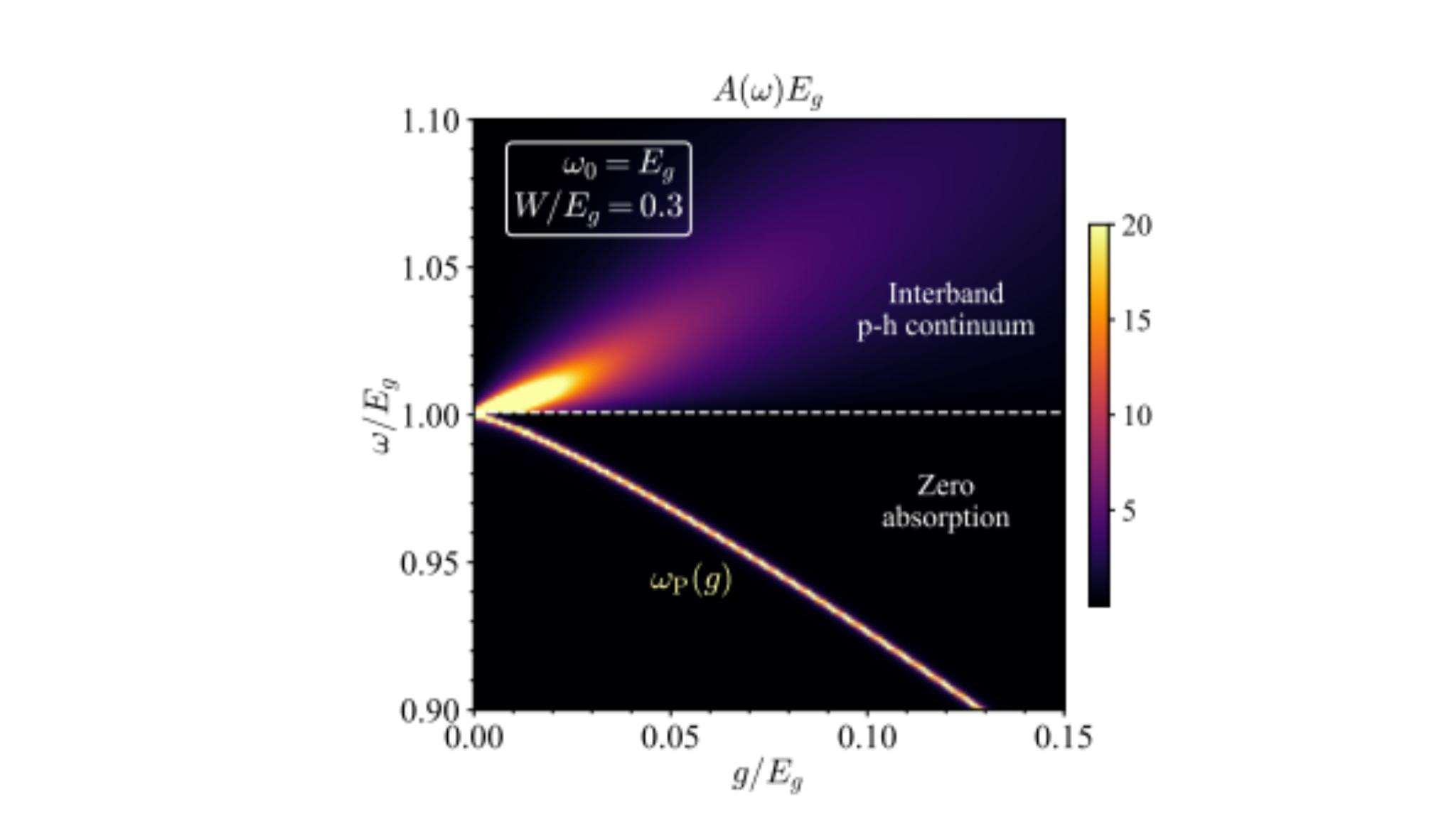
The creation of hybrid light-matter states called polaritons holds promise for advances in nonlinear optics, but achieving strong interactions between light and matter at low energies remains a significant challenge. Igor Gianardi, Michele Pini, and Francesco Piazza, from the Max Planck Institute for the Physics of Complex Systems and the University of Augsburg, investigate a method to enhance polariton formation by exploiting high-order Van Hove singularities within the electronic structure of materials. Their work demonstrates that carefully engineering the momentum dispersion of electronic bands around the energy gap strengthens the interaction with cavity photons, even when absorption is suppressed. This approach, particularly suited to implementation with ultracold atoms in optical lattices, offers a new pathway for controlling polariton properties and opens exciting possibilities for manipulating light-matter interactions at the quantum level.
Typically, achieving strong light-matter interaction requires materials that readily absorb light at specific frequencies. However, absorption often hinders the creation of stable polaritons. To overcome this limitation, scientists propose engineering a non-parabolic momentum dispersion within the material’s bands, creating a high-order Van Hove singularity in the joint density of states. Ultracold atoms trapped in tunable optical lattices provide an ideal platform for creating two-dimensional insulating phases with precisely controlled band dispersions, offering a clean system free from unwanted interactions.
Exciton-Polariton Formation and Strong Coupling Regimes
This research comprehensively explores exciton-polaritons, quasiparticles arising from the strong coupling of excitons and photons, and their behavior within solid-state materials. The study details how this strong coupling creates new hybrid states, the polaritons, with unique properties. The work focuses on understanding these phenomena in various materials, including semiconductors, two-dimensional materials like graphene, and layered heterostructures. A key aspect of the research is the investigation of many-body interactions, such as exciton-exciton interactions and electron-phonon interactions, which significantly influence polariton behavior.
The team also explores the possibility of creating quantum fluids of light using polaritons, where these quasiparticles behave collectively as a macroscopic quantum system, and investigates potential applications in areas like polariton lasers and enhanced light-matter interactions. The research begins by establishing the fundamental principles of excitons and photons and how they interact. Strong coupling between these particles requires a significant interaction strength and a sufficient number of excitons, leading to the formation of polaritons characterized by a distinct dispersion relation with upper and lower branches. The effective mass of these polaritons, which determines their mobility, is also analyzed.
The study then delves into the complex interplay of many-body effects, including exciton-exciton interactions that can lead to polariton condensates, and electron-phonon interactions that affect polariton energy and linewidth, potentially renormalizing their properties. The research further explores the possibility of achieving polariton condensation, analogous to Bose-Einstein condensation, and the potential for superfluidity within these condensates, also investigating the emergence of quantum turbulence in these systems. The study extends to examining polaritons in two-dimensional semiconductors and heterostructures, highlighting the ability to tune their properties in these materials. Finally, the research explores potential applications of polaritons, including low-threshold polariton lasers, enhanced light-matter interactions for sensing and spectroscopy, and novel optoelectronic devices.
The team utilizes advanced theoretical methods, such as Green’s functions and density functional theory, to calculate polariton properties and understand their behavior. This work provides a comprehensive overview of the field of exciton-polaritons, combining strong theoretical foundations with an exploration of many-body effects and novel materials. The emphasis on understanding the complex interactions governing polariton behavior and the potential for technological applications make this research a significant contribution to the field. Future research directions include a more detailed understanding of polariton transport, the role of polariton-polariton interactions, the development of practical polariton devices, and the exploration of high-temperature and topological polaritons.
Engineered Band Structure Enhances Light-Matter Interaction
This research demonstrates a novel approach to enhancing light-matter interaction by carefully engineering the electronic band structure of insulating materials. Scientists have shown that creating specific, high-order Van Hove singularities within these bands significantly strengthens the hybridization with cavity photons, leading to the formation of polaritons. This method allows for a substantial energy shift in these polaritons without the undesirable effect of light absorption, a common limitation in other systems. The team successfully identified that manipulating the momentum dispersion of electronic bands around the insulating gap is crucial for achieving this enhanced hybridization.
Utilizing ultracold atoms in tunable optical lattices, they created a clean and controllable platform free from the impurities and unwanted excitations often found in solid-state materials. This precise control enabled them to observe strong coupling between light and matter, offering an alternative to strategies that rely on reducing material dimensionality. The authors acknowledge that a detailed investigation into solid-state implementations of this mechanism is a logical next step, particularly given recent advances in understanding high-order Van Hove singularities in layered materials. They also highlight the potential for suppressing unwanted excitonic effects in these materials through careful control of the surrounding environment. Importantly, these polaritons exhibit an intrinsically nonlinear response, stemming from the fundamental interaction between particle-hole excitations and photons, which promises exciting possibilities for future research in quantum nonlinear optics.
🗞 Formation of Cavity-Polaritons via High-Order Van Hove Singularities
🧠 ArXiv: https://arxiv.org/abs/2509.15849