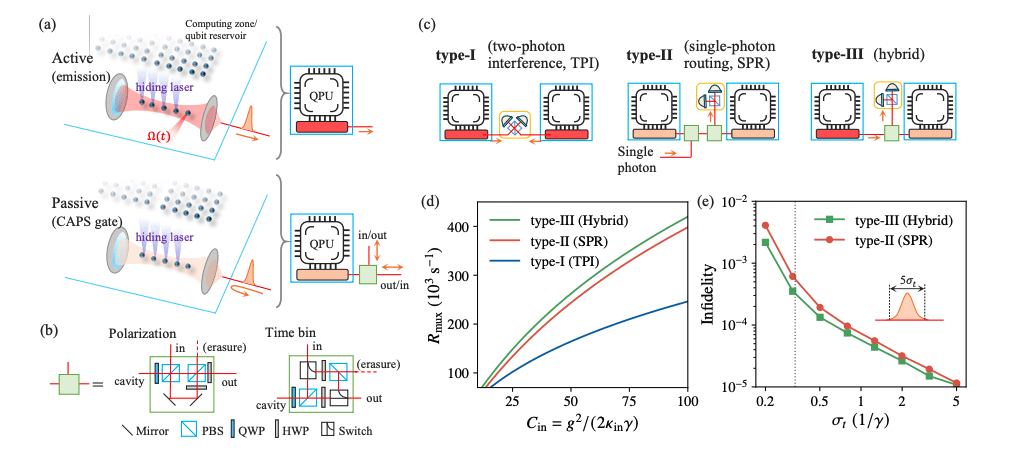
The development of scalable quantum technologies necessitates efficient and reliable methods for interconnecting quantum processors, a challenge currently limited by fidelity and operational speed. Researchers are exploring alternatives to traditional active protocols, which rely on photon emission and interference, focusing instead on passive approaches that offer inherent robustness. Seigo Kikura, Kazufumi Tanji, and colleagues, in a study detailed in their article, ‘Passive Quantum Interconnects: High-Fidelity Quantum Networking at Higher Rates and Less Overhead’, demonstrate a significant advancement in cavity-assisted photon scattering (CAPS), a passive protocol. Their work, conducted in collaboration between Nanofiber Quantum Technologies, Inc. (NanoQT) and the Clarendon Laboratory at the University of Oxford, establishes that existing and near-future cavity technology is sufficient to achieve high fidelity (0.999) and increased data transmission rates, potentially establishing CAPS as a leading protocol for scaling quantum information platforms.
The development of scalable quantum technologies necessitates efficient and reliable methods for interconnecting quantum systems, and researchers currently focus on cavity-assisted photon scattering (CAPS) as a promising approach. CAPS utilises the interaction between atoms and photons within an optical cavity to mediate entanglement, a crucial resource for quantum communication and computation. This research addresses limitations previously hindering the widespread adoption of CAPS, demonstrating that current and near-future cavity qualities are sufficient to achieve a fidelity of 0.999 with short pulses necessary for high-rate networking. Fidelity, in this context, refers to the accuracy with which a quantum state is transferred or processed.
Researchers actively address challenges associated with existing CAPS protocols and analytical frameworks through detailed analysis of atom-cavity dynamics and protocol improvements. This allows for efficient time-multiplexed operation with suppressed crosstalk, enabling high-rate entanglement generation. Crosstalk, a significant impediment in quantum networks, arises when quantum information leaks between different communication channels, corrupting the intended signal. By minimising this interference, the protocol maintains the integrity of quantum information.
To further enhance the practicality of the CAPS protocol, scientists propose a hybrid network configuration that strategically combines the strengths of both photon emission and CAPS gates. Traditional quantum networks often rely on external photon sources to initiate entanglement. This innovative approach eliminates the need for these external sources, simplifying the system and reducing costs while maintaining high performance and robustness.
As a concrete example, researchers estimate the performance of a network utilising 200 Yb atoms coupled to a cavity with an internal cooperativity of 100, predicting an atom-atom entanglement generation rate achieving a fidelity of 0.999. Cooperativity, a key parameter in cavity quantum electrodynamics, describes the strength of the interaction between atoms and the cavity field. Calculations also suggest that this rate can be further increased by utilising multiple wavelength channels, allowing for parallel entanglement generation and boosting network capacity.
This research establishes a cavity-assisted photon scattering (CAPS) based network protocol as a strong contender for scaling information platforms by overcoming limitations previously hindering its adoption. Scientists address low fidelity and slow networking rates by implementing protocol improvements and conducting a detailed analysis of atom-cavity dynamics.
👉 More information
🗞 Passive Quantum Interconnects: High-Fidelity Quantum Networking at Higher Rates and Less Overhead
🧠 DOI: https://doi.org/10.48550/arXiv.2507.01229