The pursuit of increasingly precise measurement underpins advances across diverse fields, from gravitational wave detection to fundamental tests of quantum mechanics. A key limitation to this precision is thermal noise, a consequence of atomic motion inherent in all materials. Researchers are continually developing techniques to characterise and mitigate this noise, pushing the boundaries of what is measurable. Ronald Pagano and Scott Aronson, alongside Torrey Cullen, Garrett D. Cole, and Thomas Corbitt, detail a method for measuring thermal noise in a cavity system, independent of the inherent noise floor, in their article, ‘Thermal Noise Measurement Below the Standard Quantum Limit’. Their work, conducted at Louisiana State University and the California Institute of Technology, demonstrates a measurement of thermal noise falling 5 dB below the standard quantum limit (SQL), a benchmark representing the theoretical minimum noise achievable in a measurement, and further reveals noise suppression of up to 10 dB resulting from a spring effect within the system. The SQL represents a fundamental limit imposed by the Heisenberg uncertainty principle, dictating a trade-off between the precision of conjugate variables, such as position and momentum.
The pursuit of enhanced gravitational wave detection continually drives innovation in noise reduction techniques, addressing both quantum and classical sources of interference. Current detectors, such as those operated by the LIGO, Virgo, and KAGRA collaborations, consistently report detections of gravitational waves originating from binary black hole mergers and neutron star events, validating predictions of general relativity and providing crucial insights into extreme astrophysical phenomena. This demand for increasingly sensitive detectors necessitates ongoing refinement of existing technologies and exploration of novel approaches to noise mitigation.
Research demonstrably focuses on enhancing detector sensitivity through meticulous noise reduction, encompassing both quantum and classical sources. Quantum noise, an inherent limitation arising from the wave-like nature of light, is addressed through techniques like squeezed light, which redistributes this noise to improve signal detection. Simultaneously, classical noise sources, notably thermal noise – the random motion of atoms due to heat – are targeted through advancements in materials science and coating technologies used in detector mirrors. Investigations into acoustic noise and its mitigation also contribute to overall detector performance, demonstrating a holistic approach.
Recent studies present methods for characterizing thermal noise in micro-resonators independent of the noise floor, enabling precise measurements even at cryogenic temperatures. This methodology successfully measures thermal noise falling to a maximum of 5 decibels (dB) below the standard quantum limit (SQL), confirming the efficacy of the technique and establishing a new benchmark for sensitivity. The SQL represents a fundamental limit on the precision of measurements imposed by quantum mechanics; surpassing this limit, even temporarily, demonstrates the effectiveness of noise reduction strategies. This achievement builds upon prior work demonstrating a displacement sensitivity of 2.8 dB below the SQL using a similar setup.
The core of this work lies in the investigation of noise suppression resulting from the spring effect implemented within the Fabry-Perot cavity, a key component of gravitational wave detectors. Researchers reveal a maximum noise reduction of 10 dB below the SQL, indicating a substantial improvement in sensitivity facilitated by this design. This suppression is directly linked to the spring’s ability to modify the thermal noise profile within the cavity, effectively reducing the influence of disruptive thermal fluctuations and enhancing the signal-to-noise ratio. The Fabry-Perot cavity amplifies the signal by allowing light to bounce back and forth multiple times, but also amplifies noise; careful design is therefore crucial.
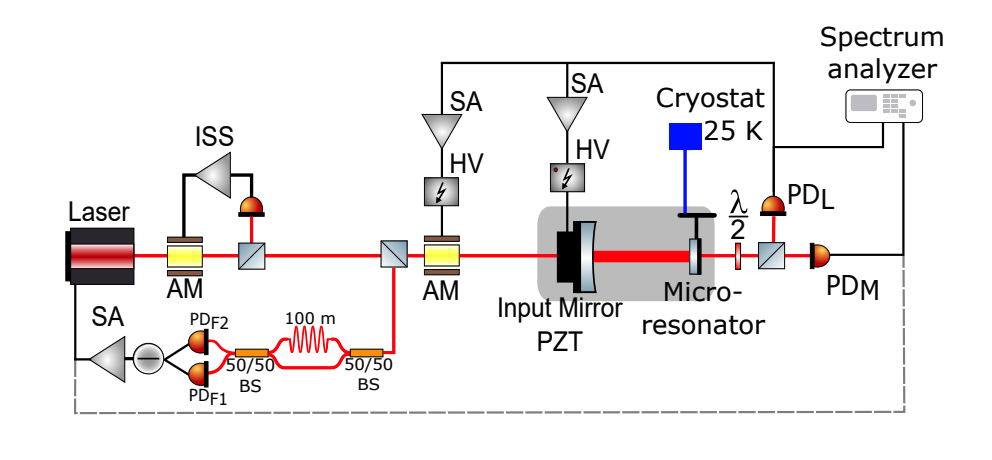
These findings are supported by a robust experimental setup utilizing a gallium arsenide (GaAs) / aluminium gallium arsenide (AlGaAs) micro-mirror suspended on a GaAs cantilever micro-resonator, cooled to approximately 25 Kelvin. Cryogenic cooling minimizes thermal noise, creating an optimal environment for sensitive measurements. The combination of cryogenic cooling and the spring-based noise suppression mechanism allows for precise measurements of thermal noise at levels previously unattainable, pushing the boundaries of precision measurement.
Advanced signal processing techniques and the application of optical clocks further enhance the ability to extract weak gravitational wave signals from noisy data. Scientists employ sophisticated algorithms to filter out unwanted noise and isolate the faint signals of gravitational waves, improving the accuracy and reliability of detections. The integration of optical clocks provides a highly stable time reference, enabling precise measurements of the arrival times of gravitational waves and facilitating the localization of their sources.
👉 More information
🗞 Thermal Noise Measurement Below the Standard Quantum Limit
🧠 DOI: https://doi.org/10.48550/arXiv.2507.02196