

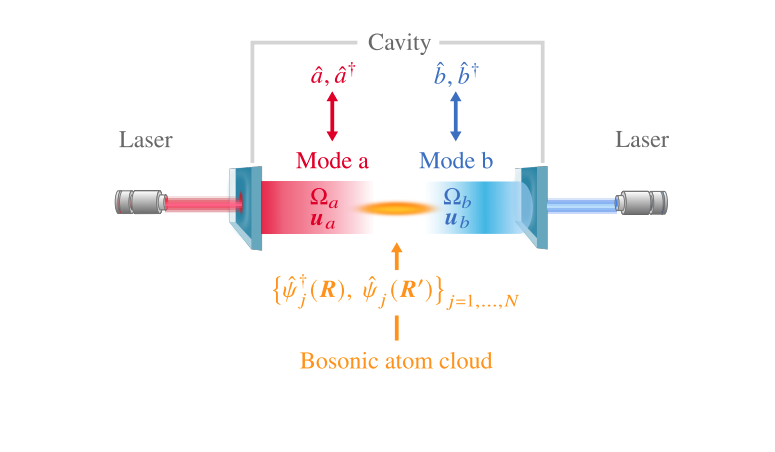
The manipulation of light and matter at the quantum level underpins numerous emerging technologies, from precision sensing to advanced atom optics. Achieving precise control necessitates a thorough theoretical understanding of complex interactions, particularly when dealing with multiple atoms and intricate electromagnetic fields. Sabrina Hartmann, Nikolija Momčilović, and Alexander Friedrich, alongside their colleagues, address this challenge in their recent work, ‘Multi-Photon Quantum Rabi Models with Center-of-Mass Motion’. They present a rigorously developed, second-quantized framework which describes the behaviour of multiple atoms within a cavity, accounting for both their internal structure and their collective motion, alongside interaction with a two-mode electromagnetic field. This approach yields a compact Hamiltonian, incorporating previously neglected effects and revealing a particle-particle interaction mediated by ancillary states, with implications for phenomena such as atomic Raman diffraction and the observation of the atomic and optical Hong-Ou-Mandel effect.
Light-Matter Interactions: Advancing Precision Measurement and Quantum Technologies
The study of light-matter interaction originates with foundational work in quantum mechanics, notably Dirac’s 1927 model and subsequent refinements by Fermi in 1932, which initially described how atoms absorb and emit light, accounting for the Doppler effect. These early investigations established the basis for modern quantum and matter-wave optics, focusing on the interaction between electromagnetic fields and atomic systems. A common conceptualisation involves a two-level atom interacting with a circularly polarised electromagnetic field, forming the basis for more complex models.
The ‘Rabi model’ represents a significant development, extending beyond the initial two-level atom to encompass analogous systems and offering a versatile tool for investigating light-matter interactions. Variations of the Rabi model now describe interactions with quantum harmonic oscillators or multiple qubits, demonstrating its adaptability to diverse physical scenarios. Researchers have extensively studied both semiclassical and fully quantized versions of the Rabi model, continually expanding its scope and applicability. A crucial simplification within these models is the Rotating Wave Approximation (RWA), which divides the Hamiltonian—the operator describing the total energy of the system—into fast and slow rotating components, enabling more tractable calculations. The RWA eliminates the fast-rotating terms under the assumption of weak coupling and near-resonance, yielding the Jaynes-Cummings model, a widely used approximation in quantum optics. However, this simplification can sometimes omit important physical effects, motivating the need for more complete descriptions.
Recent work details a sophisticated theoretical framework for modelling multi-atom dynamics within an optical cavity, relying on a precise understanding and control of light-matter interactions. Researchers are employing a second-quantized approach, originating in quantum field theory, to describe the collective behaviour of atoms interacting with a two-mode electromagnetic field, offering a more accurate depiction of many-body effects crucial for high-precision sensing. This technique considers atoms as excitations within a quantum field, allowing for a more accurate depiction of many-body effects. A key innovation lies in the systematic application of Hamiltonian averaging theory to the atomic field operators, effectively simplifying the complex equations governing the system’s evolution without sacrificing physical accuracy and providing a computationally efficient method for simulating the dynamics of many-atom systems. This averaging process yields a compact, effective Hamiltonian that incorporates subtle effects often neglected in simpler models, such as the AC-Stark and Bloch-Siegert shifts, which arise from the interaction of atoms with the light field.
By retaining these counter-rotating terms, the model captures a richer range of physical phenomena, particularly important when dealing with strong light-matter coupling or complex atomic structures. A significant finding is the prediction of a particle-particle interaction mediated by ancillary states, a consequence of the combined nature of the coupled electromagnetic field and atomic system, and opens up possibilities for manipulating and controlling atomic ensembles. This interaction, where atoms effectively ‘talk’ to each other through the light field, potentially enhances the sensitivity of quantum sensors. Researchers validated this model through an analysis of atomic Raman diffraction, determining the time evolution of a typical initial state, revealing Rabi oscillations, a characteristic signature of coherent interactions between atoms and light. Furthermore, their results confirm the prediction that both the atomic and optical Hong-Ou-Mandel effect can be observed within this Raman configuration, utilising a specific two-particle input state, and extends the utility of Raman diffraction beyond simple interference phenomena. The Hong-Ou-Mandel effect, originally demonstrated with photons, is a quantum mechanical phenomenon where indistinguishable particles exhibit a surprising correlation in their arrival times.
Atom interferometry actively advances precision measurement techniques, leveraging the wave-like properties of atoms to detect subtle changes in gravitational and inertial fields, and enabling the development of highly sensitive sensors for a wide range of applications. Researchers employ sophisticated control of light-matter interactions, often utilising multi-mode electromagnetic fields and complex atomic structures to facilitate cooling and entanglement – essential for high-precision sensing and improving the performance of atom interferometers. This recent theoretical development presents a rigorous, second-quantized framework for modelling the behaviour of multiple atoms within an optical cavity, comprehensively accounting for both their collective motion and interaction with a two-mode electromagnetic field.
The framework systematically applies Hamiltonian averaging theory to the atomic field operators, yielding a compact and physically intuitive effective Hamiltonian that governs the system’s temporal evolution, and simplifying the complex equations governing the system’s behaviour. The resulting Hamiltonian incorporates established effects like AC-Stark and Bloch-Siegert shifts, alongside contributions from all ancillary states involved, and crucially, retains counter-rotating terms often neglected in simplified rotating wave approximation (RWA) models, expanding the range of physical scenarios that can be accurately modelled. This comprehensive approach provides a more accurate description of the system’s dynamics than conventional methods and enables the development of more sensitive sensors. The emergence of a particle-particle interaction mediated by these ancillary states, directly arising from the coupling between the electromagnetic field and the atomic system, opens up possibilities for manipulating atomic ensembles. Researchers validate this model through an analysis of atomic Raman diffraction, accurately predicting the time evolution of a typical initial state and observing the resulting Rabi oscillations, confirming the theoretical predictions. The model successfully predicts the observation of both atomic and optical Hong-Ou-Mandel effects within this Raman configuration, utilising a specific two-particle input state, extending the utility of Raman diffraction beyond simple interference phenomena.
These results extend the utility of Raman diffraction beyond simple interference phenomena, providing a microscopic model for understanding the Hong-Ou-Mandel effect and offering a pathway towards more sensitive and precise quantum sensors, enabling the development of new quantum technologies. The framework’s ability to accurately describe complex interactions between atoms and light represents a significant step forward in the development of advanced atom optics and quantum technologies, paving the way for new discoveries in fundamental physics.
👉 More information
🗞 Multi-Photon Quantum Rabi Models with Center-of-Mass Motion
🧠 DOI: https://doi.org/10.48550/arXiv.2507.04829


