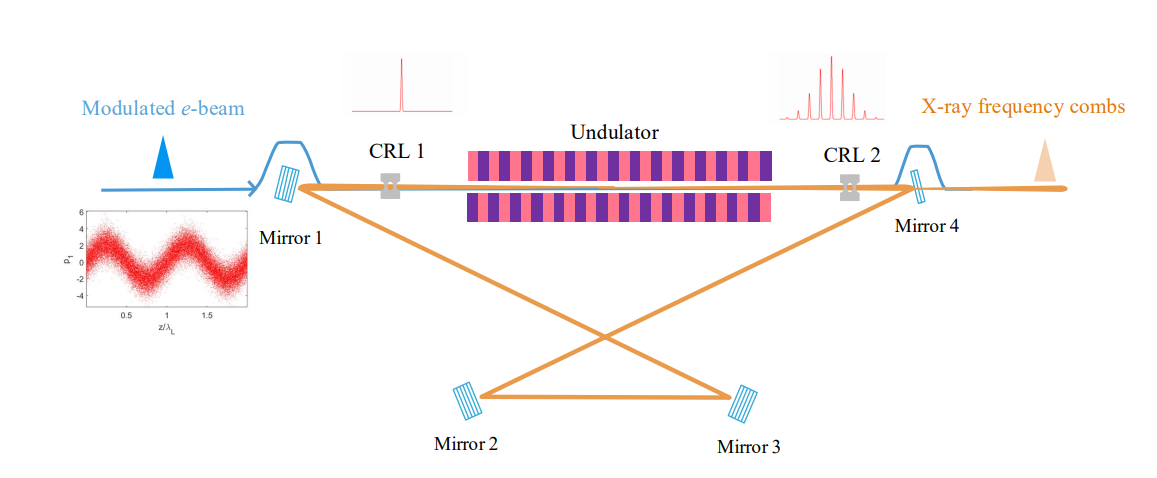
Controlling the spectral properties of X-ray beams remains a significant hurdle in advancing fields like atomic-scale science and ultrafast spectroscopy, but a new approach to X-ray generation promises greater precision and flexibility. Nanshun Huang, Hanxiang Yang, and Haixiao Deng, all from the Shanghai Advanced Research Institute, Chinese Academy of Sciences, demonstrate an actively mode-locked X-ray free-electron laser that achieves deterministic spectral programmability by coherently modulating the energy of the electron beam. This innovative method generates phase-locked pulse trains and comb-like spectra, offering unprecedented control over the X-ray output and relaxing demands on the laser’s optical components. The team’s achievement establishes active mode locking as a viable pathway to fully coherent, spectrally agile hard X-ray sources, opening exciting possibilities for time-resolved core-level spectroscopy, advanced imaging, and precision metrology.
Researchers now present an actively mode-locked cavity-based X-ray free-electron laser that achieves deterministic spectral programmability with phase-locked pulse trains and comb-like spectra. This is accomplished by coherently modulating the electron-beam energy, allowing for precise manipulation of the emitted X-ray radiation. Simulations predict substantial pulse energy and peak power, with the frequency comb spacing determined by the modulation frequency.
The team further developed selective single-line amplification via undulator tapering and absolute frequency positioning through modulation-laser tuning, achieving better than 2 × 10⁻⁵ relative precision. Importantly, stable mode-locked operation persists under greater than 80% peak-to-peak cavity-reflectivity variations, substantially relaxing requirements on X-ray optics. These results establish active mode locking as a practical route to fully coherent, spectrally agile hard X-ray sources and enable new opportunities in time-resolved core-level spectroscopy, X-ray quantum optics, and precision metrology.
Free-Electron Laser Theory and Simulation Tools
This extensive list of references details research related to Free-Electron Lasers (FELs), particularly X-ray FELs. The work covers core FEL physics, advanced concepts, and the challenges of building and operating these complex instruments. Foundational research covers basic FEL principles, including coherent radiation generation and the interaction of electrons with undulators, and simulation codes like Genesis and BRIGHT are essential tools for modeling and optimizing FEL designs. Undulator design, including tapered undulators, is crucial for achieving high efficiency and tailoring radiation properties.
Significant effort focuses on advanced FEL concepts such as oscillators and seeded FELs, which improve coherence and stability by using an external laser to modulate the electron beam. Regenerative amplifiers and cavity-based FELs represent alternative architectures for achieving high performance. The use of diamond optics, with its high thermal conductivity and radiation resistance, is also explored for manipulating X-ray beams. The references also address critical components and challenges, including thermal management and the need for high-frequency RF systems to accelerate and control the electron beam.
Research from facilities like the Shanghai Coherent Light Facility and the European XFEL demonstrates ongoing innovation in the field. The generation of tunable, phase-locked hard X-ray pulse sequences is also explored, potentially enabling new time-resolved experiments. This body of work illustrates a rapidly evolving field shifting from building first-generation FELs to developing more advanced architectures and addressing critical challenges related to thermal management and component development, ultimately aiming for higher performance, greater stability, and new capabilities for scientific research.
Coherent X-ray Combs via Active Control
This research demonstrates a new approach to generating hard X-rays with precise control over their spectral properties, achieved through actively mode-locked cavity-based free-electron lasers. Scientists successfully implemented a system capable of producing fully coherent, comb-like X-ray spectra and demonstrated deterministic programmability by coherently modulating the electron-beam energy. Simulations predict substantial peak power and pulse energy, with the frequency comb spacing determined by the modulation laser frequency. The team enabled spectral shaping through selective amplification of individual comb ‘teeth’ using undulator tapering and absolute frequency tuning via modulation laser control, achieving precision at hard X-ray energies.
Importantly, the system maintains stable operation even with significant variations in cavity reflectivity, relaxing demands on the quality of X-ray optics and extending their operational lifespan. These findings establish active mode locking as a viable route to spectrally agile hard X-ray sources, opening new possibilities for time-resolved core-level spectroscopy, X-ray quantum optics, and precision metrology. The authors acknowledge limitations related to the reliance on simulations to predict certain performance characteristics and note that further experimental validation will be necessary. Future work will likely focus on optimizing system parameters and exploring the full potential of this technique for advanced scientific applications.
🗞 Spectral Control of a Cavity-Based X-ray Free-Electron Laser via Active Mode Locking
🧠 ArXiv: https://arxiv.org/abs/2510.00640