Recent advances in ultrastable lasers depend critically on minimising noise within optical cavities, and researchers are continually seeking materials for improved mirror coatings. Dahyeon Lee, Zoey Z. Hu, and colleagues at JILA, National Institute of Standards and Technology, and the University of Colorado Boulder, now demonstrate a significant leap forward in this area. By constructing a cryogenic silicon cavity with mirrors made from aluminium gallium arsenide (AlGaAs) crystals, the team achieves a level of frequency stability four times better than previously possible with conventional mirror coatings. This breakthrough, which represents a more than tenfold reduction in mechanical loss within the mirror coatings, paves the way for cavity-stabilised lasers with unprecedented precision and opens exciting possibilities for a new generation of all-optical timescales based on continuously operating optical oscillators.
Ultra-Stable Lasers and Optical Cavity Design
The pursuit of increasingly precise timekeeping and fundamental physics research drives advancements in ultra-stable lasers and optical clocks. Scientists are achieving remarkable stability in laser frequencies, crucial for applications ranging from redefining the second to building future quantum networks. Key to this progress is the design of optical cavities with exceptionally low thermal expansion and mechanical loss, utilizing materials like fused silica, specialized glass, silicon, and crystalline compounds. Cooling these cavities to extremely low temperatures further minimizes noise and enhances stability.
Significant effort focuses on precise temperature control and the development of low-loss, highly reflective mirror coatings to maximize cavity performance. Innovative techniques, such as stacking multiple cavities and exploring integrated photonic resonators, are pushing the boundaries of stability. Optical clocks, surpassing traditional atomic clocks in accuracy, are at the forefront of this field. Strontium optical lattice clocks currently lead in performance, but ytterbium and aluminum clocks are also promising technologies. Researchers are even investigating single-ion clocks for potentially exceptional stability.
Comparing these optical clocks remotely and creating a global time scale based on their precision are major goals. Hydrogen masers and cesium fountain clocks, while historically important, are being surpassed by optical clocks in terms of accuracy. The ultimate aim is to redefine the SI second based on optical transitions and establish a global time scale reliant on a network of optical clocks. Current research focuses on miniaturizing these systems, improving frequency transfer over long distances, and addressing thermal and mechanical noise to achieve even greater stability.
Cryogenic Silicon Cavity Enhances Laser Stability
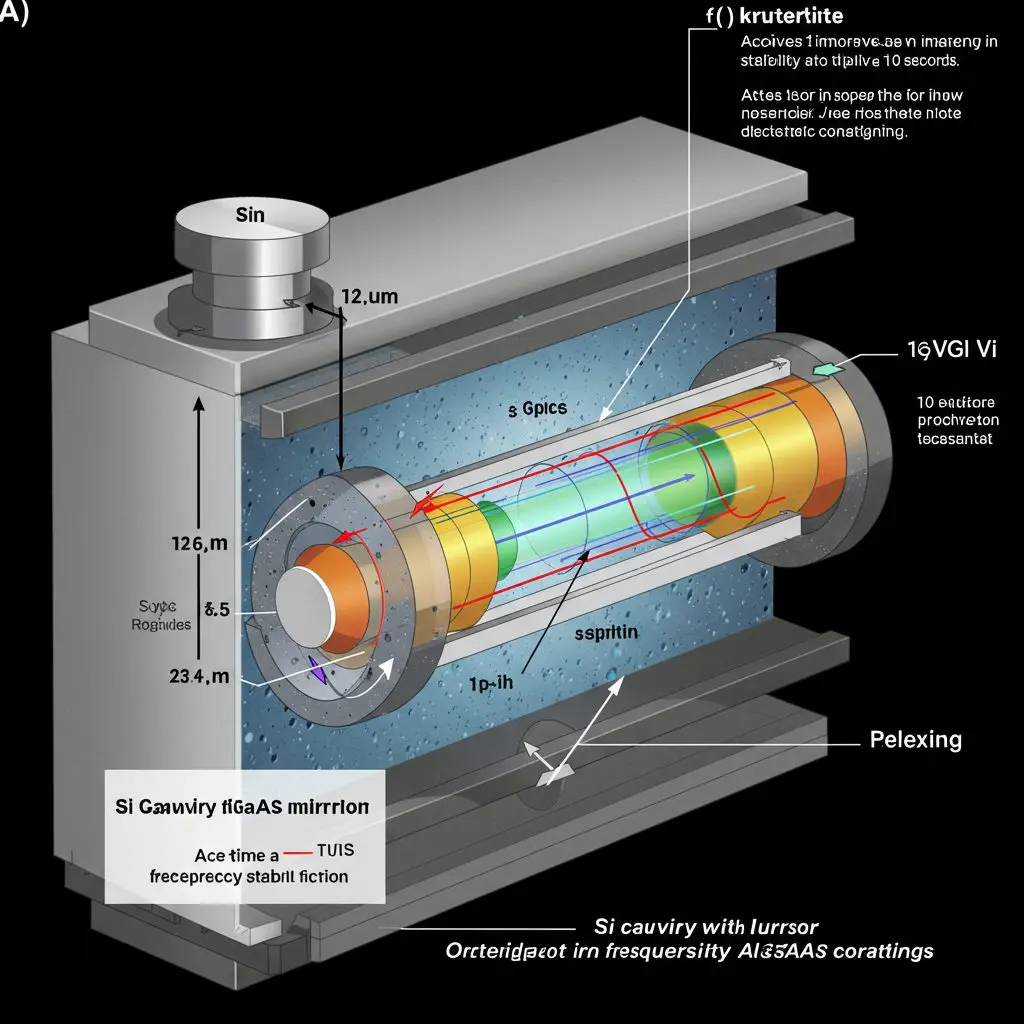
Scientists have significantly enhanced laser frequency stability by employing a novel approach involving low-noise mirror materials within cryogenic silicon cavities. A 6-centimetre-long silicon cavity, cooled to 17 Kelvin, incorporates crystalline AlGaAs coatings, demonstrating performance exceeding that of conventional dielectric mirrors. Through meticulous experimentation and utilizing a strontium lattice clock, researchers achieved a fractional frequency stability of 2. 5x 10⁻¹⁷ around 10 seconds of averaging, representing a fourfold improvement over expected performance with dielectric mirrors and indicating a more than tenfold reduction in coating mechanical loss.
The team further refined this technique by combining two state-of-the-art cryogenic silicon cavities to implement optical frequency averaging, effectively reducing noise by combining signals from multiple sources. By heterodyning a laser stabilized to one cavity with a self-referenced Er:fiber frequency comb and then phase-locking another laser to the comb, they achieved an average frequency with enhanced stability. Long-term frequency drift was monitored over several years, providing a comprehensive dataset for evaluating sustained performance. These results demonstrate the potential for all-optical timescales and continuously operating optical local oscillators.
Crystalline Coatings Enhance Laser Frequency Stability
Recent research demonstrates a significant breakthrough in optical frequency stability achieved through the development of ultrastable lasers and innovative mirror materials. Scientists are focusing on crystalline Al0. 92Ga0. 08As coatings to reduce noise in optical cavities, a critical factor in improving laser performance. Experiments utilizing a 6-centimetre-long cryogenic silicon cavity, cooled to 17 Kelvin, reveal a clear advantage of these crystalline coatings over conventional dielectric mirrors.
The team achieved a fractional frequency stability of 2. 5x 10⁻¹⁷ at 10 seconds, a result four times better than expected from cavities utilizing traditional dielectric coatings. This improvement corresponds to more than a tenfold reduction in the coating mechanical loss factor, indicating a substantial decrease in energy dissipation within the mirror materials. Researchers attribute this enhanced stability to the lower thermal noise inherent in the crystalline coatings, which minimizes fluctuations in the cavity’s resonant frequency. To further enhance stability, the team combined two silicon cavities to implement optical frequency averaging, effectively reducing noise by combining signals from multiple sources.
Long-term frequency drift measurements, compiled over more than 10 years from four silicon cavities, provide valuable data for assessing the sustained performance of these systems. These results pave the way for cavity-stabilized lasers with fractional stability reaching 10−18, and open realistic prospects for creating an all-optical timescale with continuously operating optical local oscillators, essential for precise timekeeping and fundamental physics research. The demonstrated improvements represent a substantial step towards realizing the full potential of crystalline mirrors in high-precision optical applications.
Crystalline Mirrors Enhance Laser Frequency Stability
Researchers have achieved a significant advance in laser frequency stability through the development of improved cryogenic silicon cavities incorporating crystalline AlGaAs mirrors. The team demonstrated a fractional frequency stability of 2. 5x 10⁻¹⁷ using a 6-centimetre cavity operated at 17 Kelvin, a result four times better than expected from cavities utilizing conventional dielectric mirrors. This improvement stems from a substantially reduced mechanical loss factor within the crystalline coatings, confirming the superior mechanical properties of these materials. Furthermore, the researchers successfully combined two silicon cavities to demonstrate optical frequency averaging, achieving a more stable optical frequency than either cavity individually, across both short and long averaging times.
Long-term measurements, spanning several years, were also conducted on four cryogenic silicon cavities, providing valuable data on their drift characteristics. These findings pave the way for cavity-stabilized lasers with enhanced stability and support the development of all-optical timescales with continuously operating optical local oscillators. The authors acknowledge that the underlying mechanisms causing drift in cryogenic silicon cavities remain unclear, and further investigation is needed to fully understand this behaviour. They suggest that future research, including the construction of new cavities at different operating temperatures, may provide further insight. Despite this limitation, the team anticipates that a combination of existing advancements, including 21-centimetre cavity length, 17 Kelvin operation, large radius of curvature mirrors, and crystalline coatings, will enable the practical realisation of a cryogenic silicon cavity with low-10−18 performance.
🗞 Frequency stability of in a Si cavity with AlGaAs crystalline mirrors
🧠 ArXiv: https://arxiv.org/abs/2509.13503