

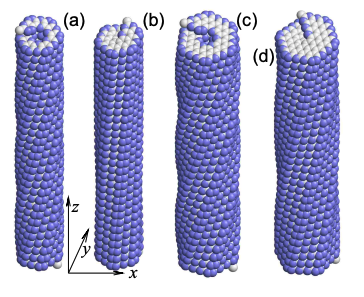
Carbon nanosprings, possessing a distinctive spiral structure, hold considerable promise for future nanotechnology applications, and a new study delves into how these structures respond to different types of stress. Alexander V. Savin from the Semenov Institute of Chemical Physics and Plekhanov Russian University of Economics, alongside Elena A. Korznikova from Ufa University of Science and Technology and Sergey V. Dmitriev from Ufa State Petroleum Technological University, investigated the ways carbon nanosprings deform under bending and twisting forces, going beyond previous research that focused solely on compression and tension. Their molecular dynamics simulations reveal that these nanosprings develop structural defects and even reverse their helical direction depending on their geometry, and importantly, exhibit a remarkably high thermal expansion coefficient, exceeding that of many conventional metals and alloys. This discovery offers valuable insights for the development of highly sensitive nanosensors capable of functioning accurately across a broad spectrum of temperatures.
Nanoscale Materials and Nonlinear Elasticity
This research explores the mechanical properties of nanoscale materials, including carbon nanotubes, graphene, and helical polymers, revealing complex behaviors beyond simple elasticity. Researchers are particularly interested in understanding how defects, edges, and structural arrangements influence their strength and flexibility. Investigations demonstrate that graphene and carbon nanotubes often exhibit nonlinear elasticity, meaning their deformation isn’t directly proportional to the applied force, arising from phenomena like rippling and, in some cases, even negative stiffness. Molecular dynamics simulations play a central role, allowing scientists to model the behavior of helical polymers and biomolecules like coiled-coil proteins, revealing how helix reversal defects form and how the topology of helical structures influences their mechanical properties.
This research spans multiple length scales, from atomic-level simulations to macroscopic structures, drawing inspiration from biomolecules to design novel materials with tailored properties. A key finding is that nonlinearity is common in nanoscale materials, and the topology and chirality of helical structures significantly impact their mechanical properties. Defects and imperfections are crucial in determining a material’s strength and failure mechanisms, demonstrating the power of computational methods in unraveling complex mechanical behavior and paving the way for advanced materials with enhanced strength, flexibility, and functionality.
Nanospring Deformation Under Complex Mechanical Loads
This research focuses on understanding how carbon nanosprings respond to bending, twisting, and axial compression under complex loading conditions. Molecular dynamics simulations are used to observe the nanosprings’ behavior at the atomic level, tracking how they deform and potentially develop defects under various stresses, beginning by establishing a stable ground state configuration. By numerically solving equations of motion and applying boundary conditions, researchers can track the position and velocity of each atom within the nanospring as it responds to applied forces. The simulations demonstrate that nanosprings exhibit a surprisingly high coefficient of thermal expansion, making them promising candidates for nanosensors. Furthermore, the research reveals that while thermal fluctuations alone do not cause structural defects, external forces like compression can induce these defects, altering the nanospring’s structure.
Nanospring Elasticity and Stable Folded Structures
Carbon nanosprings exhibit exceptional elasticity, capable of undergoing substantial deformation without fracturing, and demonstrate behaviors distinct from many conventional materials. Simulations focus on two primary types of nanosprings, helical graphene nanoribbons and helicoids, differing in their internal structure, revealing that when compressed, nanosprings can form stable, folded structures, even with some fracturing. Notably, the research reveals that carbon nanosprings exhibit a significantly higher coefficient of thermal expansion compared to most metals and alloys, making them promising candidates for highly sensitive nanosensors operating across a wide range of temperatures. The ability to predictably control and manipulate these nanosprings through various forms of deformation opens up possibilities for designing advanced nanoscale devices with tailored mechanical and electronic characteristics. The findings underscore the importance of structural defects in influencing the performance of these materials, impacting their elasticity, conductivity, and overall stability. By understanding how these defects form and propagate under different loading conditions, researchers can better engineer carbon nanosprings for specific applications, potentially leading to breakthroughs in nanoelectromechanical systems and advanced sensing technologies.
Carbon Nanosprings Exhibit High Thermal Expansion
This study investigates the mechanical behaviour of carbon nanosprings, analysing how these spiral macromolecules respond to compression, bending, and twisting forces. Using molecular dynamics simulations, researchers examined nanosprings formed from both l-kekulene and l-coronene molecules, noting a key structural difference, l-kekulene possesses an inner channel while l-coronene does not, influencing their mechanical responses. The findings demonstrate that carbon nanosprings exhibit a significantly higher coefficient of axial thermal expansion than many metals and alloys, suggesting potential applications in the development of temperature sensors capable of operating across a broad temperature range. Furthermore, the study reveals that compressive forces cause nanosprings to behave like hinged elastic rods, buckling under sufficient pressure, and that bending initiates elastic arching before potentially leading to irreversible shape changes. Notably, the presence of an inner channel in l-kekulene nanosprings appears to reduce bending stiffness and influence crack formation under compression. The authors acknowledge that the simulations represent idealised conditions, and further research could explore the impact of defects or external environments on the observed behaviours.
🗞 Structural and helix reversal defects of carbon nanosprings
🧠 ArXiv: https://arxiv.org/abs/2508.04490


