

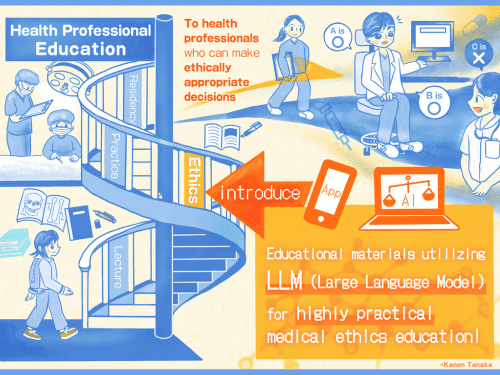
Researchers from Hiroshima University have proposed integrating large language models (LLMs) like ChatGPT into medical ethics education to address resource constraints in curriculum development. They argue that LLMs can act as virtual teachers, reducing educators’ workloads while contributing to students’ acquisition of moral knowledge and cultivation of virtue.
However, the authors emphasize that LLMs are not yet suitable for clinical settings due to limitations in critical thinking and diverse moral perspective training. The essay, published in BMC Medical Education, highlights the potential of LLMs as supplementary tools for teaching basic ethics principles and exposing students to real-life clinical scenarios while acknowledging their current limitations.
Ethics Education in Medicine
Researchers from Hiroshima University propose integrating artificial intelligence (AI) tools like ChatGPT into medical ethics education to address resource constraints and enhance teaching effectiveness. Their essay in BMC Medical Education highlights how large language models (LLMs) can serve as virtual teachers, reducing the workload on educators while fostering empathy and exposing students to real-life clinical scenarios.
The study underscores the potential of AI in medical ethics education by leveraging LLMs’ ability to understand complex ethical dilemmas and provide nuanced responses. This approach not only supplements traditional teaching methods but also prepares students for diverse clinical situations, emphasizing the importance of virtue cultivation in future healthcare professionals.
However, the researchers caution against replacing human instructors with AI. They stress that critical thinking and diverse moral perspectives remain essential in clinical settings, areas where LLMs require further development. The integration of AI into ethics education is seen as a complementary tool rather than a replacement, necessitating cautious adoption to maximize benefits while minimizing limitations.
In conclusion, the research points to the promising role of AI in enhancing medical ethics education, offering innovative solutions to current challenges. By leveraging AI’s capabilities thoughtfully, educators can create more dynamic and effective learning environments for future healthcare providers.
Caution on Over-Reliance on AI
Integrating large language models (LLMs) like ChatGPT into medical ethics education presents a promising yet cautiously approached tool for addressing resource constraints and enhancing teaching outcomes. LLMs can serve as virtual teachers, alleviating the burden on educators by fostering empathy and exposing students to diverse clinical scenarios. This capability is particularly valuable given the limited resources often allocated to ethics education in medical curricula.
However, researchers emphasize that LLMs are not yet equipped to replace human instructors in critical decision-making processes requiring diverse moral perspectives. While these models demonstrate a strong capacity for understanding complex ethical dilemmas and delivering nuanced responses, they lack the ability to fully replicate the depth of human interaction and judgment necessary for clinical settings.
The cautious adoption of AI in medical ethics education is advocated as a complementary approach rather than a replacement for human instruction. This perspective underscores the need for continued development of LLMs to better address the complexities of clinical environments, potentially drawing on educational contexts themselves for training data. The integration of AI thus presents an innovative solution to enhance learning environments while acknowledging its current limitations.
More information
External Link: Click Here For More


