Researchers from the University of Cambridge and Université Paris-Saclay have developed a new carbon-based molecular material that can link electron spin and light, opening up cheaper and simpler pathways for quantum sensing applications.
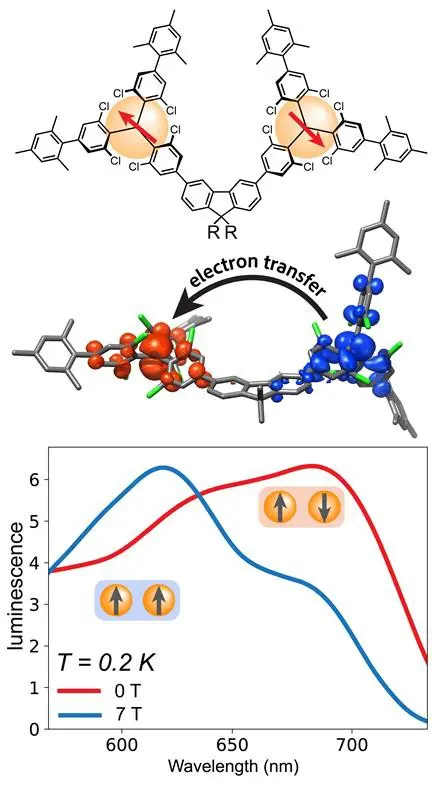
The team created an organic molecule with two units containing unpaired electrons, known as spin radicals. When connected, these electrons can align in two configurations: a triplet state where spins point in the same direction and emit orange light, or a singlet state where spins point in opposite directions and emit near-infrared light. This fine-tuned molecular design is key to achieving reliable interaction between the two spin radical units.
The molecule’s color changes based on its quantum state, which can be controlled using magnetic fields, temperature, or microwave pulses. This allows scientists to easily detect and read quantum states simply by observing the emitted light color. The color shift observed is connected to the Hubbard energy model, widely used for inorganic materials including high-temperature superconductors. At low temperatures without a magnetic field, the singlet state dominates and the molecule glows in the near infrared, while applying a magnetic field pushes it into the triplet state, making it glow orange.
This discovery provides a much simpler and cheaper alternative to current quantum sensing materials like nano-diamonds with atomic defects. The quantum states are extremely sensitive to environmental changes including magnetic fields, temperature, and chemical surroundings, enabling detection with far greater precision than traditional materials. This opens possibilities for molecular-based quantum information and sensing technologies where small size, chemical control, and low cost could accelerate implementation.
Building on earlier work showing spin-radical units could create efficient OLEDs operating in the red and near-infrared spectrum, this advance demonstrates how carefully designed molecules can tune light responses to read or control spin states. The discovery represents a new class of carbon-based materials with controllable spin-optical properties that are both highly luminescent and easier to process than traditional quantum materials. The research was published in Nature Chemistry and supported by the European Research Council.
More information
External Link: Click Here For More