The behaviour of particles undergoing Brownian motion, random movement driven by collisions with surrounding molecules, presents a long-standing challenge in understanding complex systems, and recent work clarifies the probability of disconnection within confined spaces. Gefei Cai from Peking University, alongside Xuesong Fu and Xin Sun, with Zhuoyan Xie also at Peking University, now present an exact formula determining the likelihood that a Brownian path encircling an annulus, a ring-shaped region, fails to connect its inner and outer boundaries. This achievement builds upon earlier theoretical work linking this disconnection probability to the behaviour of Schramm-Loewner evolution, and importantly, provides a precise mathematical description of this phenomenon, offering new insights into the geometry of random surfaces and the behaviour of particles in constrained environments. The team’s findings also establish a clear relationship between Brownian motion and a measure describing loop-like structures, furthering our understanding of how randomness shapes the connectivity of complex systems.
Connection and the coupling with Liouville quantum gravity (LQG). As byproducts of the proof, the researchers obtain a precise relation between Brownian motion on a disk stopped upon hitting the boundary and the Schramm-Loewner evolution (SLE) loop measure on the disk, and also a detailed description of the LQG surfaces cut by the outer boundary of stopped Brownian motion on a 8/3-LQG disk. Two-dimensional Brownian motion is an extensively studied planar stochastic process, enjoying conformal invariance and a deep connection to the Schramm-Loewner evolution (SLE).
Liouville Quantum Gravity and SLE Connections
This body of work investigates the intricate relationships between Liouville quantum gravity, Schramm-Loewner evolution, and related mathematical concepts. Researchers have extensively explored LQG, focusing on the existence, uniqueness, and properties of the LQG metric and its connection to the Brownian map and random surfaces. SLE serves as a crucial tool for understanding LQG, with studies examining its properties and application in defining and studying random surfaces. Conformal field theory plays a significant role, linking LQG to concepts like the Fyodorov-Bouchaud formula and the conformal bootstrap. The field is highly interdisciplinary, drawing from probability theory, complex analysis, mathematical physics, and statistical mechanics, and has seen significant advances in understanding LQG over the last decade. A strong emphasis on rigorous mathematical foundations characterizes the work, while maintaining clear connections to physics, particularly string theory and quantum gravity.
Brownian Paths and Disconnection Probability Derived Exactly
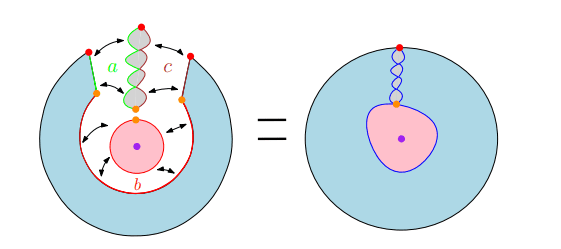
Scientists have derived an exact formula determining the probability that a Brownian path, moving within an annulus, does not disconnect the two boundaries defining that space. This work builds upon earlier research establishing a connection between this probability and the disconnection exponent identified through Schramm-Loewner evolution, and further integrates concepts from Liouville quantum gravity. The team’s derivation leverages this connection, providing a precise mathematical description of the phenomenon. Furthermore, the research provides a detailed description of Liouville quantum gravity surfaces cut by the outer boundary of stopped Brownian motion on a specific type of disk, enhancing the understanding of these complex geometries. The team demonstrated that the outer boundary of the stopped Brownian motion can be understood as the interface created by conformally welding together a Brownian disk with four marked boundary points, a chain of Brownian disks, and a smaller disk containing the starting point. This welding process, described using Schramm-Loewner evolution, provides a visual and mathematical framework for understanding the behavior of the Brownian path.
Annular Disconnection Probability and Schramm-Loewner Evolution
This research establishes an exact mathematical description of the probability that a random path, specifically a Brownian path, does not disconnect an annular region, a ring-shaped area. The team derived a precise formula for this probability, confirming its connection to previously established theoretical predictions based on Schramm-Loewner evolution. This connection validates the use of this complex mathematical framework to understand the behaviour of these random paths. These findings contribute to a deeper understanding of the geometric properties of random paths and their impact on the surfaces they interact with. Future research directions include exploring the implications of these findings for other geometric settings and investigating the potential for extending these techniques to more complex random processes.
👉 More information
🗞 Disconnection probability of Brownian motion on an annulus
🧠 ArXiv: https://arxiv.org/abs/2509.14073