
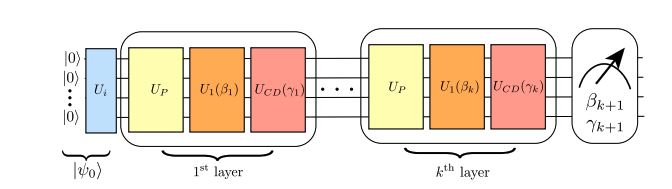
Researchers from Brookhaven National Laboratory and Stony Brook University have proposed an enhancement to the Feedback-Based Quantum Algorithm (FQA) by integrating quantum Lyapunov control with the counterdiabatic driving protocol. This integration accelerates population transfer to low-energy states and reduces the time frame compared to conventional quantum algorithms. The team’s approach to quantum circuit design involves iterative construction, introducing new layers determined through feedback from qubit measurements. The enhanced algorithm was validated on the IBM cloud computer, demonstrating its potential for expediting quantum computations for many-body systems and combinatorial optimization problems.
Quantum Algorithm Development
Researchers from the Condensed Matter Physics and Materials Science Division at Brookhaven National Laboratory and the CN Yang Institute for Theoretical Physics at Stony Brook University have proposed a significant enhancement to the Feedback-Based Quantum Algorithm (FQA). The FQA, a recent development in quantum algorithms, uses quantum Lyapunov control to iteratively construct quantum circuits, negating the need for predetermined time evolution or classical optimization. The team’s enhancement integrates quantum Lyapunov control with the counterdiabatic driving protocol, a key concept from quantum adiabaticity.
Counterdiabatic Driving Protocol
The counter-diabatic driving protocol is a concept derived from adiabaticity, which is used to effect rapid changes in the time-dependent Hamiltonian without inducing nonadiabatic transitions. The team’s approach introduces an additional control field inspired by counter-diabatic driving. This integration results in a remarkable acceleration in population transfer to low-energy states within a significantly reduced time frame compared to conventional feedback-based quantum algorithms.
Quantum Circuit Design
The team’s approach to quantum circuit design involves Quantum Lyapunov Control (QLC) and counter-diabaticity. The quantum circuit is constructed iteratively, introducing new layers where the parameters are meticulously determined through feedback derived from qubit measurements in the preceding layer. Each layer in the Counterdiabatic Feedback-Based Quantum Algorithm (CDFQA) includes a third unitary inspired by the counterdiabatic driving protocol. This addition results in a notable reduction in depth compared to the standard FQA.
Application to Ising Model Hamiltonians
The team applied their algorithm to prepare ground states in one-dimensional quantum Ising spin chains. The third unitary is selected from a pool of counter-diabatic operators. The team found that an improper choice from this pool can lead to convergence issues in the dynamics. The implications of these findings are discussed in the context of advancing quantum algorithms for ground-state preparation.
Implementation with Cloud Quantum Computers
The team validated their algorithm on the IBM cloud computer, demonstrating its efficacy in expediting quantum computations for many-body systems and combinatorial optimization problems. Implementing the Counterdiabatic Feedback-Based Quantum Algorithm (CDFQA) on cloud quantum computers represents a significant step forward in quantum computing.
Implications and Conclusion
The team’s work significantly enhances the Feedback-Based Quantum Algorithm (FQA) by integrating the counterdiabatic driving protocol. This advancement in quantum algorithms could have far-reaching implications for many-body systems and combinatorial optimization problems. The team concludes that their work exemplifies the potential of Quantum Lyapunov Control (QLC) in shaping the landscape of quantum algorithms.
“Feedback-based Quantum Algorithm Inspired by Counterdiabatic Driving” – Rajesh K. Malla, Hiroki Sukeno, Hongye Yu, Tzu-Chieh Wei, Andreas Weichselbaum, Robert Konik. Published on arXiv (Cornell University) on January 27