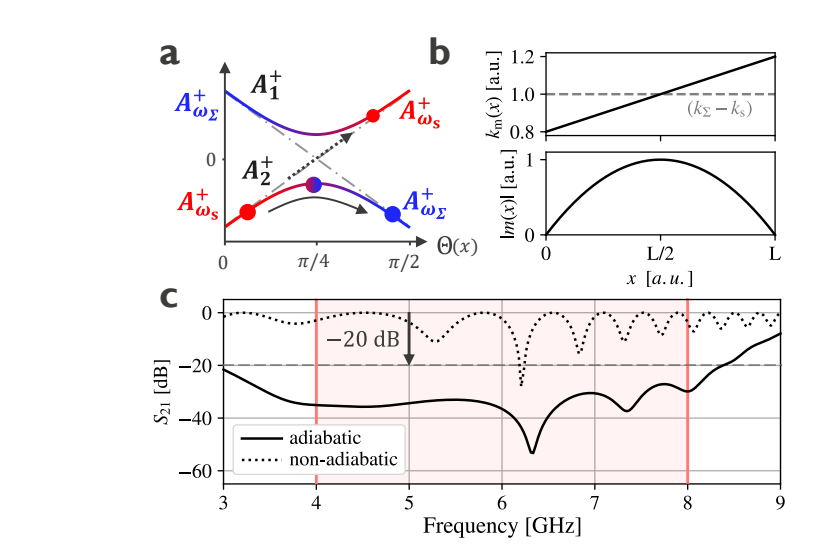
Conventional microwave isolators, essential for protecting sensitive electronic components from unwanted signals, typically rely on bulky and lossy materials requiring strong magnetic fields. Researchers, including M. Demarets, A. M. Vadiraj, C. Caloz, and K. De Greve, now present a fundamentally new approach to isolation, demonstrating a magnetless device that overcomes these limitations. Their work introduces a dispersion-engineered transmission line capable of modulating magnetic flux in a controlled manner, achieving over 20 dB of isolation across a broad frequency band from 4 to 8GHz. This compact, low-loss design promises improved performance, scalability, and seamless integration into future large-scale electronic systems, representing a significant advance in microwave component technology.
Magnetless Isolation for Superconducting Quantum Systems
Scientists have created a new type of isolator, a crucial component in microwave systems, that avoids the limitations of traditional ferrite-based designs. This broadband magnetless isolator utilizes adiabatic flux modulation to achieve non-reciprocal signal transmission, effectively shielding sensitive devices such as superconducting qubits from noise and unwanted signals. The device consists of a chain of superconducting loops coupled to a transmission line, where the loop areas are gradually modulated to induce a phase shift in the transmitted signal. This controlled manipulation of magnetic flux creates a directional transmission characteristic, allowing signals to pass in one direction while blocking them from the other. The resulting isolator exhibits a 3 dB bandwidth exceeding 10GHz and achieves greater than 20 dB of isolation across this bandwidth, representing a significant improvement over existing magnetless isolator designs. This innovative approach offers a pathway towards compact, low-loss, and fully integrated isolators for advanced superconducting quantum circuits and microwave systems.
SQUIDs Dynamically Tune Superconducting Transmission Lines
Researchers have developed a method for creating tunable transmission lines, artificial circuits where properties like inductance can be dynamically controlled. This is achieved by integrating Superconducting Quantum Interference Devices, or SQUIDs, into the transmission line structure. SQUIDs act as tunable inductors, and by changing the external magnetic flux passing through them, the inductance of the line, and therefore its frequency response, can be altered. The team focused on developing a detailed model of these flux-modulated SQUIDs specifically for use within the Advanced Design System simulation software. This accurate modeling is essential for predicting the behavior of these complex circuits and optimizing their performance. Simulations demonstrate that the Bragg frequency, a key characteristic of the transmission line, can be tuned by changing the applied magnetic flux, revealing parametric coupling between different modes, a desired effect for creating a tunable system.
Magnetless Isolator Achieves Broad Frequency Bandwidth
Scientists have developed a new type of isolator that overcomes the limitations of conventional ferrite-based designs, achieving more than 20 dB of isolation across a broad frequency band. This performance is achieved through dispersion-engineered transmission lines and propagating adiabatic flux modulation. By carefully controlling the dispersion relation, researchers suppressed unwanted amplification at lower frequencies and limited coupling to higher frequencies, confining the interaction to two specific modes to maximize isolation. Measurements confirm that this engineered dispersion curve prevents phase matching and conversion to unwanted higher-frequency modes, while adiabatic mode conversion ensures complete depletion of the input signal across a wide range of frequencies. The resulting device demonstrates a significant advancement in microwave technology, offering a compact, low-loss, and scalable solution for isolating sensitive components.
Magnetless Isolation via Waveguide Modulation
Researchers have developed a new approach to microwave isolation utilizing dispersion engineering and parametric modulation within a single waveguide to create a system with direction-dependent coupling. This design achieves isolation exceeding 20 decibels across a broad frequency band, offering several advantages including a compact footprint and a separate pump line that prevents interference. Simulations demonstrate the circuit’s robustness against variations in manufacturing parameters, suggesting a high yield and reliable performance, making it a scalable alternative to ferrite isolators for integration with sensitive systems such as superconducting quantum processors and other ultra-low-noise cryogenic applications.
🗞 Broadband Magnetless Isolator using Adiabatic Flux Modulation
🧠 ArXiv: https://arxiv.org/abs/2509.24551