

The relentless march of decoherence, caused by environmental interactions, typically limits the performance of quantum systems, but recent research demonstrates that this environmental impact can, surprisingly, be harnessed. Alexander Yosifov from Queen Mary University of London, Aditya Iyer and Vlatko Vedral from the University of Oxford, along with their colleagues, investigate how ‘memory’ within the environment affects quantum dynamics. Their work reveals that the type of memory, whether classical or quantum, needed to recreate realistic environmental interactions is not fixed, but depends on the initial state of the environment and how quantum correlations spread within it. This discovery is significant because it clarifies the origin of environmental memory in open quantum systems and offers new avenues for designing more robust quantum technologies for a range of future applications.
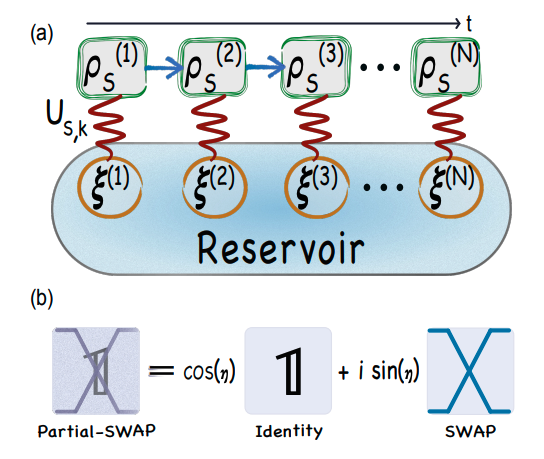
To accurately approximate complex evolution, non-Markovian dynamics, which incorporate memory effects, are commonly employed. These memory effects serve as a valuable resource in various applications, including quantum error correction and information processing. This work extends the quantum homogenizer to encompass the non-Markovian regime by introducing intra-ancilla interactions mediated by Fredkin gates, and investigates the nature of its memory.
Non-Markovian Dynamics and Open Quantum Systems
A comprehensive collection of research exists concerning quantum information, open quantum systems, and non-Markovian dynamics, alongside areas like reservoir computing and error mitigation. The central theme revolves around understanding how quantum systems evolve when interacting with their environment, particularly when that environment doesn’t simply forget past interactions. This research explores characterizing non-Markovianity, often using collision models to simulate system-environment interactions, and investigating the structural features of these processes. A strong focus lies on the impact of non-Markovian dynamics on quantum computation, including developing error mitigation techniques and exploring fault tolerance. This body of work suggests several promising research directions, including developing realistic noise models for quantum hardware, exploring new error mitigation strategies tailored for non-Markovian errors, investigating quantum reservoir computing for complex systems, and developing hybrid quantum-classical algorithms for analysing non-Markovian dynamics. Further research could focus on characterizing and controlling non-Markovianity in quantum devices, understanding the impact of correlated errors on quantum error correction, and exploring whether non-Markovianity can be harnessed as a resource for quantum information processing.
Environmental Interactions Reveal Quantum Memory Nature
Researchers have gained new insight into the nature of memory within quantum systems, specifically how environmental interactions impact the stability and performance of quantum technologies. Quantum systems are susceptible to decoherence, losing information due to interactions with their surroundings, but these interactions don’t necessarily destroy information and can, in fact, be harnessed. This work investigates whether the ‘memory’ of these interactions, how the environment ‘remembers’ past interactions with the system, is fundamentally classical or quantum in nature, a crucial distinction for designing effective quantum technologies. The team extended a model called the ‘homogenizer’, which simulates interactions between a quantum system and its environment, to include more complex, non-Markovian dynamics, where the environment retains a ‘memory’ of past interactions.
They achieved this by introducing interactions between the environmental components themselves, mediated by specific quantum gates. This allows for controlled exploration of how memory arises and propagates within the system, mirroring interactions found in solid-state and superconducting quantum devices. The researchers developed a new method to distinguish between classical and quantum memory, relying solely on observing the local dynamics of the system. Their analysis reveals that whether quantum memory is required depends critically on the initial state of the environment and the presence of entanglement within it. In scenarios with asymmetric entanglement, common in many realistic noise models, genuine quantum memory is essential for maintaining the system’s coherence. This finding is significant because it demonstrates that simply acknowledging environmental interactions isn’t enough; the type of memory dictates the design and performance of quantum technologies.
Reservoir State Dictates Quantum Memory Need
This work extends the standard quantum homogenizer to encompass non-Markovian dynamics by incorporating interactions between ancilla qubits. The research addresses a fundamental question regarding open quantum systems: what type of memory, classical or quantum, is required to accurately model their evolution? By examining the system’s behaviour and focusing on local dynamics, the team demonstrates that the dynamics of the non-Markovian homogenizer can be realised with either classical or quantum memory, crucially dependent on the initial state of the reservoir and the entanglement structure within it. Specifically, an initially uncorrelated reservoir allows for classical memory, while an entangled or perturbed reservoir necessitates quantum memory.
The results illuminate the conditions under which quantum memory becomes essential for describing non-Markovian evolution and suggest a pathway for both engineering and characterizing memory in physical systems. The team’s simulations corroborate earlier analytical predictions and demonstrate the effectiveness of this approach compared to traditional Markovian models. The authors acknowledge that even small imperfections in structured environments can activate memory effects, highlighting the importance of error correction schemes that account for correlated, history-dependent noise in real quantum devices.
🗞 On the emergence of quantum memory in non-Markovian dynamics
🧠 ArXiv: https://arxiv.org/abs/2507.21907


