

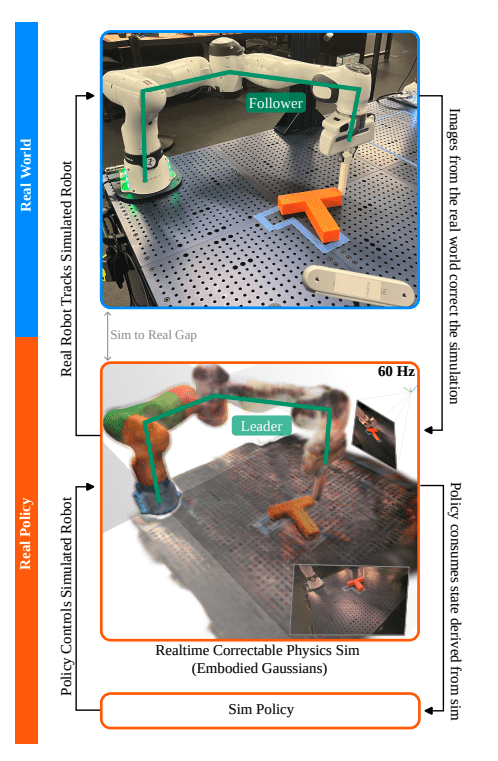
On April 4, 2025, Jad Abou-Chakra and colleagues introduced Real-is-Sim, a dynamic digital twin framework that bridges the simulation-to-real gap in robotics, validated through successful real-world evaluations of robot policies on the PushT task.
Recent advancements in behavior cloning for complex manipulation tasks face challenges in accurately assessing training performance due to poor correlation between behavior cloning losses and real-world success. To address this, researchers propose real-is-sim, a novel framework incorporating a dynamic digital twin (based on Embodied Gaussians) across data collection, training, and deployment. This approach enables flexible state representations, offline policy evaluation, and mitigation of domain-transfer challenges by aligning simulated and physical worlds. Validation on the PushT task demonstrates strong correlation between simulator success rates and real-world evaluations, validating the framework’s effectiveness.
The Rise of Simulation Tools
Simulation has long been a cornerstone of robotic research, enabling scientists to test and refine algorithms without the need for physical hardware. Recent advancements in simulation tools have further enhanced this capability. For instance, PhysTwin, a physics-informed reconstruction and simulation framework, allows researchers to model deformable objects from videos with unprecedented accuracy. This technology has significant implications for robotics, particularly in scenarios involving soft or flexible materials.
Similarly, Warp, a high-performance Python framework for GPU-based simulation and graphics, has emerged as a powerful tool for developers. Its ability to leverage the computational power of GPUs enables faster simulations, making it easier to design and test complex robotic systems. These tools are not only accelerating research but also paving the way for more practical applications in industries such as manufacturing, healthcare, and logistics.
AI Models: Enhancing Robotic Capabilities
Artificial intelligence (AI) continues to play a pivotal role in advancing robotics. Dinov2, an unsupervised learning model, has demonstrated its ability to learn robust visual features from raw data, enabling robots to better understand their environments. This advancement is particularly significant for tasks that require real-time decision-making and adaptability.
Another notable development is the Robotic View Transformer (RVT), which enhances 3D object manipulation by providing robots with a more comprehensive understanding of their surroundings. By leveraging transformer architectures, RVT enables robots to perform complex tasks with greater precision and efficiency. These AI-driven innovations are not only improving robotic performance but also expanding the range of applications in fields such as e-commerce, healthcare, and autonomous vehicles.
Manipulation Skills: A New Frontier
One of the most challenging aspects of robotics is achieving dexterous manipulation, a skill that humans perform effortlessly but remains difficult for machines. Recent breakthroughs in this area are beginning to bridge this gap. For example, Diffusion Policy, a visuomotor policy learning framework, has shown remarkable success in enabling robots to perform fine-grained bimanual manipulation tasks. This technology relies on diffusion models, which generate actions by gradually refining random noise into meaningful policies.
Cloth-Splatting, another innovative approach, focuses on estimating the 3D state of cloth from RGB supervision. This method has significant implications for robotics applications involving flexible materials, such as garment handling or food preparation. These advancements in manipulation skills are bringing robots closer to performing tasks that were previously deemed too complex or delicate for machines.
Real-Time Rendering and Visualization
Real-time rendering is another area where robotics is making strides. Techniques like 3D Gaussian Splatting enable real-time radiance field rendering, providing robots with highly detailed visual representations of their environments. This technology is particularly useful in scenarios requiring high precision, such as surgical robotics or autonomous navigation.
Additionally, advancements in position-based simulation, such as Xpbd (Extended Position-Based Dynamics), are improving the realism and efficiency of robotic simulations. These methods allow for more accurate modeling of compliant constrained dynamics, which is essential for tasks involving contact-rich interactions, such as grasping or manipulation.
Challenges and Future Directions
Despite these remarkable advancements, challenges remain in robotics research. Issues such as energy efficiency, adaptability to dynamic environments, and the integration of ethical considerations into robotic systems require further exploration. However, the pace of innovation suggests that many of these challenges will be addressed in the near future.
The convergence of simulation tools, AI models, manipulation skills, and real-time rendering is creating a robust foundation for the next generation of robots. As researchers continue to push the boundaries of what is possible, we can expect to see even more sophisticated and versatile robotic systems that will transform industries and enhance our daily lives.
In conclusion, the future of robotics is bright, with groundbreaking developments poised to redefine the capabilities of machines. From enhancing simulation accuracy to improving AI-driven decision-making, these innovations are setting the stage for a new era in robotics—one where machines can perform tasks with greater precision, adaptability, and intelligence than ever before.
🗞 Real-is-Sim: Bridging the Sim-to-Real Gap with a Dynamic Digital Twin for Real-World Robot Policy Evaluation
🧠 DOI: https://doi.org/10.48550/arXiv.2504.03597


