

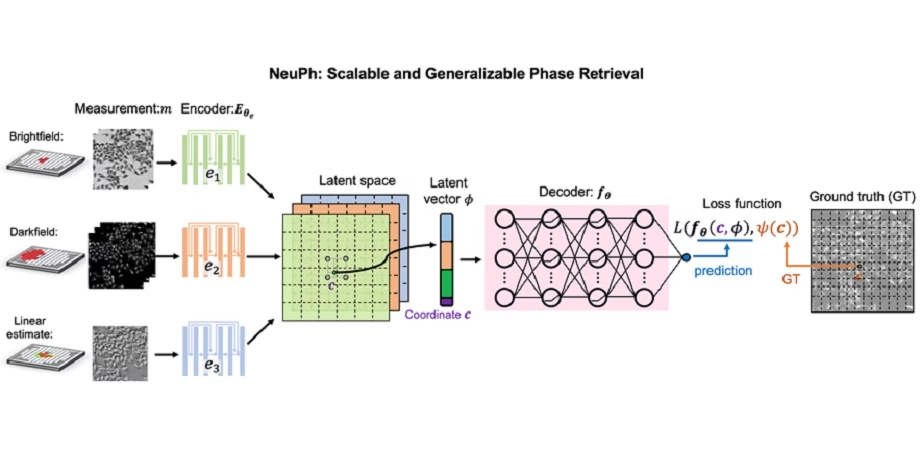
Researchers at Boston University’s Computational Imaging Systems Lab have developed a novel approach to reconstruct high-resolution images from low-resolution measurements, leveraging advanced deep learning techniques. The method, called “neural phase retrieval” or “NeuPh,” employs a convolutional neural network (CNN) encoder and a multilayer perceptron (MLP) decoder to capture multiscale object information. Led by researcher Hao Wang, the team demonstrated that NeuPh can accurately reconstruct intricate subcellular structures, eliminate common artifacts, and maintain high accuracy even with limited or imperfect training data.
NeuPh’s ability to apply continuous and smooth priors to reconstruction showcases more accurate results compared to existing models. The system also exhibits strong generalization capabilities, consistently performing high-resolution reconstructions when trained with very limited data or under different experimental conditions. This breakthrough has significant implications for deep learning-based computational imaging techniques, offering a scalable, robust, accurate, and generalizable solution for phase retrieval.
Neural Phase Retrieval: A Breakthrough in High-Resolution Image Reconstruction
Neural phase retrieval, also known as NeuPh, is a novel approach to reconstruct high-resolution images from low-resolution measurements. This method employs advanced deep learning techniques to overcome the limitations of traditional methods that rely on discrete pixel representations. Researchers from Boston University’s Computational Imaging Systems Lab have introduced a local conditional neural field (LCNF) network, which they use to address the problem.
NeuPh leverages a convolutional neural network (CNN)-based encoder to compress captured images into a compact latent-space representation. This is followed by a multilayer perceptron (MLP)-based decoder that reconstructs high-resolution phase values, effectively capturing multiscale object information. By doing so, NeuPh provides robust resolution enhancement and outperforms both traditional physical model-based methods and current state-of-the-art neural networks.
The reported results highlight NeuPh’s ability to apply continuous and smooth priors to the reconstruction, showcasing more accurate results compared to existing models. Using experimental datasets, the researchers demonstrated that NeuPh can accurately reconstruct intricate subcellular structures, eliminate common artifacts such as residual phase unwrapping errors, noise, and background artifacts, and maintain high accuracy even with limited or imperfect training data.
Scalability and Generalizability of NeuPh
One of the significant advantages of NeuPh is its scalability and generalizability. It consistently performs high-resolution reconstructions when trained with very limited data or under different experimental conditions. This adaptability is further enhanced by training on physics-model-simulated datasets, which allows NeuPh to generalize well to real experimental data.
According to lead researcher Hao Wang, “We also explored a hybrid training strategy combining both experimental and simulated datasets, emphasizing the importance of aligning the data distribution between simulations and real experiments to ensure effective network training.” This approach enables NeuPh to facilitate ‘super-resolution’ reconstruction, surpassing the diffraction limit of input measurements.
Applications of NeuPh in Computational Imaging
NeuPh opens new possibilities for deep learning-based computational imaging techniques. Its ability to reconstruct high-resolution images from low-resolution measurements makes it a valuable tool for various applications, including biomedical imaging, materials science, and astronomy.
In biomedical imaging, NeuPh can be used to reconstruct high-resolution images of subcellular structures, enabling researchers to study the intricate details of cellular processes. In materials science, NeuPh can be applied to reconstruct high-resolution images of material surfaces, allowing researchers to analyze their properties and behavior. In astronomy, NeuPh can be used to reconstruct high-resolution images of celestial objects, providing valuable insights into the universe.
Future Directions and Implications
The development of NeuPh marks a significant breakthrough in computational imaging. Its scalability, generalizability, and accuracy make it a powerful tool for various applications. However, further research is needed to explore its full potential and limitations.
Future directions may include exploring new architectures and training strategies to improve the performance of NeuPh, as well as applying it to diverse domains and applications. The implications of NeuPh are far-reaching, with potential applications in fields such as medicine, materials science, and astronomy. As researchers continue to push the boundaries of what is possible with deep learning-based computational imaging techniques, NeuPh is likely to play a significant role in shaping the future of these fields.
External Link: Click Here For More


