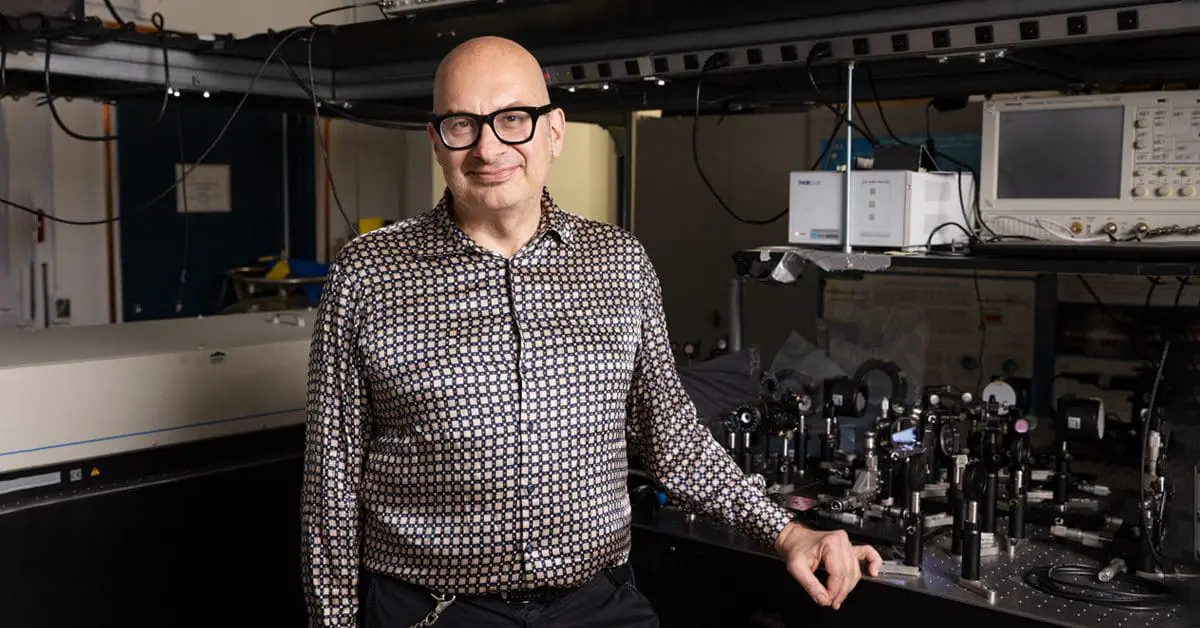
A breakthrough in quantum research has opened up new possibilities for efficient processing of quantum information, with potential applications in quantum computing, secure communication protocols, and more. Led by Professor Roberto Morandotti of the Institut national de la recherche scientifique (INRS), a team of international researchers has developed a synthetic photonic lattice capable of generating and manipulating quantum states of light.
This innovation builds on the concept of quantum walks, which have been instrumental in advancing the field of quantum computing over the past two decades. The team’s discovery, published in Nature Photonics, demonstrates a method for controlling the evolution of photon propagation, enabling improved detection and efficiency. Key to this achievement is the use of synthetic photonic dimensions, which allow for the exploration of fundamental quantum phenomena and their application to quantum technologies.
With its potential to simplify complex systems and integrate with existing telecommunications infrastructure, this breakthrough could pave the way for widespread adoption of quantum computing and secure communication protocols.
Synthetic Dimensions in Quantum Information Processing: A Breakthrough Discovery
The manipulation of quantum states is a crucial aspect of quantum information processing, with applications ranging from quantum computing to secure quantum communication protocols. Recently, a research team led by Professor Roberto Morandotti of the Institut national de la recherche scientifique (INRS) has made a significant breakthrough in this field, demonstrating the use of synthetic photonic lattices to efficiently process quantum information.
The Concept of Quantum Walks
At the heart of the research team’s experiments is the concept of quantum walks. This notion, which emerged about twenty years ago, has greatly benefited the development of quantum computing by increasing the speed and complexity of computer algorithms. Quantum walks are known to enhance the detection and number of photon coincidences, as well as the efficiency of the system.
Synthetic Photonic Networks: A New Frontier
The scientific community has recently developed another concept: synthetic photonic networks. These networks enable the exploration of various quantum phenomena at a fundamental level and their application to quantum technologies. The potential of this type of lattice was already known, for instance, to simulate effects such as parity-time symmetry, superfluidity of light, and topological structures. However, using conventional technology, a synthetic photonic lattice capable of handling quantum states had never been demonstrated.
Temporal Synthetic Photonic Lattices: A Novel Approach
The research team has successfully discovered a temporal synthetic photonic lattice capable of generating and manipulating quantum states of light (photons) using the concept of quantum walks in simple fiber systems. This breakthrough is unprecedented for two reasons: it allows better control of the evolution of quantum walks in the time domain, and it makes possible the simultaneous manipulation of classical light and entangled photons.
Applications in Quantum Information Processing
This innovative technique has far-reaching implications for various fields of fundamental physics linked to quantum information processing, including quantum computing, quantum metrology, and secure quantum communications. The system, entirely based on fiber-optic devices used in telecommunications, can be combined with current and future telecommunications infrastructures. This discovery demonstrates that it is possible to realize high-performance quantum systems using devices, techniques, and infrastructures that are within reach.
The research team’s findings have the potential to contribute significantly to the realization of a system capable of processing quantum information in a simple yet powerful way. The use of synthetic photonic lattices simplified by the use of quantum walks for quantum information processing opens up new avenues for advanced quantum computing and information protocols on telecom-ready architectures compatible with microprocessor chips.
External Link: Click Here For More