Scientists have made significant progress towards building a fault-tolerant quantum computer using neutral atoms. Researchers at a leading quantum computing company Infleqtion, have demonstrated the ability to implement high-fidelity entangling gates and non-destructive state-selective readout on a 24-qubit array. This breakthrough enables faster qubit operations and a broader set of quantum error correction protocols.
The team achieved a discrimination fidelity of 99.6% and reduced bright state detection error to 2.6%. The technology uses electric field control to achieve high ground-Rydberg coherence, unlocking greater connectivity for quantum computing applications. This work brings researchers closer to building a practical quantum computer that can support at least 100 logical qubits, a requirement for meaningful scientific and commercial value. The advancements in neutral-atom architectures are rapidly evolving towards this goal, with potential integration of other demonstrated capabilities such as dual-species platforms, mid-circuit measurement, and alternate addressing architectures.
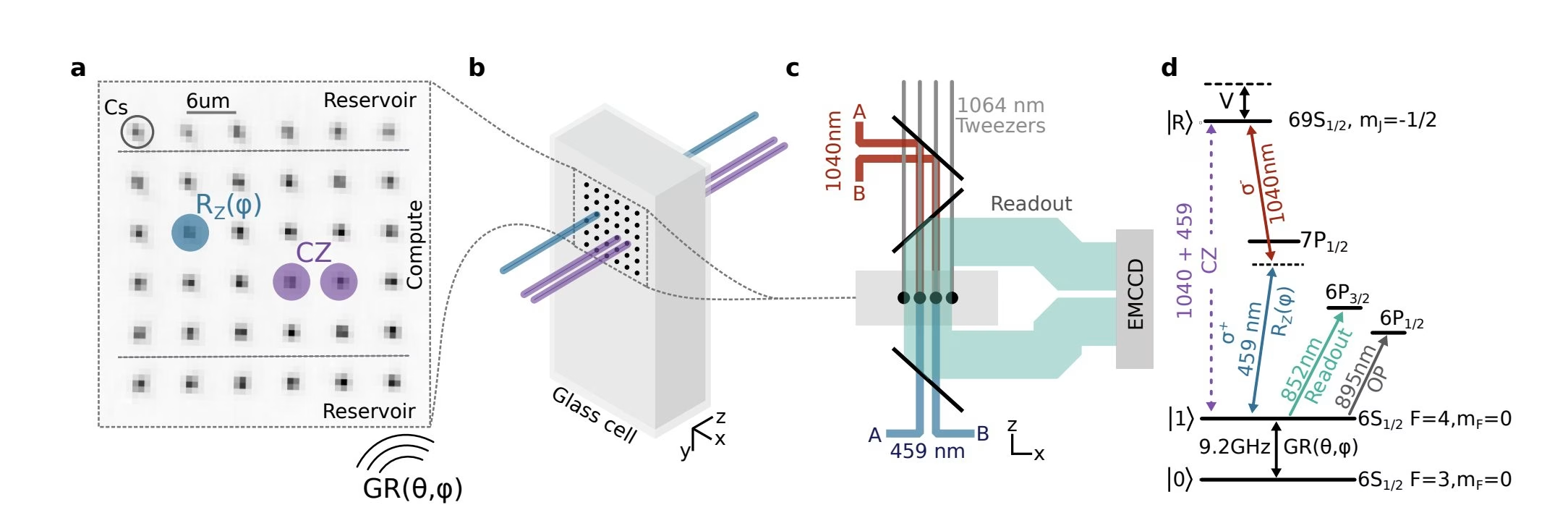
The authors are working on developing a quantum computer using neutral atoms, specifically Rydberg atoms. They’ve made significant progress in implementing high-fidelity entangling gates and non-destructive state-selective readout, which are crucial components of a functional quantum computer.
The researchers used a technique called controlled-phase (CZ) gates to entangle two atoms. By applying multiple CZ gates, they demonstrated that the probability of obtaining the expected measurement outcome increases, eventually reaching an asymptote of 25%. This is impressive, as it shows that their gate implementation is reliable and accurate.
The non-destructive state-selective readout (NDSSR) technique allows the researchers to measure the state of an atom without destroying its quantum properties. They achieved a discrimination fidelity of 99.6(2)%, which means they can accurately determine whether an atom is in a bright or dark state.
The NDSSR process involves taking images of the atoms using an EMCCD camera, and then analyzing the photo-electron counts to determine the state of each atom. The researchers found that depumping and atom loss during the NDSSR process contribute to errors in state detection, but they were able to reduce these errors by post-selecting out atom loss.
One of the key advantages of this approach is its potential for scalability. By operating at cryogenic temperatures, the researchers can improve trapping lifetimes and increase the number of qubits that can be addressed individually. This is essential for building a large-scale quantum computer capable of performing complex calculations.
The authors also highlight the benefits of using Rydberg atoms, which offer high ground-Rydberg coherence times (T∗2 = 15 µs) at n = 69. This enables greater connectivity between qubits, making it more suitable for quantum error correction protocols and applications.
In conclusion, this work demonstrates significant progress towards building a fault-tolerant quantum computer using neutral atoms. The ability to implement high-fidelity entangling gates and non-destructive state-selective readout paves the way for faster qubit operations and a broader range of quantum error correction protocols. As the field continues to evolve, we can expect to see even more advanced capabilities emerge, ultimately leading to the development of practical quantum computers that can tackle complex scientific and commercial problems.
External Link: Click Here For More