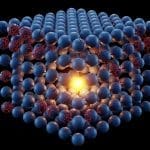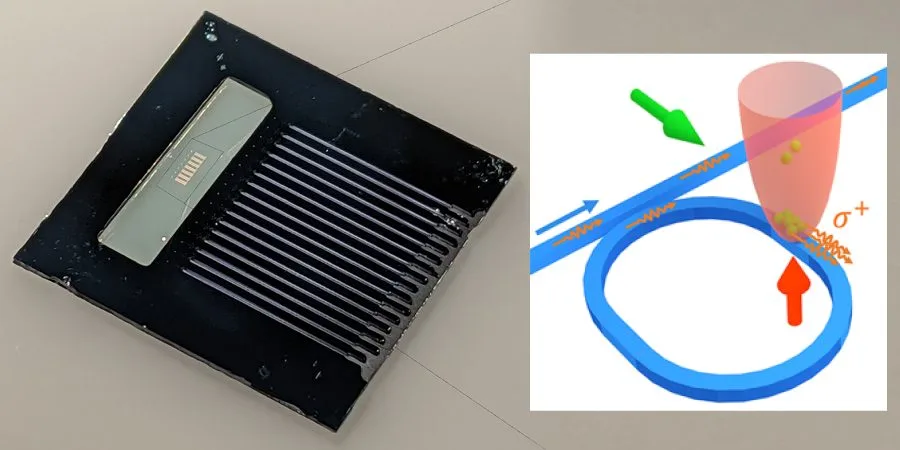
Researchers at Purdue University have made a breakthrough in developing cold-atom integrated nanophotonic circuits, a technology that could revolutionize quantum computing and photonics. The team, led by Associate Professor Chen-Lung Hung, has successfully demonstrated the efficient cooling and trapping of atoms on a circuit, paving the way for new research directions. This achievement builds upon previous breakthroughs, including realizing the “tractor beam” method in 2023 and highly efficient optical fiber coupling to a photonic chip in 2022.
The team plans to explore several promising next steps, including arranging trapped atoms in an organized array along a photonic waveguide and forming new states of quantum matter on an integrated photonic circuit. This work was supported by the U.S. Air Force Office of Scientific Research and the National Science Foundation.
Breakthrough in Quantum Computing: Researchers Develop Integrated Photonic Circuit to Store and Manipulate Quantum Information
In a significant breakthrough in the field of quantum computing, researchers at Purdue University have successfully developed an integrated photonic circuit that can store and manipulate quantum information using trapped atoms. This innovative technology has the potential to revolutionize the way we process and transmit quantum information, paving the way for the development of a quantum network.
Led by Associate Professor Chen-Lung Hung, the research team has created a photonic circuit that obeys the principles of quantum superposition, allowing them to manipulate and store quantum information in trapped atoms, known as qubits. The circuit can efficiently transfer stored quantum information into photons, which can then be transmitted through a fiber network to communicate with other atom-coupled integrated circuits or atom-photon interfaces.
This achievement builds upon previous breakthroughs by the team, including the realization of the “tractor beam” method in 2023 and the development of highly efficient optical fiber-coupling to a photonic chip in 2022. The successful demonstration of atoms being efficiently cooled and trapped on a circuit has opened up new research directions, with many avenues to explore.
According to Hung, several promising next steps include arranging trapped atoms in an organized array along the photonic waveguide, building the first nanophotonic platform to realize “selective radiance,” and forming new states of quantum matter on an integrated photonic circuit. The team also plans to cool the atoms closer to absolute zero temperature to reach quantum degeneracy and synthesize cold molecules from trapped atoms.
This research was supported by the U.S. Air Force Office of Scientific Research and the National Science Foundation, with publication support from the Purdue University Libraries Open Access Publishing Fund. The work is part of Purdue Computes, a major initiative that enables the university to advance to the forefront of quantum science and engineering.
The Department of Physics and Astronomy at Purdue University has a rich history dating back to 1904 and is known for its excellent and diverse community of faculty, postdocs, and students who are pushing new scientific frontiers. The department offers a dynamic learning environment, an inclusive research community, and an engaging network of scholars.
Purdue University is a public research institution demonstrating excellence at scale, with a commitment to affordability and accessibility. The university’s main campus has frozen tuition for 13 years in a row, making it an attractive option for students seeking a high-quality education.
External Link: Click Here For More