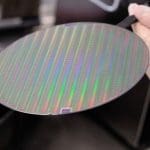
Researchers from the Australian National University and Northwestern Polytechnical University have made a significant breakthrough in developing on-chip light sources, paving the way for widespread adoption of photonic chips in consumer electronics. The team, led by Professor Lan Fu, has developed an innovative method for growing high-quality multi-quantum well nanowires using semi-conductor materials Indium Gallium Arsenide and Indium Phosphide. This achievement could overcome a major hurdle in the development of photonic chips, which currently require external light sources, limiting their miniaturization.
The new approach, outlined in a paper published in Light: Science & Applications, enables the precise control of nanowire dimensions and crystal composition, allowing for the design of controllable optical cavities. Co-first authors Fanlu Zhang and Xutao Zhang explain that this technology has the potential to enable the batch construction of nanoscale laser light sources in the near-infrared telecommunication band, a crucial step towards large-scale photonic integration.
This breakthrough could have significant implications for the development of faster and more efficient consumer electronics, including mobile phones, autonomous vehicles, and biosensors. The researchers are now working on designing electrical contacts to achieve electrical injected lasing, a key next step in this research.
Unlocking the Potential of Photonic Chips: A Breakthrough in On-Chip Light Sources
The development of photonic chips has revolutionized the way information is transmitted, offering faster and more efficient data transfer compared to traditional electrical transmission. However, a significant limitation of current photonic chips is the lack of an on-chip light source, which hinders further miniaturization of these devices. Researchers from the Australian National University and Northwestern Polytechnical University have made a significant breakthrough in addressing this challenge by developing a new engineering approach to grow high-quality multi-quantum well nanowires that can serve as on-chip light sources.
Overcoming the Limitations of Current Photonic Chips
Photonic chips, also known as photonics integrated circuits, have become ubiquitous in various applications, including telecommunication devices, autonomous vehicles, biosensors, and consumer electronics such as mobile phones. Despite their widespread adoption, these chips rely on external light sources, which restricts their miniaturization and integration into smaller devices. The development of on-chip light sources is crucial to overcome this limitation and unlock the full potential of photonic chips.
Nanowire Lasers: A Promising Solution
Nanowire lasers are an attractive solution for on-chip light sources due to their compact size, low power consumption, and high efficiency. However, fabricating high-quality nanowires with smooth sidewalls, controlled dimensions, and precise crystal composition has been a significant challenge. The researchers have developed an innovative multi-step facet engineering approach using selective area epitaxy by metalorganic chemical vapor deposition technique to grow high-quality multi-quantum well nanowires.
Facet Engineering Approach: A Key Breakthrough
The facet engineering approach enables the precise control of nanowire diameter and length, resulting in uniform morphology and high crystal quality. This approach allows for the design of controllable nanowire optical cavities, enabling the regulation of spatial modes and longitudinal modes. By modulating the composition and thickness of quantum wells in the nanowires, the lasing wavelength can be adjusted to cover a wide spectral range in the near-infrared region.
Scalable Manufacturing: The Next Step
The researchers’ breakthrough sets the stage for the mass manufacture of photonic devices with on-chip light sources. The next step will be to design and fabricate electrical contacts to achieve electrical injected lasing. This development has significant implications for the widespread adoption of photonic chips in various applications, enabling faster, more efficient, and compact devices.
Conclusion
The development of on-chip light sources is a critical milestone in the advancement of photonic chips. The researchers’ innovative facet engineering approach has overcome a significant limitation in the fabrication of high-quality nanowires, paving the way for scalable manufacturing of photonic devices with integrated light sources. This breakthrough has far-reaching implications for various industries, including telecommunications, automotive, and consumer electronics, enabling faster, more efficient, and compact devices that will transform the way we live and work.
External Link: Click Here For More