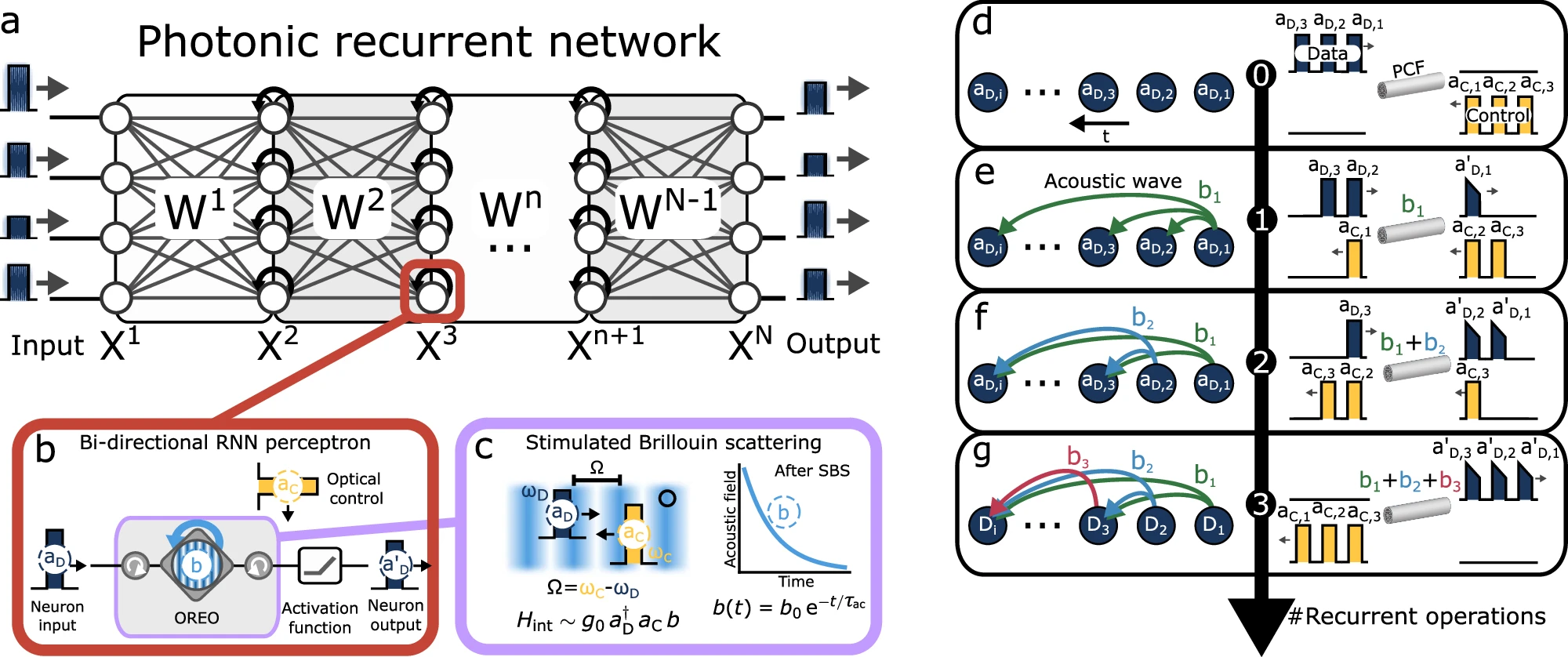
Scientists Steven Becker, Dirk Englund, and Birgit Stiller have developed an optoacoustic recurrent operator (OREO) that enhances the capabilities of recurrent neural networks (RNNs). RNNs are used in artificial intelligence for tasks like language processing and image recognition. The OREO uses acoustic waves to store and manipulate information, improving the RNN’s ability to process sequential data. This development could lead to more efficient and powerful artificial neural networks. The research was published in Nature Communications.
The Optoacoustic Recurrent Operator: A New Approach to Recurrent Neural Networks
Recurrent neural networks (RNNs) are a type of artificial neural network designed to recognize and predict sequences of information, making them ideal for tasks such as language processing and image recognition. However, their ability to track internal states is limited, prompting research into analog implementations in photonics. This article discusses a recent breakthrough in this field: the optoacoustic recurrent operator (OREO).
OREO is a bi-directional perceptron that uses acoustic waves to contextualize the information of an optical pulse sequence. This allows it to capture the information from different optical pulses and use it to manipulate subsequent operations. The all-optical control of OREO offers simple reconfigurability and has been used to implement a recurrent drop-out and pattern recognition of 27 optical pulse patterns.
The Power of Contextualization in Neural Networks
The human brain’s ability to understand the context of a situation and make intelligent decisions based on that context is a powerful tool. Artificial neural networks, while powerful computing architectures, struggle with contextualization. To overcome this limitation, they can be equipped with recurrent feedback, allowing them to process current inputs based on previous ones. This is the principle behind RNNs.
The Elman network, one of the simplest versions of a RNN, adds a recurrent operation to each neuron of its fully-connected network, analogous to the neuron’s activation function. More complex models have proven themselves in various creative applications, demonstrating the potential of RNNs.
The Promise of Optical Neural Networks
The scientific community is currently working to transfer electronic neural networks into the optical domain. Optical neural networks offer high processing speed, broad bandwidth, and low dissipative losses, making them a promising avenue for future artificial neural network development.
However, the field of recurrent optical neural networks is still in its early stages, with most concepts based on artificial reservoirs such as free-space cavities, delay systems, and microring resonators. These designs face several challenges, including the need for additional tuning due to manufacturing-dependent properties and limitations on the control of the recurrent process.
The Optoacoustic Recurrent Operator: A Solution to Recurrent Optical Neural Networks
OREO, based on stimulated Brillouin-Mandelstam scattering (SBS), offers a solution to these challenges. SBS is an interaction of optical waves with traveling acoustic waves, which serve as a latency component due to the slow acoustic velocity. OREO uses these acoustic waves as a memory to remember previous operations.
Unlike previous approaches, OREO controls its coherent recurrent operation completely optically on pulse level without the need of any artificial reservoir. This makes it a versatile tool that can function in any optical waveguide, including on-chip devices.
The Potential of OREO in Future Neural Networks
OREO’s ability to process time-encoded serial information within a photonic crystal fiber and control the recurrent interaction all-optically gives it unique features. It can adjust its recurrent operation at the single pulse level, offering an all-optical degree of freedom. It can also compute amplitude and phase information, potentially allowing it to compute quadrature amplitude modulated (QAM) data streams.
The current configuration of the OREO setup could realize up to four layers in an OREO-based RNN. With further development, OREO could potentially increase the computational efficiency of existing methods by three orders of magnitude. The information bandwidth of an optical signal could also be significantly increased by employing different optical frequencies as independent information channels. This could pave the way for the realization of a multi-frequency recurrent neural network.
External Link: Click Here For More