Researchers have made a breakthrough in developing a system for Post-Quantum Cryptography (PQC) applications, which could potentially protect sensitive information from quantum computing attacks. The team has created a Gaussian noise-generating module that can be integrated into a single chip, making it suitable for low-power and cost-effective PQC systems.
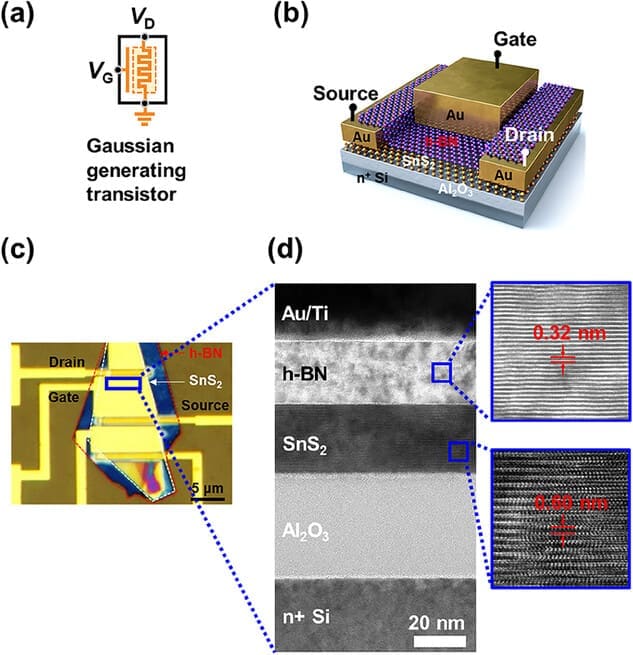
The module uses a SnS2-channel mem-transistor fabricated by the researchers, which exhibits resistive switching characteristics and generates an unpredictable Gaussian distribution. The system also includes electronic components such as analog-to-digital converters (ADCs) and microcontrollers like the ATmega32U4. Companies involved in the work include Texas Instruments and Renesas. The research was supported by the National Research Foundation of Korea and the research fund of Hanbat National University.
The authors have successfully demonstrated a novel approach to generating Gaussian noise, a crucial component in Post-Quantum Cryptography (PQC) systems. PQC is a new generation of cryptographic protocols designed to be secure against attacks from quantum computers. The key innovation here lies in the use of a SnS2 thin film mem-transistor as a Gaussian error sampler.
To achieve this, the researchers fabricated a device consisting of an SnS2-channel mem-transistor with a heavily n-type doped Si wafer serving as the back-gate electrode. They then integrated this device into a microcontroller-based system, which enabled them to generate Gaussian distributed errors through electrical pulses applied to the gate electrode.
The results show that the proposed module can reliably produce Gaussian error data, which is essential for PQC implementation. The generated error data were used in additive operations to produce ciphered data, providing resistance to cryptanalysis, including quantum computing attacks. Statistical normality tests confirmed the Gaussian distribution of the error data, aligning closely with software-generated Gaussian distributions and distinct from uniform random distributions.
One of the most impressive aspects of this study is the identification of the optimal programming voltage (-5.25 V) and the verification of the robustness of the Gaussian error sampler across various temperatures. This suggests that the proposed module could be a viable solution for PQC applications, where reliability and stability are paramount.
The ultimate goal of this research is to develop a system-on-chip (SoC) that integrates electronic components such as Gaussian generating transistors and analog-to-digital converters (ADCs). The SoC would encompass all PQC functions, including public key generation, encryption, and decryption, while achieving low power consumption and cost-effectiveness.
In conclusion, this study marks a significant step forward in the development of PQC systems. The proposed Gaussian noise-generating module has the potential to play a critical role in securing our digital communications against the threats posed by quantum computers.
DOI: https://onlinelibrary.wiley.com/doi/full/10.1002/qute.202400394