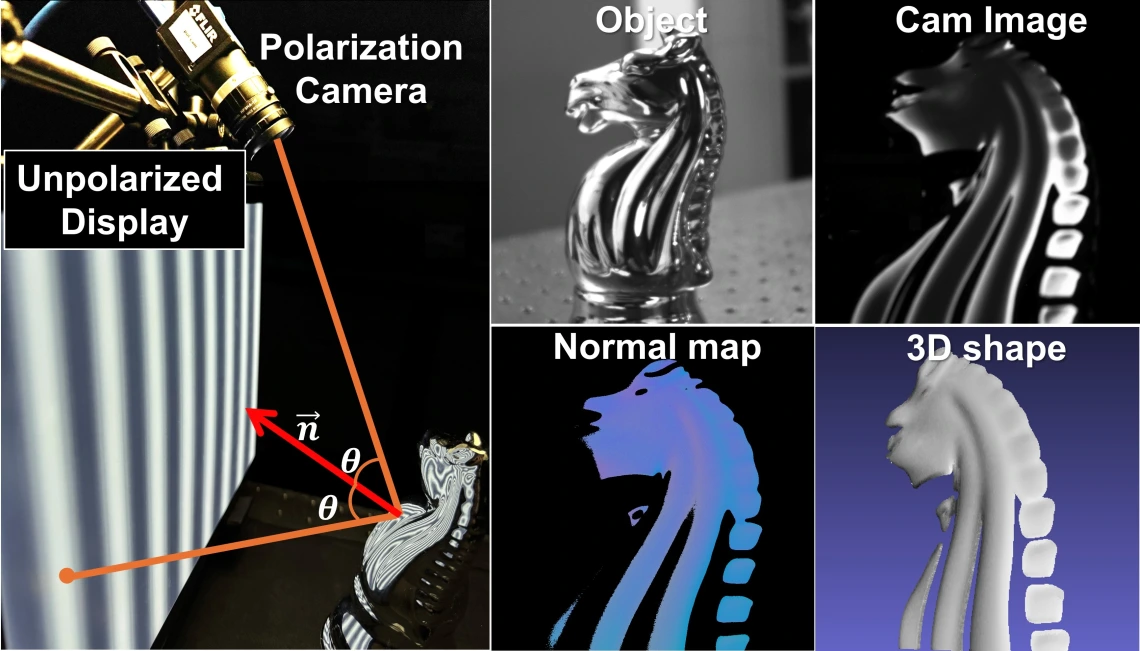
Researchers at the University of Arizona’s Wyant College of Optical Sciences have developed a novel 3D imaging technique that combines Phase Measuring Deflectometry (PMD) and Shape from Polarization (SfP). This innovative approach addresses the challenges of imaging specular surfaces by integrating the strengths of both methods, resulting in accurate and flexible single-shot measurements. The study, conducted at the Computational 3D Imaging and Measurement (3DIM) Lab, overcomes limitations inherent to PMD and SfP, offering practical solutions for applications such as industrial inspection and medical imaging.
Accurate 3D imaging of specular surfaces is crucial in various fields, such as virtual reality, cultural heritage preservation, and industrial inspection. These surfaces, which reflect light uniformly, pose significant challenges due to their lack of texture and difficulty capturing depth information.
Specular surfaces are prevalent in everyday objects like polished metals, glass, and ceramics. Imaging these surfaces accurately is essential for applications ranging from quality control in manufacturing to creating realistic virtual environments. Despite advancements in imaging technology, achieving precise 3D models of specular surfaces remains a complex task due to their reflective properties, which can lead to artefacts such as glare and reflection distortions.
Imaging specular surfaces presents unique challenges compared to diffuse surfaces. The uniform light reflection on these surfaces makes it difficult to extract depth information using traditional stereo vision or structured light techniques. Additionally, the lack of texture complicates feature extraction and matching processes.
One major challenge is the presence of reflections from external light sources, which can obscure the surface details. This issue is particularly pronounced in environments with multiple light sources or when imaging objects with complex shapes. Another challenge is maintaining high spatial resolution while capturing depth information, as many techniques require trade-offs between resolution and accuracy.
Advances in 3D Imaging of Specular Surfaces
Recent advancements in imaging technology have addressed some of the challenges associated with specular surfaces. Techniques such as polarization-based imaging and advanced optical metrology have shown promise in improving the accuracy of 3D models for these surfaces.
Polarization-based methods exploit the polarization properties of reflected light to separate surface reflections from other components, enabling more accurate depth measurements. These techniques are particularly effective in reducing glare and improving contrast in images captured under controlled lighting conditions.
Another promising approach is the use of machine learning algorithms to enhance image processing and feature extraction. By training models on datasets of specular surfaces, researchers have achieved improved accuracy in reconstructing 3D models from limited data.
Applications of Accurate Specular Surface Imaging
The ability to accurately image specular surfaces has wide-ranging applications across various industries. In virtual reality, precise 3D models of specular objects enhance the realism and immersion of virtual environments. For cultural heritage preservation, accurate imaging enables the creation of digital archives for conservation and study.
In industrial inspection, high-resolution 3D models of specular surfaces are critical for quality control and defect detection. These models allow manufacturers to identify and address surface irregularities with greater precision, improving product quality and reliability.
More information
External Link: Click Here For More