A breakthrough in cancer diagnosis has been achieved through the development of a non-invasive, early detection material technology based on bio-fluids. Led by Dr. Ho Sang Jung of the Korea Institute of Materials Science (KIMS), a research team has created an innovative sensor material that amplifies optical signals of cancer metabolites in body fluids, such as saliva, mucus, and urine, and analyzes them using artificial intelligence to diagnose cancer.
This technology can quickly and sensitively detect metabolite changes in cancer patients’ body fluids, providing a non-invasive way to diagnose cancer without traditional blood draws or biopsies. Collaborating with Professor Soo Woong Yoo of Chonnam National University Hospital, the team successfully diagnosed colorectal cancer using a plasmonic needle that amplifies Raman signals of molecules.
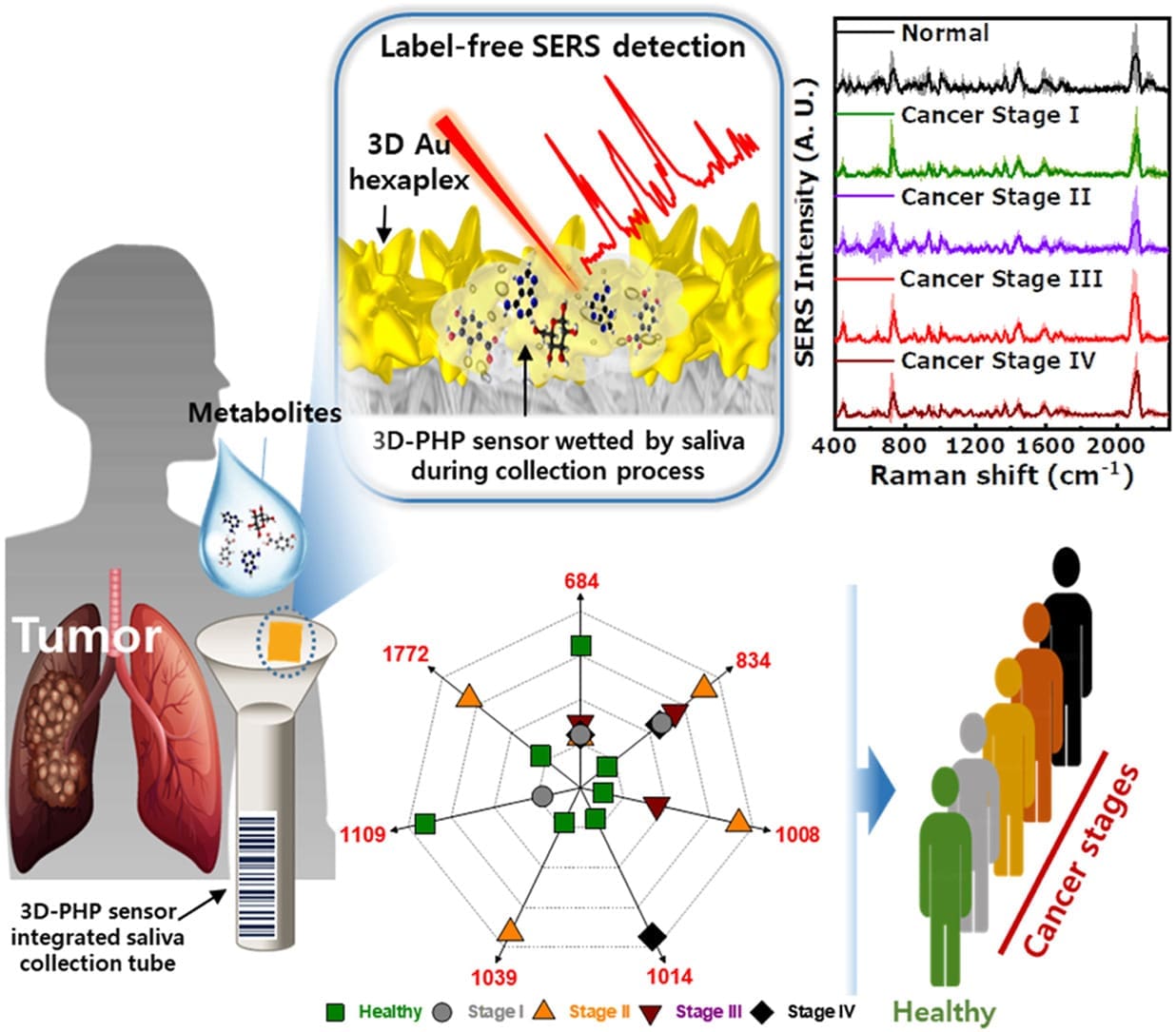
Additionally, they developed a technology that collects saliva from lung cancer patients and categorizes the cancer’s stage in collaboration with Professor Byung-Ho Chung at Samsung Medical Center. The research has been recognized for its excellence, with three papers published in leading scientific journals and 10 patents filed in Korea, the U.S., and Europe.
Early Cancer Diagnosis through Innovative Sensor Technology
The development of a non-invasive and early cancer diagnosis material technology based on bio-fluid has opened the door to a new era in cancer detection. A research team led by Dr. Ho Sang Jung at the Korea Institute of Materials Science (KIMS) has created an innovative sensor material that amplifies the optical signals of cancer metabolites in body fluids, such as saliva, mucus, urine, and analyzes them using artificial intelligence to diagnose cancer.
This technology quickly and sensitively detects metabolites and changes in cancer patients’ body fluids, providing a non-invasive way to diagnose cancer instead of traditional blood draws or biopsies. The team has successfully demonstrated the application of this technology in diagnosing colorectal cancer by inserting a plasmonic needle that amplifies the Raman signals of molecules into a 1-millimeter hole that can be inserted with a colonoscopy camera, and swabbing the surface of the tumor without causing bleeding.
The team has also developed a technology that collects saliva from lung cancer patients and categorizes the cancer’s stage using artificial intelligence. The breath of lung cancer patients contains volatile organic compounds (VOCs) that are different from those of healthy individuals. These compounds dissolve in saliva and are present as lung cancer metabolites. The team has perfected a technology that uses paper-based sensors to distinguish between normal individuals and lung cancer patients, as well as to stage lung cancer.
The innovative sensor material developed by the team detects signals from metabolites in body fluids with high sensitivity using plasmonic materials that amplify Raman signals by more than 100 million times without utilizing conventional, complex, and expensive equipment. Artificial intelligence analysis and mathematical modeling calculations were used to suggest biomarkers for diagnosis. This technology has the potential to be expanded not only to diagnose cancer but also to diseases with poorly understood diagnostics, such as synaptic diseases.
The Science behind the Technology
The research team’s innovative sensor material is based on plasmonic materials that amplify Raman signals by more than 100 million times. This amplification enables the detection of metabolites in body fluids with high sensitivity. The team used artificial intelligence analysis and mathematical modeling calculations to suggest biomarkers for diagnosis.
The technology developed by the team is also capable of detecting multiple cancers in urine at once. By analyzing urine samples from approximately 250 patients with pancreatic cancer, prostate cancer, lung cancer, and colorectal cancer, the team was able to perform rapid analysis and use artificial intelligence to determine results within about 2 hours for 100 patients.
The Potential Impact on Cancer Diagnosis
The development of this innovative sensor technology has the potential to revolutionize cancer diagnosis. Traditional methods of cancer diagnosis, such as blood draws or biopsies, can be invasive and painful. This new technology provides a non-invasive way to diagnose cancer, which could lead to earlier detection and treatment.
Furthermore, the technology developed by the team is not limited to diagnosing cancer. It has the potential to be expanded to diseases with poorly understood diagnostics, such as synaptic diseases. The research team’s innovative sensor material could also be used to detect other biomarkers in body fluids, leading to new possibilities for disease diagnosis and treatment.
The Future of Cancer Diagnosis
The research team’s innovative sensor technology is a significant step forward in the development of non-invasive cancer diagnosis methods. With further research and development, this technology has the potential to become a standard tool in cancer diagnosis.
The transfer of the technology to SOLUM Healthcare last year and the filing of 10 patents in Korea, the U.S., and Europe demonstrate the commercial viability of this innovation. As the technology continues to advance, it is likely that we will see widespread adoption in the medical community, leading to improved patient outcomes and earlier detection of cancer.
The research team’s work has been recognized for its excellence, with three papers published in leading scientific journals, including Biosensors and Bioelectronics and Sensors and Actuators B-Chemical. The recognition of this research highlights the significance of this innovation and its potential impact on the field of cancer diagnosis.
DOI: http://dx.doi.org/10.1016/j.bios.2023.115779