
The ability to effectively communicate with large language models (LLMs) through carefully crafted prompts has become increasingly important, yet the cognitive skills and brain processes involved in this expertise remain largely unknown. Hend S. Al-Khalifa, Raneem Almansour, and Layan Abdulrahman Alhuasini, all from King Saud University, along with colleagues, investigate the neural basis of prompt engineering proficiency by comparing brain activity in experts and those with intermediate skills. Their research reveals distinct patterns of brain connectivity and activity in regions associated with language and higher-level cognition, suggesting specific neural signatures differentiate skilled prompt engineers. These findings offer initial insights into how humans interact with AI, potentially informing the design of more intuitive interfaces and contributing to a deeper understanding of the cognitive processes involved in harnessing the power of large language models.
Brain Networks Underlying Prompt Engineering Skill
This research investigates the neural basis of prompt engineering, a newly recognised skill crucial for interacting with large language models (LLMs) like ChatGPT. The central argument is that successful prompt engineering relies on cognitive abilities reflected in the brain’s functional architecture, specifically within networks involved in language processing, cognitive control, and mental imagery. The study aims to identify brain networks that correlate with proficiency in prompt engineering, suggesting this skill taps into deeper cognitive processes. The research employed functional magnetic resonance imaging (fMRI) to measure brain activity by detecting changes in blood flow.
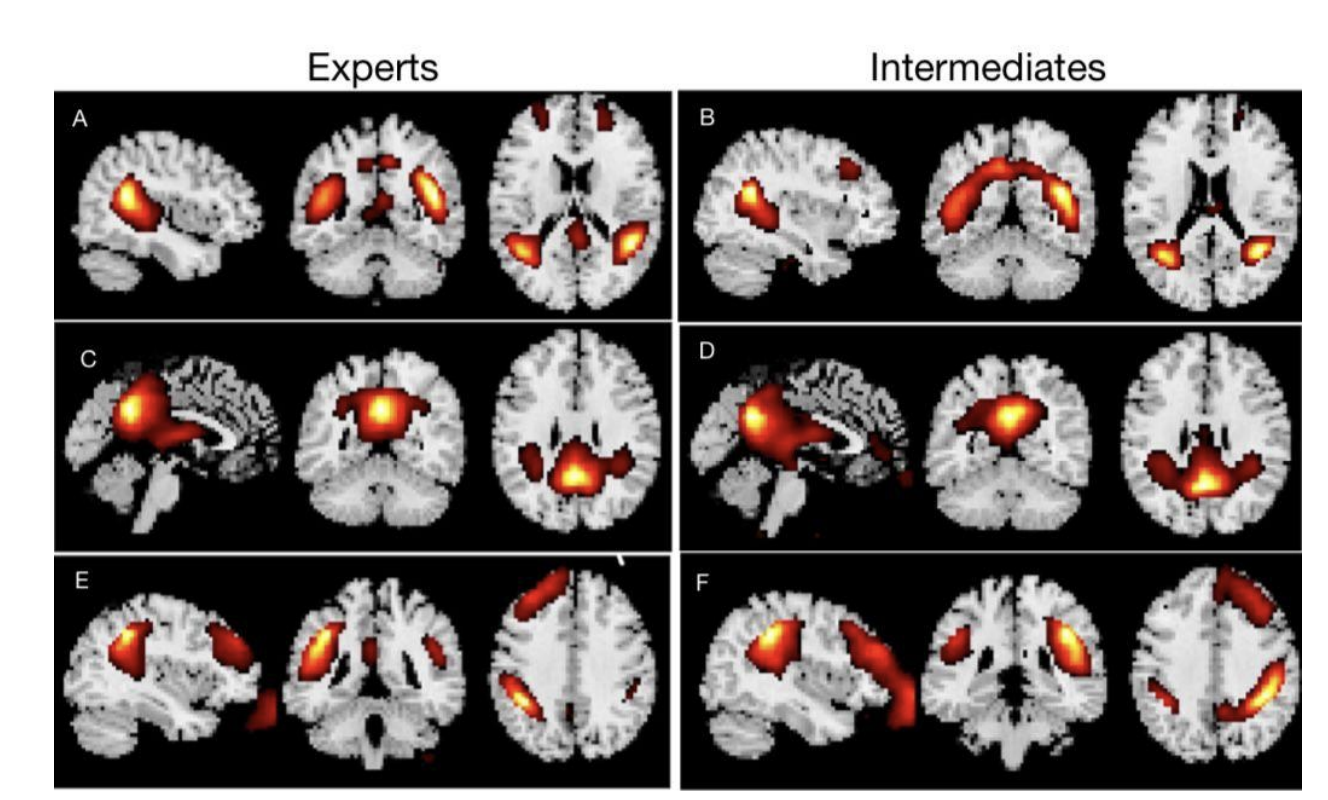
Participants engaged in tasks related to prompt engineering, involving the creation and refinement of prompts for LLMs. Data was collected both while participants were at rest, to assess the intrinsic functional connectivity of different brain networks, and while they were actively performing prompt engineering tasks. Sophisticated analytical techniques, including assessments of network connectivity and the amplitude of brain activity fluctuations, were used to examine patterns of brain activity. The study identified several brain networks important for prompt engineering. The Default Mode Network, involved in internal thought processes and mental imagery, suggests that prompt engineers envision the desired output and mentally simulate interactions with the LLM.
The Central Executive Network, responsible for cognitive control and planning, highlights the need for strategic thinking and iterative refinement of prompts. As prompt engineering fundamentally involves crafting linguistic input, the Language Network, including areas like Broca’s and Wernicke’s areas, plays a crucial role. Additionally, the Mental Imagery Network and the Salience Network contribute to visualising outcomes and focusing on key aspects of the task. This research provides evidence that prompt engineering relies on complex cognitive abilities, not merely technical skill. Understanding the neural basis of prompt engineering could inform the development of more effective training programs, potentially by targeting the cognitive abilities associated with these brain networks.
The findings also shed light on the cognitive processes involved in interacting with AI systems, potentially leading to more intuitive and effective human-AI interfaces, and enabling AI systems to adapt to individual cognitive styles. The study employed sophisticated statistical methods to ensure the reliability and validity of the findings, carefully controlling for potential confounding factors. While acknowledging limitations such as sample size and establishing causality, it provides valuable insights into the cognitive and neural basis of prompt engineering, a skill becoming increasingly important in the age of AI.
Expert Prompt Engineering Brain Activity Revealed
This study employed neuroimaging to investigate the cognitive basis of expertise in prompt engineering. Recognising that effective prompting goes beyond technique, researchers hypothesised that proficiency is reflected in distinct patterns of brain function and connectivity. The team used functional magnetic resonance imaging (fMRI) to observe brain activity in individuals categorised as either expert or intermediate prompt engineers, based on a newly developed scale to quantify prompt engineering literacy. The methodology centred on comparing resting-state brain activity between these two groups, focusing specifically on functional connectivity, which reveals how different brain regions communicate, and network power dynamics, which assess the strength and frequency of activity within key cognitive networks.
This approach allowed researchers to move beyond simply observing where brain activity occurred, and instead examine how different brain areas coordinated during the task of prompt engineering. A novel aspect of this work is its attempt to bridge the gap between cognitive neuroscience and natural language processing. By applying neuroimaging techniques to a skill that involves both linguistic and logical reasoning, the researchers aimed to identify objective neural indicators of prompting proficiency. This prioritises understanding the cognitive processes within the human user, offering a foundation for designing more intuitive human-AI interfaces, developing targeted training programs, and potentially inspiring new AI architectures that better align with human cognitive styles.
Expert Prompt Engineers Show Distinct Brain Activity
Researchers have begun to explore the neurological basis of expertise in prompt engineering, the skill of crafting effective instructions for large language models (LLMs). This emerging field recognises that simply understanding how LLMs work is not enough; successful interaction also relies on specific cognitive abilities reflected in brain activity. A recent study used functional magnetic resonance imaging (fMRI) to compare the brains of experienced prompt engineers with those of intermediate users, revealing distinct patterns of neural connectivity. The research demonstrates that experts exhibit increased functional connectivity in brain regions associated with language processing and executive control, specifically the left middle temporal gyrus and the left frontal pole.
This suggests that skilled prompt engineers engage these areas more effectively when formulating instructions, potentially allowing for more nuanced and strategic prompting. Furthermore, the study identified alterations in the power-frequency dynamics of key cognitive networks within the brains of experts, indicating a different way of processing information during the prompting process. These findings represent a significant step towards understanding the cognitive demands of interacting with LLMs, moving beyond a focus solely on the models themselves. By identifying neural markers associated with prompt engineering proficiency, researchers hope to inform the design of more intuitive human-AI interfaces, leading to systems that better align with human cognitive workflows and making it easier for users to harness the power of LLMs. The study’s implications extend to the development of training programs for prompt engineering, potentially allowing for targeted instruction that builds upon the brain’s natural capabilities. Ultimately, this interdisciplinary approach aims to bridge the gap between human cognition and machine intelligence, fostering a deeper understanding of how people learn and adapt to increasingly complex AI systems.
Neural Signatures of Prompt Engineering Expertise
This pilot fMRI study provides initial evidence of distinct neural signatures associated with expertise in prompt engineering. Researchers observed altered low-frequency power dynamics in cognitive networks and increased functional connectivity in brain regions crucial for language processing and higher-order cognition among individuals more proficient in prompting. These findings offer a first glimpse into the neurobiological basis of this increasingly important skill and suggest how the brain processes and utilises effective prompting strategies. The implications of this research extend to the field of Natural Language Processing, particularly in designing more intuitive human-AI interactions.
Understanding the neural basis of effective prompting can inform the development of targeted training methodologies and potentially guide the design of next-generation Large Language Models that better align with human cognitive architectures. While the study’s findings are preliminary, the authors acknowledge limitations including a relatively small sample size and the cross-sectional design, which prevents establishing causal relationships. Future research should focus on expanding these findings through longitudinal studies tracking the development of these neural markers as individuals gain expertise, and larger-scale validation studies to refine classification boundaries for expertise levels.
👉 More information
🗞 The Prompting Brain: Neurocognitive Markers of Expertise in Guiding Large Language Models
🧠 ArXiv: https://arxiv.org/abs/2508.14869